- Home
- Rolex Explorer vs Oyster Perpetual: Which Simpler Luxury Watch Ages Better?
Rolex Explorer vs Oyster Perpetual: Which Simpler Luxury Watch Ages Better?
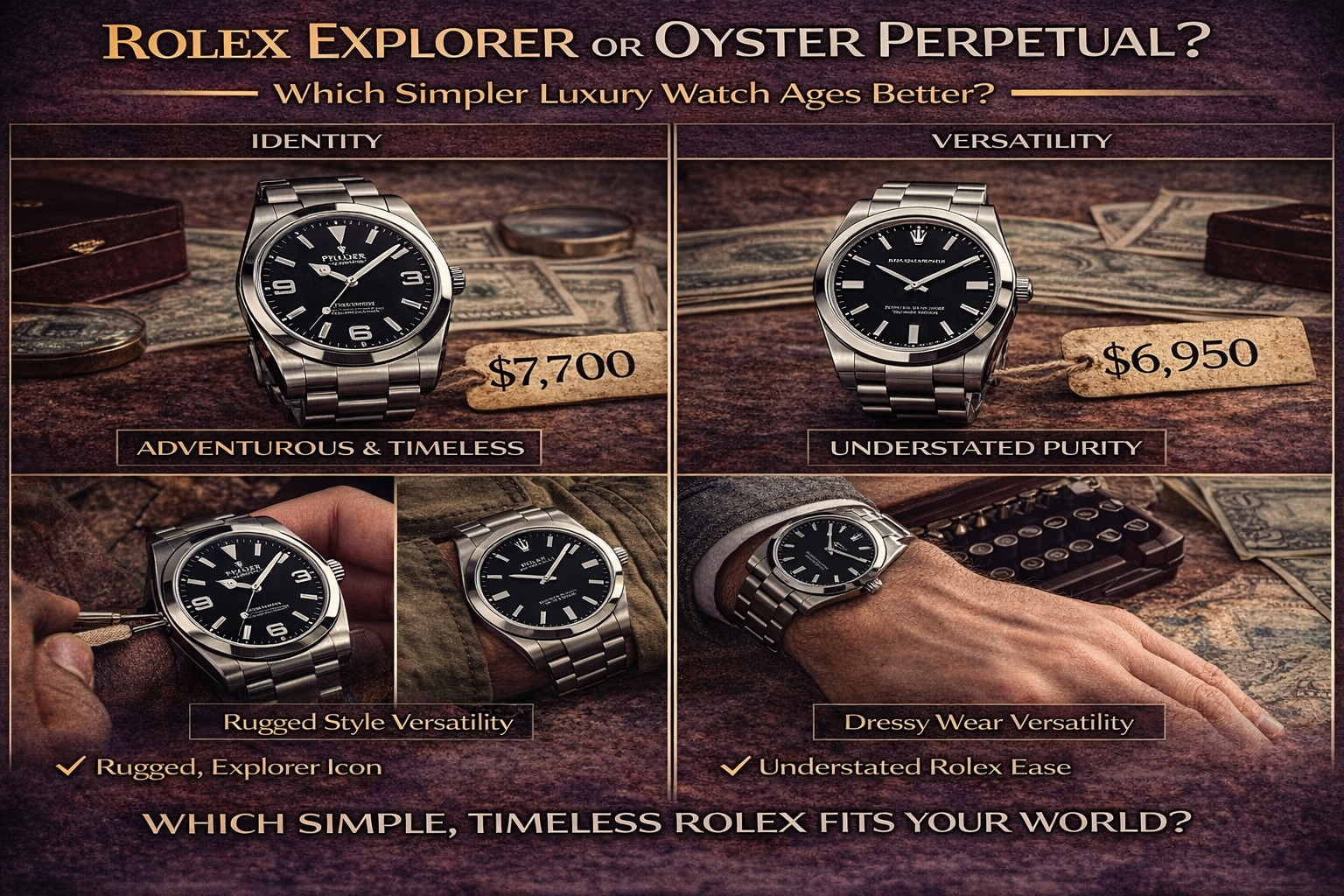
If the Datejust is the “complete” classic Rolex and the Submariner is the default sports Rolex, the Explorer and the Oyster Perpetual sit in a more interesting space.
They are the watches buyers usually end up looking at once they realize something important: simpler watches often last longer in real life.
Not longer mechanically. Longer emotionally.
They are easier to wear, easier to style, harder to get tired of, and often more satisfying after the honeymoon phase than watches that feel more obviously “special” in the first week. That is exactly why the Explorer and the Oyster Perpetual create such a strong comparison for thoughtful buyers. Both are simple. Both are wearable. Both feel more restrained than many other Rolex models. Both can absolutely work as one-watch luxury pieces.
But they do not age in the same way.
The Explorer usually feels more tool-rooted, more purposeful, and a little more character-driven. The Oyster Perpetual usually feels more minimal, more neutral, and more quietly elegant. One ages through identity. The other ages through purity.
So this is not really a question of which watch is more famous or more collectible. It is a question of what kind of simplicity you want to live with for years.
Quick answer
The Rolex Explorer usually ages better if you want a simple luxury watch with stronger personality, sportier purpose, and a little more visual character over time. The Rolex Oyster Perpetual usually ages better if you want a purer, quieter, more neutral Rolex that fits almost any wardrobe and rarely feels dated or overcommitted to one mood. The Explorer often ages better for buyers who like identity. The Oyster Perpetual often ages better for buyers who like calm.
Why simpler watches often age better in the first place
A lot of buyers start their watch journey by chasing features, hype, or visual excitement. Then a few years later they notice something strange: the watches they keep reaching for are often the simpler ones.
That happens because simple watches create less friction.
They do not fight your clothes. They do not demand a certain mood. They do not rely on novelty as much. And they usually survive shifts in taste better because they are built around proportion and clarity rather than stimulation.
That is exactly why the Explorer and Oyster Perpetual matter so much. They both sit inside the kind of design logic behind Best Everyday Automatic Watch Features: 8 Specs That Matter More Than Marketing, because long-term satisfaction usually comes from comfort, legibility, balance, and wearability rather than whatever felt most dramatic in the boutique or on Instagram.
The question is not whether simple watches age well. They usually do. The question is which kind of simple watch ages best for you.
The Explorer’s biggest strength: simple, but not anonymous
The Explorer is simple in the right way for people who still want some personality.
That is what makes it special.
At a glance, it looks restrained. There is no rotating bezel, no date, no bright color story, and no extra complication trying to prove anything. But once you spend time with it, the watch does not feel generic at all. The 3-6-9 dial, the slightly more purposeful vibe, and the broader “built for use” identity give it a kind of quiet character that keeps it from fading into the background.
This matters for long-term ownership.
Some buyers think they want maximum minimalism, then slowly realize they miss a little individuality. The Explorer solves that problem well. It stays clean, but it still feels like a specific watch with a specific point of view.
That is one reason it tends to age beautifully for people who want one simple luxury watch without slipping into total neutrality.
The Oyster Perpetual’s biggest strength: almost nothing dates it
The Oyster Perpetual ages differently.
Where the Explorer stays interesting through character, the Oyster Perpetual stays satisfying through purity. It is one of those watches that almost never looks like it was trying too hard in the first place, which means it almost never looks embarrassing later.
That is a huge advantage.
The Oyster Perpetual usually feels cleaner, quieter, and more universal. It does not lean as hard into the idea of “adventure” or “tool-watch heritage.” It is simply a very well-balanced Rolex that lets the case, dial, bracelet, and proportions do the work.
That kind of restraint often wears extremely well over time.
A lot of buyers who choose the Oyster Perpetual end up liking it more the longer they own it. At first it can feel understated. Later it starts to feel exact. You stop asking what it lacks and start appreciating how little there is to correct.
That is the kind of simplicity that often ages best for buyers who value calm design above all else.
Identity: do you want a watch with a point of view, or a watch with none?
This is really the core of the comparison.
The Explorer has a point of view. It is not loud, but it is not neutral either. The dial layout alone gives it a more distinct personality than the Oyster Perpetual. Even though both watches are simple, the Explorer feels slightly more assertive in its identity.
The Oyster Perpetual is closer to pure form. It does not tell as much of a story on the wrist. That makes it a little less romantic to some buyers and more perfect to others.
So ask yourself something basic: when you think about a luxury watch aging well, do you mean a watch that keeps expressing the same strong character, or a watch that almost disappears into your life?
That answer usually points you in the right direction.
A buyer who enjoys the quiet idea of heritage, exploration, and tool-watch clarity often keeps bonding with the Explorer. A buyer who values understatement, design calm, and broad style flexibility often grows more attached to the Oyster Perpetual.
Style: which one survives wardrobe changes better?
This is where “aging well” becomes real.
A watch does not age only on its own. It ages with you. Your clothes change. Your work changes. Your idea of what looks refined changes. A watch that felt perfect when you dressed one way may feel less natural five years later.
That is why wardrobe adaptability matters so much here.
The Oyster Perpetual usually has the advantage if your style moves around a lot. It works with casual clothing, office wear, minimalist dressing, knitwear, tailoring, and even more dressed-up settings with almost no resistance. It is one of the few luxury watches that can feel almost invisible in the best way: always appropriate, rarely overcommitted.
The Explorer can absolutely do casual and smart-casual beautifully, and many people wear it with tailoring too. But it usually keeps a slightly more purposeful, rugged undertone. That is part of why some people love it. It makes the watch feel more alive. It is also why the Oyster Perpetual may edge it out for buyers who want the least wardrobe friction possible.
This choice overlaps naturally with Dress Watch vs Everyday Watch: What’s the Real Difference and Which Should You Buy First? and Tool Watch vs Dress Watch: Which One Fits Your Lifestyle Better?, because the Explorer leans a little more toward tool-watch simplicity, while the Oyster Perpetual leans a little more toward pure everyday versatility.
The dial makes a bigger difference than many buyers expect
A lot of people underestimate how much the dial determines long-term satisfaction.
The Explorer’s dial is famous because it is strong. The 3-6-9 layout gives the watch identity immediately. It also gives the watch a slightly more assertive face. That is exactly why it feels more distinctive.
The Oyster Perpetual dial is calmer. It usually feels more open, more symmetrical, and more purely balanced. Over time, that can become a major advantage for buyers who are sensitive to visual noise and who tend to prefer objects that feel orderly rather than expressive.
This is very close to the logic behind Date Window vs No-Date Watch: Which One Is Better for Everyday Wear?, even though both of these watches are fundamentally clean. Buyers who crave symmetry and visual calm often end up bonding strongly with the Oyster Perpetual. Buyers who want a little more dial character often stay more emotionally attached to the Explorer.
Dial color matters too. Many buyers comparing these two are really comparing black-dial simplicity against slightly different flavors of black-dial simplicity, which is why Black Dial vs White Dial Watch: Which One Is More Versatile for Everyday Wear? still belongs in the background of this conversation. The calmer the dial, the more the rest of the design has to carry the watch.
Which one looks more expensive over time?
This is a surprisingly useful question because “aging better” is partly about whether the watch still looks refined after the novelty disappears.
The Oyster Perpetual often looks more expensive through purity. Its simplicity can make it feel incredibly mature, especially when the proportions are right. Nothing looks added for effect. That usually ages very well.
The Explorer often looks more expensive through confidence. It is still simple, but the watch feels like it knows exactly what it is. That clarity can also age beautifully, especially for buyers who want their watch to have a little more emotional shape.
This is where the design logic behind Domed vs Flat Sapphire Crystal: Looks, Legibility, Durability & Which to Choose and Automatic Watch Thickness Guide: Why 11mm Feels Elegant and 14mm Feels Sporty becomes relevant in a broader sense. Watches age well visually when their proportions and details stay believable. Both the Explorer and Oyster Perpetual generally succeed there, but they do it through slightly different emotional tones.
Wrist presence: which one do you notice less, and is that good?
Some watches age well because they keep exciting you. Others age well because they never start tiring you out.
That difference matters here.
The Explorer usually keeps a little more wrist personality. You notice the dial. You notice the intent. The watch reminds you what it is. That can be a huge part of its long-term charm.
The Oyster Perpetual usually fades into the routine more easily. It becomes “your watch” very fast. Some buyers find that magical. Others find it slightly too quiet.
Neither reaction is wrong.
A practical example makes this clearer. A buyer who tends to get bored with overly plain things may appreciate that the Explorer stays just a little more alive over time. A buyer who gets tired of visual insistence may find the Oyster Perpetual more satisfying every year because it never argues with anything.
That is why the better-aging watch is not universal. It depends on what kind of long-term relationship you want with the object.
Size and proportion decide more than brand forums do
A watch that “ages well” has to fit you physically before it can fit you emotionally.
That sounds obvious, but a lot of buyers still choose based on model mythology rather than actual wrist fit. Then years later they realize the watch never quite sat right, never felt balanced under a cuff, or always looked a little more dominant than they wanted.
That is especially important with simple watches, because there is less visual distraction hiding a size mistake. When the design is clean, the proportions become the story.
That is why Automatic Watch Size Guide: 36mm vs 38mm vs 40mm vs 42mm — What Actually Fits Your Wrist? and Best Automatic Watches for Small Wrists: What to Look for Before You Buy matter so much here. A slightly wrong Explorer will not age as well as a perfectly sized Oyster Perpetual, and the reverse is just as true.
The watch that ages better is often just the watch that felt right from the beginning.
Which one is better if your taste becomes more refined over time?
This is where many buyers change their answer.
Early in the hobby, people often want a watch that feels more identifiable. Later, they sometimes start craving watches that feel more edited, more subtle, and less coded. That shift can make the Oyster Perpetual more attractive over time.
But the opposite can happen too.
Some buyers start by thinking they want perfect minimalism, then discover they actually miss some emotional texture. In that case, the Explorer can age better because it keeps a little more personality without becoming loud.
A good rule is this:
If your taste tends to move toward cleaner clothes, quieter objects, and more design restraint, the Oyster Perpetual often ages better.
If your taste tends to stay connected to heritage, purpose, and a subtle sense of character, the Explorer often ages better.
A real-world buyer example
Imagine two buyers with similar budgets but different ideas of long-term satisfaction.
Daniel wants a simple Rolex that can live with him for ten years. He dresses fairly cleanly, likes understated design, and does not want the watch to feel rugged unless it has to. He wants something that works with a T-shirt, knit polo, blazer, or office shirt without pulling the outfit toward any one story.
The Oyster Perpetual probably ages better for Daniel.
Now imagine Alex. He also wants a simple Rolex, but he does not want it to become emotionally invisible. He likes the idea that the watch has a slightly stronger personality, a slightly stronger tool-watch undertone, and a little more individuality than pure minimalist perfection.
The Explorer probably ages better for Alex.
Both are buying simple watches. But they are buying different kinds of simplicity.
Which one makes more sense as a one-watch Rolex?
This is probably the most useful practical question.
If you want the cleanest, broadest, least demanding one-watch Rolex, the Oyster Perpetual usually has the easier case. It works across more style situations with less explanation and less visual insistence.
But if you want your one-watch Rolex to feel a little more like a Rolex with a specific voice rather than just a beautifully restrained luxury watch, the Explorer can be the better one-watch answer. It offers simplicity with identity, which is a hard thing to do well.
So the decision becomes very personal:
Do you want your one watch to disappear into every situation, or do you want it to carry a slightly stronger sense of self while still staying simple?
That is the real Explorer vs Oyster Perpetual question.
A simple decision test
Choose the Explorer if these thoughts sound more like you:
- I want a simple watch, but not one that feels anonymous.
- I like a little more character and purpose in the dial.
- I want my watch to age through identity, not just neutrality.
- I prefer subtle ruggedness over pure design calm.
Choose the Oyster Perpetual if these thoughts sound more like you:
- I want the cleanest possible Rolex that still feels luxurious.
- I value wardrobe flexibility and visual quiet more than personality.
- I want a watch I am least likely to outgrow or get tired of.
- I prefer simple design that becomes better the less I think about it.
Final verdict
If your top priority is a simple luxury watch with a little more personality, a little more heritage flavor, and a stronger sense of purpose on the wrist, the Rolex Explorer usually ages better.
If your top priority is a simpler luxury watch that stays calm, versatile, and visually fresh across changing tastes, clothes, and routines, the Rolex Oyster Perpetual usually ages better.
The Explorer often ages better through character.
The Oyster Perpetual often ages better through purity.
The smarter choice is not the one other people call more iconic. It is the one whose version of simplicity still feels correct after the excitement fades, your taste evolves, and the watch becomes part of ordinary life.
That is when you find out which watch really aged better.
FAQ
Does the Explorer age better because it has more character?
For many buyers, yes. The Explorer’s stronger dial identity can make it feel more emotionally engaging over the long term. But buyers who prefer pure minimalism may still find the Oyster Perpetual ages better.
Is the Oyster Perpetual too plain to stay interesting?
Not for the right buyer. For many people, its restraint is exactly what makes it more satisfying over time.
Which one is better for everyday wear?
Both are excellent, but the Oyster Perpetual often feels slightly more neutral and broadly adaptable, while the Explorer feels slightly more purposeful and character-driven.
Which one should I choose if I only want one simple Rolex?
Choose the Explorer if you want a little more identity. Choose the Oyster Perpetual if you want maximum calm and flexibility.
Which one looks more timeless?
Both do, but in different ways. The Explorer feels timeless through heritage and purpose. The Oyster Perpetual feels timeless through design purity and restraint.