Date Window vs No-Date Watch: Which One Is Better for Everyday Wear?
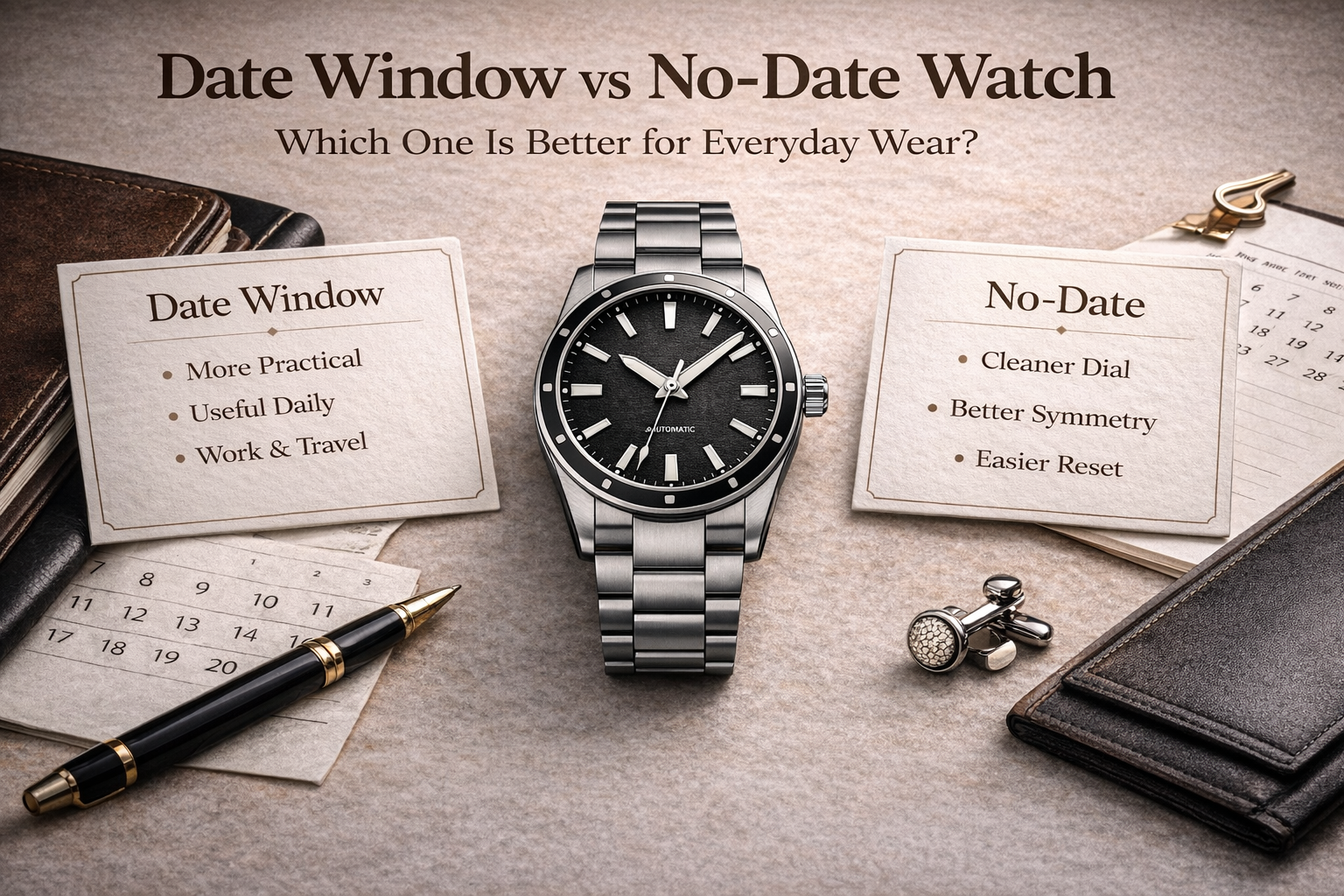
Date Window vs No-Date Watch: Which One Is Better for Everyday Wear?
Some watch decisions are obvious.
This one usually is not.
A bigger case feels bigger. A leather strap looks dressier. A dive watch usually feels sportier. But the decision between a date window and a no-date watch is more subtle, because both can seem right until you actually live with the watch for a few months.
That is when the real difference appears.
A date window can feel incredibly practical in daily life. You glance down, check the time, check the date, and move on. A no-date watch can feel cleaner, calmer, and more satisfying every single time you look at the dial.
So here is the practical answer first:
Choose a date window if you genuinely check the date often and want your watch to be more useful in normal daily life. Choose a no-date watch if you care more about dial symmetry, simplicity, and easier ownership.
That is the short version.
For most people, neither option is objectively better. The better choice depends on whether you want your watch to solve one more small daily task, or whether you want it to stay as visually clean and low-maintenance as possible.
If you are still early in the process, it helps to start with What Is an Automatic Watch? Pros, Cons & Who Should Buy One and Best Automatic Watches for Beginners: Top Picks & Buying Tips. But if your real question is whether a date window or no-date layout is better for everyday wear, this guide is the practical version.
The short answer: what is the real difference?
The simplest way to think about it is this:
- A date window adds utility
- A no-date layout adds calm
A date window usually gives you:
- more practical daily use
- one less reason to check your phone
- a more functional watch overall
A no-date watch usually gives you:
- cleaner dial symmetry
- less visual interruption
- easier ownership if the watch stops
- a simpler, more timeless look
That is the real difference.
It is not a huge technical choice.
It is a daily-use choice.
And because it affects the dial every single time you look at it, it matters more than many buyers expect.
Why this small decision matters so much
Because a date display changes both the look and the behavior of a watch.
A date window changes the watch visually:
- it introduces asymmetry
- it adds text or a cutout
- it can interrupt markers or dial balance
- it shifts how “clean” the watch feels
It also changes the watch operationally:
- you may need to reset the date after the watch stops
- you may need to be more careful when setting it
- it can make the watch more useful during work or travel
That is why the debate never really goes away. One side is arguing for beauty. The other is arguing for usefulness.
And in everyday wear, both are legitimate.
What is a date window watch?
A date window watch is a watch with a display showing the current date, usually through a small cutout in the dial.
That date can appear:
- at 3 o’clock
- at 6 o’clock
- sometimes at 4:30
- or in other less common positions
For most buyers, the point is simple:
the watch tells you the date without needing your phone or computer.
That sounds like a small benefit, but in real life it can be more useful than watch enthusiasts sometimes admit.
What is a no-date watch?
A no-date watch has no date display at all.
The dial shows only the core time display, usually with:
- hands
- hour markers or numerals
- and nothing else competing for attention
The appeal is obvious once you see a good one.
A no-date watch often feels:
- cleaner
- calmer
- more balanced
- more timeless
- more intentional in design
That is why many enthusiasts grow to appreciate no-date layouts more over time. The watch feels complete without having to “do one more thing.”
Date window vs no-date: the real-life comparison
| Category | Date Window | No-Date |
|---|---|---|
| Everyday utility | Higher | Lower |
| Dial symmetry | Usually weaker | Usually stronger |
| Visual simplicity | Lower | Higher |
| Ease after the watch stops | Lower | Higher |
| Setting hassle | More | Less |
| Practical workday value | Strong | Medium |
| Design purity | Medium | Strong |
| Best for | Utility-first buyers | Style-first or simplicity-first buyers |
That table captures the entire debate in a practical way.
If you value function first, date often wins.
If you value visual harmony first, no-date often wins.
Why date windows are so useful in real life
This is the part many buyers understand immediately.
A date window is useful because daily life includes dates all the time:
- signing forms
- checking appointments
- travel
- office work
- invoices
- schedules
- remembering what day it is during a busy week
And yes, your phone also shows the date. But that does not make the watch display irrelevant. In real use, many people genuinely like glancing down and seeing both time and date in one place.
This is especially true for buyers who want one watch to function as a real daily companion rather than purely as an object of design appreciation.
If you treat your watch as something you actually use, the date window can feel like a small but meaningful upgrade.
Why no-date watches feel so satisfying
Because symmetry is powerful.
A no-date dial often feels immediately more composed. There is no cutout interrupting the markers. No date wheel color mismatch. No tiny little square drawing attention away from the rest of the design. Just the dial, the hands, and the overall balance working together.
That is why no-date watches often feel:
- calmer
- more premium
- less busy
- more timeless
Even when the watch is simple, removing the date can make it feel more deliberate.
That visual calm is hard to overstate. It is one of those details you may not care about at first—but once you notice it, it can become very hard to ignore.
The hidden practical benefit of no-date: easier ownership
This is the strongest argument for no-date that has nothing to do with appearance.
A no-date watch is usually easier to live with if:
- it stops overnight
- you rotate watches
- you do not wear the same watch every day
- you do not want to think about date-setting logic
If a no-date watch stops, you usually just:
- wind it
- set the time
- put it on
That is it.
If a date watch stops, you may also need to:
- wind it
- set the time
- set the date correctly
- avoid unsafe adjustment periods depending on the movement
That extra step may sound minor, but over months and years it becomes part of the ownership experience.
This is why no-date can be a surprisingly strong choice for people who value lower-friction ownership. If you want the practical side of that issue, Do Automatic Watches Stop If Not Worn? Power Reserve, Why It Happens & Easy Fixes and How to Set an Automatic Watch Safely (Time, Date, and the “Danger Zone” Explained) are directly relevant.
Which one is better for everyday wear?
For most people, the honest answer is:
- Date window is better for everyday wear if you value utility
- No-date is better for everyday wear if you value simplicity
That may sound like a non-answer, but it is the true answer.
Everyday wear is not only about practicality. It is also about what kind of friction you personally notice more.
Some people notice the inconvenience of not having the date.
Some people notice the visual annoyance of a dial cutout every single time they look at the watch.
Whichever one bothers you more should usually decide the purchase.
Real-world buyer case #1: the office worker who checks dates constantly
This buyer uses dates all the time:
- meetings
- scheduling
- paperwork
- invoices
- calendar awareness
- deadlines
For them, a date window often makes perfect sense.
Why?
Because the usefulness is not theoretical. It shows up in real daily behavior. If the buyer checks the date multiple times a day anyway, having it on the wrist genuinely improves the watch’s usefulness.
For this person, the practical value may outweigh the visual compromise.
Real-world buyer case #2: the buyer who cares deeply about clean design
This person is bothered by:
- dial imbalance
- cut-off markers
- mismatched date wheels
- too much visual interruption
They care about proportion and design calm more than added functionality.
For them, no-date often feels much better.
This is one of those buyers who may try date-window watches repeatedly and keep coming back to the same conclusion: the dial simply looks better without it.
And for a watch you will look at hundreds of times per week, that matters.
Real-world buyer case #3: the one-watch buyer
This is where the decision gets most interesting.
A one-watch buyer wants one automatic for:
- work
- weekends
- travel
- errands
- daily life
For this buyer, a date window often makes a lot of sense because it increases real-world utility. If one watch has to do most things, one more practical function can be valuable.
That said, if the buyer is highly sensitive to dial cleanliness, no-date can still be the better long-term answer. The decision becomes:
Do you want more usefulness, or less visual compromise?
That is a very personal call.
Which one looks better?
For most people, no-date looks better.
That is the simplest aesthetic answer.
A no-date watch usually wins on:
- symmetry
- visual calm
- dial balance
- timelessness
- cleaner overall presence
This is especially true on watches where the date window:
- cuts into a marker
- sits awkwardly
- has a mismatched background
- disrupts a very simple dial
A well-done date window can still look excellent. But a no-date layout usually has the easier path to beauty.
Which one is more practical?
For most people, date window is more practical.
That is the simplest functional answer.
A date window wins when:
- you actually use the date often
- your watch is your main daily watch
- you like having more information on the wrist
- you treat your watch as a functional daily tool
That practicality should not be dismissed. Watches are emotional objects, but everyday watches are still daily-use objects too.
Date window placement matters more than many buyers think
Not all date windows are equal.
A date at 3 o’clock may feel familiar and easy.
A date at 6 o’clock may feel more balanced.
A date at 4:30 can divide opinion sharply.
A date that cuts into an hour marker may bother some buyers more than others.
This matters because some people do not actually dislike date windows. They dislike badly integrated date windows.
So before deciding that you are “date” or “no-date,” it is worth asking:
- Is it the concept I dislike?
- Or just this specific execution?
That question can save a lot of confusion.
Which one is better for dress watches?
Usually, no-date.
Dressier watches often benefit from:
- simplicity
- symmetry
- restraint
- lower visual clutter
That is one reason cleaner dress watches tend to feel more elegant. A date window can still work on a dress watch, but the no-date version often feels more refined and timeless.
That same principle is part of why buyers drawn to cleaner formal options often end up gravitating toward watches similar in spirit to those in Best Automatic Dress Watches Under $1000: Elegant Picks for Formal Style.
Which one is better for a daily sports watch?
Usually, date window has the edge.
A practical everyday sports watch often benefits from a little more function. In that context, the date display feels natural rather than intrusive.
That is especially true for buyers who want their watch to act like a real daily companion rather than a pure design object.
This is one reason so many buyers of versatile everyday automatics accept, or even prefer, a date window. In the daily-sports or everyday-watch category, usefulness often matters more than dial purity.
Which one is better if you rotate watches?
Usually, no-date.
If you rotate several watches, a date display becomes slightly more annoying because every time the watch stops, there is one more thing to fix. Over time, that can make no-date feel much more relaxing.
A buyer who switches often between watches may discover that the beauty of a no-date dial is only half the benefit. The other half is simply not having to deal with the date every time the watch comes back into rotation.
Which one is better if you wear one watch most of the time?
Usually, date window becomes more attractive.
If the watch is on your wrist most days, the date is less annoying to maintain and more useful to have. The more stable your routine with that one watch, the more the date display can justify itself.
That is why there is no universal answer. The right choice depends not only on your taste, but on your wearing pattern.
What buyers often get wrong
1. Assuming date is always the smarter choice
Not if the buyer is bothered by dial disruption every time they look at the watch.
2. Assuming no-date is only for enthusiasts
Not true. Plenty of normal buyers simply prefer cleaner design and easier ownership.
3. Ignoring how often they actually use the date
Some people think they need a date window, then realize they almost never check it.
4. Ignoring how often the watch will stop
This matters a lot for automatic watches. If it stops often, the date becomes more work.
A quick practical test before you buy
If you are stuck, ask yourself these four questions:
1. Do I check the date on my phone or computer all the time?
If yes, a date window may genuinely help.
2. Does dial symmetry matter a lot to me?
If yes, you may be happier no-date.
3. Will this be my main watch or part of a rotation?
Main watch leans more toward date. Rotation leans more toward no-date.
4. What will annoy me more over time?
- not having the date
- or seeing the date cutout every day
That last question is usually the real answer.
Which one should most buyers choose?
Here is the most honest recommendation.
Choose a date window if:
- you use the date regularly
- this will be your main everyday watch
- you want more function from the watch
- you do not mind a little visual compromise
- you value utility over perfect symmetry
Choose no-date if:
- you care strongly about dial purity
- you rotate watches
- you want simpler ownership
- you prefer timeless, cleaner design
- the visual balance of the dial matters more than added function
If you are unsure
Ask whether you are more likely to notice:
- the missing date
or - the disrupted dial
That usually tells you everything.
FAQ
Is a date window worth it on an everyday watch?
For many people, yes. A date window can be genuinely useful in daily life, especially if the watch is worn most days.
Are no-date watches better looking?
For many buyers, yes. No-date watches usually offer cleaner symmetry and a calmer, more balanced dial.
Is a no-date watch easier to own?
Yes, especially if you rotate watches or if the watch stops often. There is less to reset and less to think about.
Are date windows bad on dress watches?
Not necessarily, but many dress watches look more elegant without a date window because the dial stays cleaner and more restrained.
Should my first automatic watch have a date?
If it will be your one main daily watch and you like practical utility, a date window can be a very good choice. If you value clean design more, no-date may still be better.
What is better for a one-watch collection: date or no-date?
Usually date has a slight practical edge, but no-date can still be the better choice if the owner cares deeply about symmetry and wants simpler ownership.
Final verdict
If you want the simplest possible takeaway:
- Date window is better for utility
- No-date is better for purity
- Date is often better for a main daily watch
- No-date is often better for clean design and easier ownership
That is the real answer.
Not which one is more “correct.”
Not which one is more enthusiast-approved.
Not which one wins online arguments.
The real question is:
What do you want from your watch every day—one more useful feature, or one less visual compromise?
If you want usefulness, choose the date window.
If you want calm design and lower-friction ownership, choose no-date.
And for most buyers, the right answer is simply the one they will stop noticing for the wrong reasons.