Dress Watch vs Everyday Watch: What’s the Real Difference and Which Should You Buy First?
A lot of first-time buyers think this decision is about formality.
In real life, it is usually about friction.
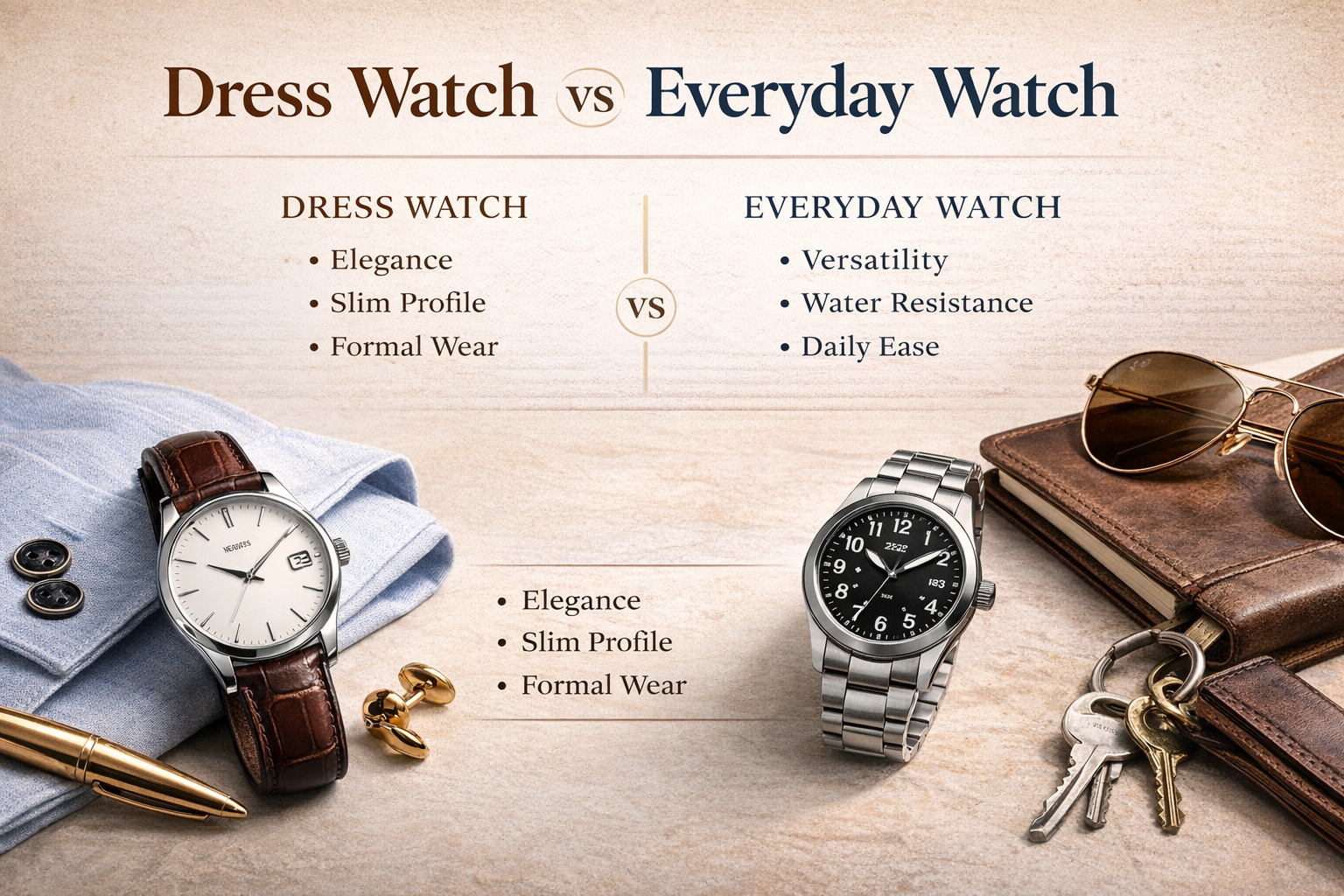
A dress watch is often more elegant, more refined, and better with tailored clothing. An everyday watch is usually more versatile, more forgiving, and easier to live with from Monday to Sunday. That means the real difference is not just how the watch looks. It is how much your lifestyle asks from it.
That is why this comparison matters so much.
Because many buyers do not regret buying a bad watch. They regret buying the wrong role first.
So here is the practical answer up front:
Choose a dress watch first if your life genuinely includes formal or office-smart situations often enough that elegance matters. Choose an everyday watch first if you want one watch that can handle most of normal life with the fewest compromises.
That is the short version.
And for most people, the honest answer is that an everyday watch is the safer first purchase. But not for everyone.
If you are still building the basics, it helps to start with What Is an Automatic Watch? Pros, Cons & Who Should Buy One and Best Automatic Watches for Beginners: Top Picks & Buying Tips. But if your real question is “dress watch or everyday watch first?”, this guide is the practical version.
The short answer: what is the real difference?
The simplest distinction is this:
- A dress watch is built to feel refined
- An everyday watch is built to feel adaptable
A dress watch usually prioritizes:
- elegance
- slimness
- visual restraint
- formal or smart styling
- lower visual bulk
An everyday watch usually prioritizes:
- versatility
- durability
- comfort
- easier water tolerance
- broader wardrobe flexibility
That is the real difference.
It is not price.
It is not prestige.
It is not whether one is “better made.”
It is what kind of life the watch is designed to fit into.
What is a dress watch?
A dress watch is usually a watch designed to look clean, refined, and appropriate with smarter clothing.
That often means:
- a simpler dial
- slimmer case proportions
- less visual bulk
- more restrained design
- leather strap or cleaner bracelet styling
- a watch that sits more quietly under a cuff
A good dress watch does not need to be flashy. In fact, the category often works best when it is restrained.
It is the kind of watch that makes sense with:
- shirts
- tailoring
- knitwear
- dressier dinners
- business or formal settings
That is why dress watches often appeal to buyers who want elegance more than ruggedness.
If you want to explore the category directly, Best Automatic Dress Watches Under $1000: Elegant Picks for Formal Style is the natural internal next step.
What is an everyday watch?
An everyday watch is usually a watch designed to work in more situations with less effort.
That often means:
- moderate size
- moderate thickness
- clear readability
- practical water resistance
- good comfort
- strap or bracelet versatility
- a design that works with casual and smart-casual clothing
An everyday watch is not necessarily boring. It just wins differently.
It wins by being:
- easy to wear
- easy to style
- easy to trust
- easy to keep reaching for
That is why everyday watches often become the better first purchase. They solve more daily problems.
Why buyers confuse the two
Because many modern watches try to do both.
A lot of so-called “everyday watches” borrow dress-watch cleanliness.
A lot of dress-leaning watches try to become more versatile with stronger cases or bracelets.
So the categories overlap more than they used to.
But the difference still shows up in real use.
A dress watch feels most right when the situation asks for restraint.
An everyday watch feels most right when you do not want to think too much at all.
That is the easiest way to separate them.
Dress watch vs everyday watch: the real-life comparison
| Category | Dress Watch | Everyday Watch |
|---|---|---|
| Core purpose | Elegance | Versatility |
| Best setting | Smart, formal, office-refined | Casual, travel, mixed daily life |
| Size and thickness | Usually slimmer and more restrained | Usually moderate and practical |
| Strap preference | Often leather | Bracelet, leather, or rubber depending on use |
| Water resistance | Often lower | Usually more practical |
| Formality | Higher | Medium |
| Daily flexibility | Lower to medium | High |
| First-watch safety | More situational | Safer for most people |
That table gets to the point quickly.
If your life is varied, everyday usually wins.
If your life is dressier, or you really value elegance, dress may make more sense.
Style: which one fits more wardrobes?
For most people, everyday watches fit more wardrobes.
That is because everyday watches usually work with:
- T-shirts
- jeans
- overshirts
- casual office wear
- weekend clothes
- travel outfits
- many smart-casual combinations
A dress watch usually works best with:
- button-down shirts
- tailoring
- office-smart clothing
- cleaner, more refined outfits
- occasions where visual restraint matters
That does not mean a dress watch cannot be worn casually. It can. But it often feels like a deliberate style move rather than a natural all-situation choice.
An everyday watch usually asks less from the rest of your outfit.
Comfort: dress watches often feel lighter, everyday watches often feel easier
This is one of the more interesting tradeoffs.
Dress watch comfort
A dress watch can feel excellent because it is often:
- slimmer
- lighter
- lower under sleeves
- more refined on the wrist
But dress watches can also feel slightly more limited because you may become more conscious about where and when you wear them.
Everyday watch comfort
An everyday watch may be a little thicker or more substantial, but it often feels easier overall because it is built for more normal-life use. You worry less. You wear it more freely.
So dress watches often win in pure physical elegance, while everyday watches often win in psychological ease.
That difference matters more than many buyers expect.
Water resistance and worry: everyday watches usually win clearly
This is one of the biggest practical differences.
A dress watch may be beautiful, but it is often not the watch you want to wear when:
- it starts raining
- you are traveling
- you are washing hands constantly
- you want one watch for a busy day
- your routine is unpredictable
An everyday watch is usually much better at absorbing those normal-life realities.
That is why practical water resistance matters so much in this comparison. A watch that looks better on paper but makes you anxious in ordinary life may not be the right first purchase.
This is exactly why Water Resistance Explained for Everyday Watches: 30m vs 50m vs 100m vs 200m — What You Can Actually Do belongs in the same decision chain.
Strap choice changes the whole category more than buyers think
A dress watch on leather often feels exactly right.
An everyday watch on bracelet often feels like the safest one-watch answer.
This matters because strap choice can push a watch closer to one category or the other.
Dress watch usually works best on:
- leather
- slimmer, more elegant bracelets
- refined, low-profile setups
Everyday watch usually works best on:
- bracelet
- leather if the lifestyle is mostly dry and office-based
- rubber if comfort, heat, or water matters
That means some watches are not naturally “one thing” forever. Their role can shift depending on what they are attached to.
If you want to understand that side properly, Leather vs Bracelet vs Rubber Strap: How Strap Choice Changes Fit, Style, and Value is a good companion read.
Which one is better as your first watch?
For most people, everyday watch is better as a first watch.
That is the honest answer.
Why?
Because your first watch usually needs to do more than you think. It has to survive real life:
- commuting
- weekends
- dinners
- casual office days
- travel
- weather
- uncertainty about your own style
An everyday watch handles that better.
A dress watch can still be a brilliant first watch—but usually only when the buyer’s life actually supports it.
So the default answer is:
buy everyday first, unless your life clearly points toward dress.
When a dress watch should be your first watch
Dress watch should come first if most of these sound like you:
- you wear shirts, tailoring, or business-smart clothing regularly
- you care more about elegance than ruggedness
- you want a watch that sits quietly and beautifully
- your routine is mostly dry, controlled, and less physically demanding
- you already know you dislike sporty or tool-like watches
This buyer is not buying a watch for maximum flexibility. They are buying a watch for the way they actually live.
For them, a dress watch is not a compromise. It is the right answer.
When an everyday watch should be your first watch
Everyday watch should come first if most of these sound like you:
- you want one watch for almost everything
- you dress casually or smart-casually most of the time
- you travel or commute often
- you do not want to worry about weather or ordinary life
- you are still figuring out your taste
- you want the safest no-regret purchase
This is the most common real-life buyer.
And for this buyer, everyday watch usually makes far more sense.
That is why so many strong first-watch recommendations end up leaning toward versatile, moderate-spec daily pieces rather than pure dress watches.
Real-world buyer case #1: the office professional who actually dresses up
This buyer wears shirts, wool trousers, jackets, loafers, and generally neat clothing most weekdays. They want their watch to feel refined rather than rugged.
For them, a dress watch can be the better first choice.
Why?
Because a bulky or too-casual everyday watch may solve theoretical versatility, but it may still feel slightly wrong most of the time. The buyer will notice that.
For this person, refinement is not an occasional need. It is the baseline.
Real-world buyer case #2: the beginner who wants one watch only
This person is buying their first automatic watch and wants one piece that can do:
- work
- weekends
- errands
- dinner
- travel
- normal life
For this person, everyday watch is almost always the better first purchase.
It is easier to live with, easier to style, and more forgiving while the buyer is still learning what they like.
This is also why the best beginner advice so often overlaps with broader practical guides like Best Automatic Watches by Budget: $300 vs $500 vs $1000 — How to Choose the Right One.
Real-world buyer case #3: the small-wrist buyer
This is where the answer gets more interesting.
A small-wrist buyer may actually find dress watches easier to wear because they are often:
- slimmer
- smaller
- lower in visual bulk
- more naturally proportioned
But that does not automatically mean dress watch is the better first purchase. It just means fit may favor dress designs.
If the lifestyle still demands more flexibility, the buyer should look for an everyday watch with compact proportions rather than defaulting to dress. That is exactly the logic behind Best Automatic Watches for Small Wrists: What to Look for Before You Buy.
Which one is better for travel?
For most people, everyday watch.
Travel makes all the normal-life demands more obvious:
- weather changes
- different outfits
- unpredictable environments
- more walking
- more casual moments
- more need for ease
A dress watch can still travel well, especially for business trips. But as a category, everyday watches are usually better suited to the mixed reality of travel.
Which one is better long-term?
This depends on what “better” means.
Dress watch is better long-term if:
- you truly dress that way
- elegance is central to your style
- you want a watch that feels timeless and refined
- you do not need it to do everything
Everyday watch is better long-term if:
- you want maximum use
- you value practicality
- you want fewer ownership compromises
- you would rather wear one watch often than several watches selectively
For most buyers, everyday watch provides more total wearing value over time.
But a truly good dress watch can hold emotional value in a very different way. It often feels more deliberate, more elegant, and more quietly satisfying.
The biggest mistake buyers make
The biggest mistake is not choosing the wrong watch.
It is choosing the wrong first role.
A buyer chooses a dress watch because it looks beautiful, then realizes they only wear it twice a month.
Or they choose an everyday watch because it is practical, then realize they really wanted something more refined and special from the start.
That is why this decision needs honesty.
Not “Which watch is objectively better?”
But:
Which watch fits the life I actually have right now?
That is the question that prevents regret.
What buyers often get wrong
1. Assuming dress watch means “better taste”
Not necessarily. It just means a different purpose.
2. Assuming everyday watch means boring
A well-chosen everyday watch is often the smartest purchase in the whole collection.
3. Thinking a dress watch can automatically do everyday duty
Sometimes it can. Often it can, but with tradeoffs. Buyers should be honest about those.
4. Thinking an everyday watch can fully replace a dress watch forever
Sometimes it can. But if elegance matters deeply to you, that gap will still be felt.
A quick decision checklist
If you are unsure, use this:
Buy a dress watch first if:
- you wear smarter clothing often
- you care deeply about elegance
- you want slimness and restraint
- you do not need broad lifestyle versatility
- you want the watch to disappear quietly into refined outfits
Buy an everyday watch first if:
- you want one watch for most of life
- you value comfort and practicality
- your wardrobe is mixed or casual-smart
- you want easier ownership
- you are not yet sure what kind of collector or wearer you will become
This checklist solves the question for most buyers.
FAQ
What is the difference between a dress watch and an everyday watch?
A dress watch is built mainly for elegance and refined wear. An everyday watch is built mainly for versatility, comfort, and normal-life practicality.
Which should I buy first, a dress watch or an everyday watch?
For most people, an everyday watch is the safer first purchase. A dress watch should come first when your wardrobe and routine genuinely support it.
Can a dress watch be an everyday watch?
Sometimes, yes. But it often comes with tradeoffs in water resistance, durability, and casual versatility.
Can an everyday watch be worn with formal clothing?
Sometimes, yes. A clean everyday watch can dress up surprisingly well, but it usually will not feel as naturally elegant as a true dress watch.
Are dress watches smaller than everyday watches?
Often, yes. Dress watches are usually slimmer and more restrained, while everyday watches often prioritize broader practicality.
Is a dress watch worth it if I only wear formal clothes occasionally?
Usually not as your first watch. For most buyers in that situation, an everyday watch first and a dress watch later is the smarter order.
Final verdict
If you want the simplest possible answer:
- Dress watch is for elegance
- Everyday watch is for versatility
- Dress watch should come first only if your life genuinely supports it
- Everyday watch is the smarter first purchase for most people
That is the real difference.
Not prestige.
Not price.
Not which one sounds more sophisticated.
The right first watch is the one that fits your actual life now, not the version of your life you imagine in product photos.
So if you want a cleaner, safer, more broadly useful answer, buy the everyday watch first.
If you already know elegance is your baseline, buy the dress watch first.
That is the decision that actually makes sense.