Best Automatic Watches for Small Wrists: What to Look for Before You Buy
Best Automatic Watches for Small Wrists: What to Look for Before You Buy
Buying an automatic watch for a smaller wrist can feel harder than it should.
You find a watch that looks great in product photos, sounds perfect on paper, and gets recommended everywhere. Then you try it on—or finally receive it—and something feels off. It looks too wide, too tall, or strangely top-heavy. The dial dominates your wrist. The lugs hang over. The bracelet feels like it is wearing you instead of the other way around.
That experience is extremely common.
And the good news is that it usually is not because you “cannot wear” automatic watches. It is because many buyers are taught to look at the wrong things first.
So here is the practical answer up front:
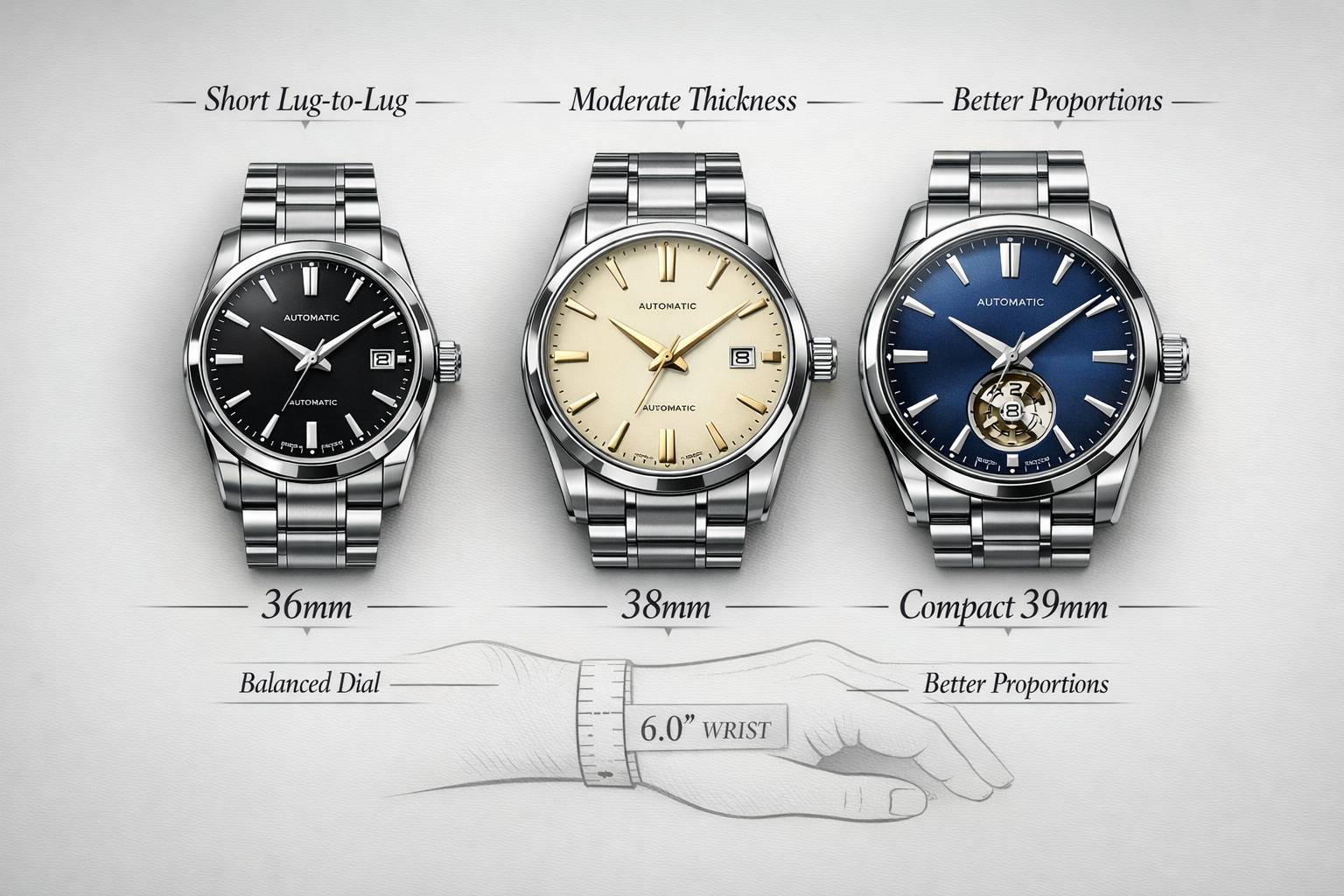
The best automatic watch for a small wrist is usually not the one with the smallest diameter. It is the one with the right overall proportions: wearable diameter, short lug-to-lug, moderate thickness, balanced dial design, and a strap or bracelet that helps the watch sit naturally.
That is the real buying rule.
If you are still early in the learning process, it helps to start with What Is an Automatic Watch? Pros, Cons & Who Should Buy One and Best Automatic Watches for Beginners: Top Picks & Buying Tips. But if your specific problem is fit on a smaller wrist, this guide is the practical version you actually need.
The short answer: what size automatic watch is best for a small wrist?
For most buyers with smaller wrists, the safest starting range is usually:
- 36mm to 38mm for dressier or classic everyday watches
- 38mm to 39mm for versatile daily watches
- 40mm only when the watch has compact proportions and short lugs
That does not mean every small-wrist buyer must stay under 40mm. It means the watch needs to be proportioned intelligently.
A smaller wrist can still wear:
- a 39mm field watch well
- a 40mm daily sports watch well
- even some 40mm divers well
But not if the watch is long, thick, or visually oversized.
That is why the best small-wrist buying advice is not “just buy smaller.”
It is: buy better proportioned.
Why small-wrist buying goes wrong so often
Because many buyers look only at case diameter.
Diameter matters, but it is only one part of the fit story. A 38mm watch can wear larger than a 40mm watch if:
- the lugs are longer
- the bezel is thinner
- the dial opening is larger
- the case is slab-sided
- the watch is much thicker
That is why small-wrist buyers often make the same mistake twice:
they choose by the headline number, not by the full shape of the watch.
If you only remember one thing from this article, remember this:
For small wrists, lug-to-lug and thickness often matter as much as diameter.
What counts as a “small wrist”?
There is no universal line, but in practical watch-buying terms, smaller wrists are usually around:
- under 6.25 inches / about 15.9 cm
- and sometimes up to 6.5 inches / about 16.5 cm, depending on wrist shape
That said, wrist circumference is not the whole story. Two people with the same measurement can wear watches differently because one has a flatter wrist top and the other has a rounder wrist profile.
So “small wrist” is partly about measurement, and partly about how much flat surface the watch actually has to sit on.
The 5 features that matter most for small wrists
If you want the fastest possible summary, focus on these five things first:
- Diameter
- Lug-to-lug length
- Thickness
- Dial design
- Strap or bracelet behavior
Everything else comes after that.
1. Diameter: start here, but do not stop here
For smaller wrists, the safest everyday automatic sizes are often:
- 36mm for classic and dress-leaning wear
- 37mm to 38mm for the best mix of comfort and versatility
- 39mm if the watch is well balanced
- 40mm only when the overall proportions are compact
A 36mm watch can look fantastic on a small wrist. In fact, it often looks more expensive, more intentional, and more comfortable than a larger watch trying too hard.
A 38mm watch is often the sweet spot. It gives enough presence to feel modern while still staying balanced.
A 40mm watch is not automatically too big, but it needs to earn its place with good design.
2. Lug-to-lug: the hidden number that changes everything
This is the most important spec many buyers ignore.
Lug-to-lug is the total length of the watch from the tip of the top lug to the tip of the bottom lug. On a small wrist, this often determines whether the watch looks balanced or awkward.
A safe rule for many small wrists is:
If the lugs start to extend beyond the flat top of the wrist, the watch will usually look too large.
That means a compact 39mm with short lugs can work beautifully, while a 37mm with long, straight lugs can still wear awkwardly.
For small-wrist buyers, short lug-to-lug usually matters more than shaving off one millimeter of diameter.
3. Thickness: because height can ruin a good fit
This is where many people get surprised.
A watch can have the right width and still feel wrong because it is too tall. On a small wrist, thickness becomes even more noticeable because:
- the watch sits higher
- it can feel top-heavy faster
- it catches sleeves more easily
- it looks bulkier relative to wrist size
For many smaller wrists, everyday thickness is often best around:
- 10mm to 12.5mm
- with 13mm still workable depending on category
- and 14mm+ becoming much more conditional
If the goal is daily wear, moderate thickness matters a lot.
4. Dial design: visual size is real size
Some dials simply look larger.
A watch with:
- a thin bezel
- a big open dial
- large numerals
- lots of negative space
can wear bigger than the diameter suggests.
On the other hand, a watch with:
- a thicker bezel
- more visual framing
- better proportion balance
may wear smaller and neater.
This is why two 38mm watches can feel very different on the wrist.
Small-wrist buyers should pay attention not only to case size, but also to how visually open the dial is.
5. Strap or bracelet: the wrong attachment can make the right watch feel wrong
A watch does not wear by case alone.
For smaller wrists:
- leather can soften the watch and make it feel more compact
- bracelet can add visual and physical weight, but also improve balance when sized well
- rubber can be excellent for comfort, though it depends on thickness and integration
If you are buying your first watch for a smaller wrist, the strap choice can change the whole ownership experience. That is why broader buying guides like Leather vs Bracelet vs Rubber Strap: How Strap Choice Changes Fit, Style, and Value matter more than many people think.
What types of watches work best on small wrists?
This depends partly on style, but some categories are naturally easier than others.
Dress watches
Dress watches are often the easiest win for small wrists because they tend to be:
- smaller
- thinner
- cleaner
- easier under sleeves
This is one reason smaller-wrist buyers often do very well in categories like Best Automatic Dress Watches Under $1000: Elegant Picks for Formal Style.
Field watches
Field watches are another strong category because many of them prioritize:
- compact practicality
- clean dials
- restrained thickness
- straightforward wearability
That makes them a natural fit for smaller wrists, especially for everyday casual use. Buyers in that zone often overlap with Best Automatic Field Watches Under $1000: Rugged, Minimal & Built to Last.
Dive watches
This is where things get trickier.
A dive watch can still work on a small wrist, but the proportions need to be right. Divers often run thicker and visually heavier, so smaller-wrist buyers need to be more careful. Some compact divers wear well. Some wear much larger than the numbers suggest.
That is why dive watches can be great, but they are less forgiving than dress or field watches.
Real-world buyer case #1: the 6.0-inch wrist buyer who keeps getting drawn to 40mm sports watches
This is extremely common.
The buyer sees a 40mm sports watch online and assumes it is the “normal modern size.” On arrival, the watch feels too broad, too tall, or too assertive. Nothing is technically absurd—but the fit just does not look natural.
For this buyer, the better answer is often:
- 36mm to 38mm for daily wear
- or 39mm only if the lug-to-lug is compact and the case is controlled
This is a perfect example of why chasing “normal size” is less important than chasing good balance.
Real-world buyer case #2: the buyer who wants one watch for everything
This person has a smaller wrist but does not want a tiny dress watch. They want one automatic watch for:
- work
- weekends
- travel
- dinner
- daily life
For them, the sweet spot is often around:
- 37mm to 39mm
- moderate thickness
- short lugs
- simple dial
- a bracelet or versatile strap setup
This is the kind of buyer who benefits from reading Best Everyday Automatic Watch Features: 8 Specs That Matter More Than Marketing, because the goal is not just small size. It is all-around wearability.
Real-world buyer case #3: the buyer who thinks small watches will look “too small”
This fear is understandable, but often exaggerated.
A lot of people with small wrists assume a 36mm or 37mm watch will look tiny because they are used to seeing big watches in photos, ads, or on larger wrists. In real life, once that watch is actually on wrist, it often looks balanced, clean, and much better proportioned than expected.
What looks “small” in isolation often looks just right in context.
That is one of the most important mindset shifts for small-wrist buying.
The biggest mistakes small-wrist buyers make
1. Buying for photos instead of wrist reality
Product shots often make bigger watches look appealing. Real life is less forgiving.
2. Ignoring lug-to-lug
This is probably the most expensive avoidable mistake.
3. Underestimating thickness
A watch can feel oversized vertically even if the diameter seems safe.
4. Equating bigger with more masculine or more premium
Usually, better proportion looks stronger and more considered than forced wrist presence.
5. Buying a category before buying a fit
If you love dive watches, that is fine—but the fit still comes first.
How to measure your wrist properly before buying
This is worth doing, especially if you shop online.
What you need
- a soft tape measure
or - a strip of paper and a ruler
How to do it
- Wrap the tape around the place where you wear your watch
- Keep it snug, not tight
- Write down the wrist circumference
- If possible, also look at the flat top area of your wrist in a mirror
That last step matters because your wrist shape affects how much lug-to-lug you can wear comfortably.
A practical small-wrist size guide
This is not a hard rule, but it is a very useful starting point.
For wrists around 5.5" to 6.0"
Look first at:
- 34mm to 37mm
- and compact 38mm watches
For wrists around 6.0" to 6.5"
Look first at:
- 36mm to 38mm
- and compact 39mm watches
For wrists around 6.5" and just above
You can often wear:
- 37mm to 39mm easily
- and some 40mm models if the lugs and thickness are controlled
Again, those are starting points. The final answer is always about the whole watch.
What kind of dial works best for small wrists?
Smaller wrists usually benefit from dials that feel visually balanced, not oversized.
That often means:
- clean layouts
- controlled numeral size
- enough bezel or framing
- not too much empty dial space
- hands and markers that do not visually overwhelm the case
Interestingly, a very bold pilot-style dial can wear larger than expected, even when the watch is not huge on paper. That is why category matters. A pilot watch can be great on a small wrist, but the design needs to be judged more carefully than a compact field or dress watch.
Is bracelet or leather better for small wrists?
Usually, both can work—but differently.
Leather is often easier at first
Leather can make a watch feel:
- lighter
- slimmer
- more flexible
- more forgiving on a small wrist
That makes it a very strong option for dress watches and compact everyday pieces.
Bracelet can still be excellent
A good bracelet can look fantastic on a small wrist if:
- it tapers well
- it is sized correctly
- the links are not too bulky
- the watch head itself is balanced
In fact, a well-tapered bracelet can make a small wrist look more intentional and put-together than a poor strap choice.
So the answer is not that one is always better. It is that bracelet needs to be good, while leather is often more forgiving.
Should small-wrist buyers avoid dive watches?
Not necessarily. But they should be more selective.
A dive watch often brings:
- extra thickness
- more bezel bulk
- more visual weight
- more wrist presence
That means small-wrist buyers should usually favor:
- compact divers
- shorter lug-to-lug
- restrained thickness
- not overly wide bracelets
Dive watches can absolutely work, but the category demands more discipline.
Should small-wrist buyers avoid open-heart or skeleton watches?
Not automatically, but those styles can magnify visual size because they pull more attention to the dial. For many smaller wrists, a clean three-hand dial is easier to wear daily. If the goal is long-term versatility, simpler usually wins.
That is one reason practical buyers often do better starting with readability and proportion instead of visual novelty.
The easiest one-watch strategy for small wrists
If you want one automatic watch and do not want to make a mistake, this is the safest formula:
- 36mm to 38mm
- short lug-to-lug
- moderate thickness
- simple dial
- good strap or bracelet
- enough water resistance for normal life
That formula will beat a lot of “more exciting” options in actual daily wear.
If you are also trying to stay inside a budget, this way of thinking works especially well with Best Automatic Watches Under $300: Affordable & Reliable Picks, Best Automatic Watches Under $500: Premium Value Without Overspending, and Best Swiss Automatic Watches Under $1000: Luxury Feel Without the Luxury Price, because proportion matters at every price point.
A simple 5-minute buying checklist for small wrists
Before you buy, ask these questions:
1. Is the diameter actually appropriate?
Not based on trend. Based on your wrist.
2. What is the lug-to-lug?
If you cannot find it, that is already a warning sign.
3. Is the thickness reasonable for daily wear?
A small wrist feels height faster.
4. Does the dial look visually oversized?
A wide-open dial can wear much larger than expected.
5. Will the strap or bracelet help the watch sit well?
This is not a small detail. It changes everything.
That checklist alone will save many buyers from the wrong purchase.
FAQ
What size automatic watch is best for small wrists?
For most small wrists, 36mm to 38mm is the safest and most versatile range, with some compact 39mm options also working very well.
Is 40mm too big for a small wrist?
Sometimes, but not always. A 40mm watch can still work if the lug-to-lug is short, the case is not too thick, and the overall design is compact.
What matters more for small wrists, diameter or lug-to-lug?
Lug-to-lug often matters just as much, and sometimes more. A smaller diameter alone does not guarantee a good fit.
Are automatic watches good for small wrists?
Yes, absolutely. The key is choosing the right proportions, not avoiding automatic watches altogether.
Is leather or bracelet better for small wrists?
Leather is often more forgiving and easier at first. A well-designed bracelet can also be excellent if it tapers well and does not add too much bulk.
Should small wrists only wear dress watches?
No. Dress watches are often easy to wear, but many field watches and compact everyday sports watches can also work extremely well.
Final verdict
If you want the simplest real-world answer:
The best automatic watches for small wrists are the ones with balanced proportions, not just smaller case diameters.
That usually means prioritizing:
- compact diameter
- short lug-to-lug
- moderate thickness
- controlled dial design
- a strap or bracelet that supports the fit
The mistake most buyers make is trying to force a watch category or a trend onto a wrist shape that needs more thoughtful proportion.
The smarter move is to buy the watch that looks natural, feels comfortable, and disappears into daily life.
Because for small wrists, the best watch usually is not the one that looks biggest.
It is the one that looks right.