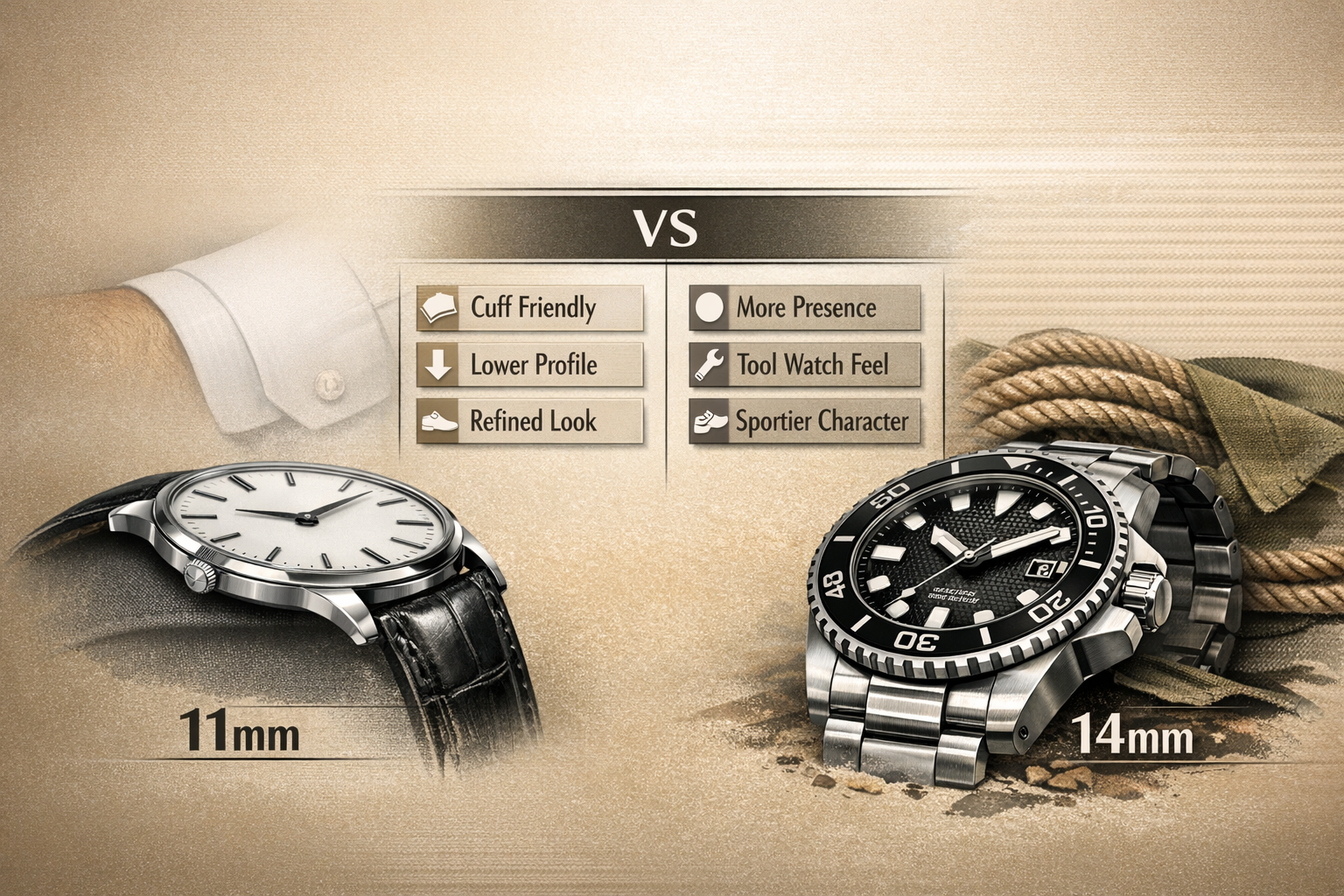
Automatic Watch Thickness Guide: Why 11mm Feels Elegant and 14mm Feels Sporty
Most buyers pay attention to watch diameter first.
They compare 36mm, 38mm, 40mm, and 42mm. They look at lug-to-lug. They think about dial color, bracelet style, and movement type. But then the watch arrives, goes on the wrist, and somehow feels bulkier, taller, or less refined than expected.
Very often, the missing piece is thickness.
That is because thickness changes more than comfort. It changes the entire personality of a watch.
An 11mm automatic watch usually feels cleaner, slimmer, and more elegant. A 14mm automatic watch often feels more rugged, sporty, and substantial. Neither is automatically better. But they create very different ownership experiences.
So here is the practical answer first:
If you want a watch that feels refined, slips more easily under a cuff, and disappears into daily wear, start around 10mm to 12mm. If you want a watch that feels tougher, more visual, and more tool-like, 13mm to 14mm and above can make much more sense.
That simple rule will help many buyers avoid a very common mistake: choosing a watch that looks perfect in photos but feels too tall in real life.
If you are still working through the basics of automatic watches, it helps to start with What Is an Automatic Watch? Pros, Cons & Who Should Buy One and Automatic Watch vs Quartz: Differences, Pros & Which to Choose. But if your real question is how thickness affects daily wear, this is the guide that answers that in practical terms.
The short answer: what watch thickness actually feels like
Let’s keep it simple.
Around 10mm to 11mm
This usually feels:
- elegant
- dressier
- lower-profile
- easier under sleeves
- more refined in daily office wear
Around 12mm to 13mm
This usually feels:
- balanced
- versatile
- modern
- substantial without being overly chunky
- suitable for many everyday sports or casual watches
Around 14mm and above
This usually feels:
- sporty
- tool-like
- visually bolder
- more noticeable on the wrist
- less dress-friendly, but often more rugged in character
So if you want the fastest buying rule:
11mm feels elegant. 14mm feels sporty. 12mm to 13mm is where a lot of modern all-rounders live.
Why thickness matters more than many buyers expect
Thickness affects four things immediately:
- how the watch sits on the wrist
- how easily it fits under a shirt cuff
- how top-heavy it feels over a full day
- how formal or sporty it looks
That last point matters a lot.
A watch can have a modest diameter and still feel big because of its height. A 39mm watch at 14mm thick may feel more aggressive than a 41mm watch at 11.5mm thick. That is why thickness often changes the visual impression more than buyers expect.
This is also why some people try on a watch and say, “It looks great, but it feels a bit tall.” What they are reacting to is not size in the usual sense. It is vertical presence.
Diameter tells you width. Thickness tells you attitude.
That is the easiest way to think about it.
- Diameter tells you how wide the watch looks
- Thickness tells you how much it stands up off the wrist
And that vertical height changes the whole mood of the watch.
A thin watch tends to look:
- cleaner
- sharper
- more intentional
- more elegant
- easier with formal clothing
A thicker watch tends to look:
- tougher
- sportier
- more casual
- more mechanical
- more like a tool watch
That is one reason buyers who want a refined piece often end up liking the proportions common in Best Automatic Dress Watches Under $1000: Elegant Picks for Formal Style, while buyers who prefer a more robust wearing experience often gravitate toward styles closer to Best Automatic Dive Watches Under $1000: Durable, Reliable & Built for Adventure or Best Automatic Field Watches Under $1000: Rugged, Minimal & Built to Last.
Why 11mm feels elegant
There is nothing magical about 11mm. But in practical watch-wearing terms, it often lands in a very comfortable sweet spot.
At around 11mm, a watch usually feels:
- low enough to sit neatly on the wrist
- slim enough to work under a cuff
- restrained enough to read as refined
- substantial enough to avoid feeling flimsy
This is the zone where a lot of watches start to feel “clean” rather than “thick.” That matters in office wear, dinner settings, and any situation where you want the watch to complement your outfit instead of dominating it.
For many buyers, 11mm also feels psychologically right. It is not ultra-thin in a fragile or delicate way. It still feels like a normal automatic watch. It just feels better behaved.
Why 14mm feels sporty
At 14mm, a watch usually starts leaning firmly into sports-watch territory.
That does not mean it is too thick. Plenty of great watches live here. But the wearing message changes.
A 14mm watch often feels:
- more powerful on the wrist
- more rugged
- more casual
- more noticeable under sleeves
- more aligned with dive-watch or tool-watch design
In photos, 14mm can look exciting. In real life, it can feel satisfying too—especially if you like the presence of a real sports watch. But it is rarely subtle.
That is why buyers who want a bold, weekend-friendly, water-capable watch may enjoy this zone, while buyers hoping for a clean one-watch office piece often realize 14mm is taller than they really wanted.
The most useful thickness ranges for buyers
If you want a quick practical guide, this is the easiest breakdown.
| Thickness | How It Usually Feels | Best For |
|---|---|---|
| Under 10mm | Very slim, dressy, refined | Dress watches, cuff-friendly wear |
| 10mm–11.5mm | Elegant, easy, versatile | Office wear, refined everyday use |
| 11.5mm–13mm | Balanced, modern, all-round | Everyday automatics, casual-smart wear |
| 13mm–14mm | Sportier, more substantial | Tool watches, divers, casual-heavy use |
| 14mm+ | Bold, chunky, wrist-present | Dive watches, rugged sports styles |
This table is not a law. Case shape, bezel design, and caseback shape all influence the final result. But as a buying guide, it is extremely useful.
Real-world buyer case #1: the office wearer who keeps bumping into shirt cuffs
This is one of the most common complaints.
A buyer chooses an automatic watch because they want something more special than quartz. The watch looks great online. The size sounds reasonable. But once it arrives, it keeps catching on shirt cuffs and feels too noticeable during the workday.
Very often, the issue is thickness.
For this buyer, 11mm or 12mm usually feels much better than 14mm.
Why? Because the problem is not the watch being “too big.” The problem is the watch being too tall for the way they dress.
If your daily clothing includes shirts, knitwear, light jackets, or office tailoring, lower profile matters more than many people expect.
Real-world buyer case #2: the weekend sports-watch buyer
Now imagine someone wants a watch for denim, T-shirts, weekends, travel, and a more rugged look. They like a little heft. They enjoy visible bezels, stronger wrist presence, and a tougher personality.
For that buyer, 13.5mm to 14mm may feel exactly right.
This is where a watch starts to feel more like equipment, not just jewelry or formal wear. It looks more purposeful and more relaxed in casual settings.
That is why thickness is never just a comfort issue. It is also a style choice.
Real-world buyer case #3: the first-time buyer who wants one watch for everything
This buyer usually wants the hardest thing: one automatic watch that can do office, weekend, travel, and dinner without feeling wrong anywhere.
For this person, 11.5mm to 13mm is usually the safest target.
That range gives enough presence for everyday wear without tipping too far into dress-only or sports-only territory. It is often the most forgiving thickness zone for someone who wants one versatile piece.
If that sounds like your situation, Best Automatic Watches for Beginners: Top Picks & Buying Tips and Best Automatic Watches by Budget: $300 vs $500 vs $1000 — How to Choose the Right One are useful next steps, because they help connect specs with actual wear scenarios.
Why thicker does not always mean worse
A lot of people start reading thickness discussions online and come away thinking every good watch should be as thin as possible.
That is not true.
A thicker watch can be better if:
- the design is meant to feel sporty
- the watch has stronger water resistance
- you want more visual presence
- you dress casually most of the time
- you simply enjoy a more substantial wrist feel
There is nothing wrong with liking a thicker watch. The mistake is only choosing thickness that does not match your life.
A 14mm watch can be great on vacation, on weekends, or as a daily diver. But if your wardrobe and routine are mostly refined, that same thickness may feel like the wrong kind of energy.
Why thin does not always mean better either
Thin watches look refined in photos and often wear beautifully. But thinner is not always better for everyone.
A very slim watch can sometimes feel:
- too delicate for the buyer’s taste
- too dressy for casual use
- visually small if the case diameter is modest
- less satisfying for buyers who like substance
Some owners simply enjoy knowing the watch is there. They like a bit of case height. They like the feeling of a more mechanical, more robust object on the wrist.
Again, the right answer depends on what kind of owner you are.
Thickness and comfort: what changes after eight hours
This is where thickness becomes much more real.
A watch that is tall relative to its diameter can feel more top-heavy over time. That can lead to:
- more wrist movement
- more need to adjust the bracelet or strap
- more awareness while typing
- more catching on sleeves or jacket cuffs
A thinner watch often feels easier because its mass sits closer to the wrist. It stays tucked in visually and physically.
That is why thickness affects long-day comfort, not just mirror aesthetics.
Thickness and caseback shape
This is an important detail that many buyers miss.
Two watches can both be listed at 13mm, but one may feel much better on the wrist because of its caseback design. A domed or curved caseback can help a thicker watch sit more naturally. A flat, slab-like case can make the same thickness feel clumsier.
So when judging thickness, do not think only about the number. Think about:
- overall case shape
- bezel height
- caseback curve
- lug design
- how the watch distributes its height
The number matters, but the design matters too.
Practical operation: how to judge watch thickness before you buy
If you are shopping online, use this simple checklist.
Step 1: check the listed thickness
Do not ignore it. Many buyers compare only diameter and miss the number that will affect daily feel the most.
Step 2: compare thickness to category
Ask whether the thickness makes sense for the style.
- Dress watch: thinner usually feels right
- Everyday all-rounder: moderate thickness is often ideal
- Diver or sports watch: more thickness can be acceptable
Step 3: imagine your wardrobe
Will this watch mostly be worn with:
- shirts and cuffs?
- knitwear and jackets?
- T-shirts and casual clothes?
- beachwear and travel outfits?
The answer changes how much thickness will bother you.
Step 4: do the cuff test in your head
If you regularly wear fitted sleeves, a thick watch will matter more.
Step 5: think about your tolerance for wrist presence
Some people love a watch that feels present. Others want one that disappears. Be honest here.
A simple “daily wear thickness test”
If you are trying on a watch in person, do this:
- Put the watch on and leave it there for at least three minutes
- Bend your wrist naturally
- Slide a shirt cuff or jacket sleeve over it if possible
- Rest your hand on a desk or table
- Ask yourself one question:
Does this feel integrated, or does it feel like it sits on top of me?
That question is more useful than most technical specs.
A good daily watch usually feels integrated.
A thicker sports watch can still feel great—but it should feel intentionally sporty, not accidentally bulky.
How thickness changes formality
This is one of the simplest and most overlooked rules in watch style.
As a general rule, thinner watches look more formal and thicker watches look more casual.
That is not absolute, but it is directionally true.
Why? Because lower-profile watches tend to look cleaner, more restrained, and easier with tailored clothing. Taller watches create more visual impact, which pushes them toward sports-watch territory.
So if you want a watch that can quietly disappear into a smarter outfit, thinner usually helps. If you want the watch to feel like a visible part of the outfit, more thickness can work in your favor.
How water resistance often affects thickness
There is usually a relationship here.
Watches designed for stronger water resistance, more rugged use, or sportier categories often end up thicker. That does not make them worse. It just means the priorities are different.
A buyer choosing between a dressier automatic and a more capable sports model is often really choosing between:
- elegance and lower profile
- or versatility and toughness
That same decision shows up in Water Resistance Explained for Everyday Watches: 30m vs 50m vs 100m vs 200m — What You Can Actually Do, because watches that can do more around water often feel different on the wrist too.
Common buyer mistakes
1. Looking only at diameter
A 39mm watch can still feel big if it is thick.
2. Assuming thicker means more premium
Not always. Thicker often means sportier, not necessarily better.
3. Assuming thinner means more comfortable for everyone
Usually, but not always. Some buyers prefer more presence.
4. Ignoring your sleeves
The watch may look great at home and become annoying the moment it meets a work shirt.
5. Buying for photos instead of daily life
A tall watch can photograph beautifully and still be the wrong watch for your real routine.
What thickness should most buyers choose?
If you want the safest recommendation:
Choose around 10mm to 11.5mm if:
- you dress smartly most days
- you want elegance
- you want better cuff compatibility
- you prefer restrained daily wear
Choose around 11.5mm to 13mm if:
- you want one watch for almost everything
- you want a balanced daily automatic
- you are unsure and want the safest middle ground
- you prefer versatility over extremes
Choose around 13mm to 14mm+ if:
- you like sports watches
- you prefer more wrist presence
- your wardrobe is casual
- you want a rugged, tool-watch feel
For many buyers, 12mm to 13mm is the no-regret zone.
That is often where a watch feels modern and solid without becoming awkward.
FAQ
Is 14mm too thick for an automatic watch?
Not necessarily. It depends on the style and how you dress. For a diver or sporty daily watch, 14mm can feel completely right. For office-heavy or dressier wear, it may feel too tall.
Is 11mm a good thickness for a daily watch?
Yes. Around 11mm is often an excellent thickness for buyers who want comfort, elegance, and better wear under sleeves.
What is the best thickness for a dress watch?
Generally, thinner feels better. Around 10mm to 11mm often works very well for a refined, dressier wearing experience.
What is the best thickness for an everyday automatic watch?
For many buyers, around 11.5mm to 13mm is the best all-round zone. It balances comfort, presence, and versatility.
Does watch thickness affect comfort?
Yes, often more than buyers expect. Thickness changes top-heaviness, cuff fit, and how integrated the watch feels over a full day.
Why do dive watches feel thicker?
Because they are usually designed around a sportier, more robust character, often with stronger case structures and more visual presence.
Final verdict
If you want the simplest practical answer:
- 11mm feels elegant
- 14mm feels sporty
- 12mm to 13mm is where many of the best all-round everyday watches live
So when you shop for your next automatic, do not ask only, “What diameter should I buy?”
Also ask:
Do I want this watch to slip into my life, or do I want it to make more of a statement?
Because that is what thickness really changes.
It does not just change the case.
It changes the mood of the watch, the comfort of the watch, and the situations where the watch feels right.
And that is why a few millimeters matter more than most buyers think.