Power Reserve Explained: 40 Hours vs 72 Hours vs 120 Hours — What Actually Matters in Daily Wear
 If you have ever looked at an automatic watch spec sheet and paused at “40-hour power reserve” or “72-hour power reserve,” you are not alone. For many buyers, that number sounds important, but it is not always clear how important it really is.
Here is the practical answer:
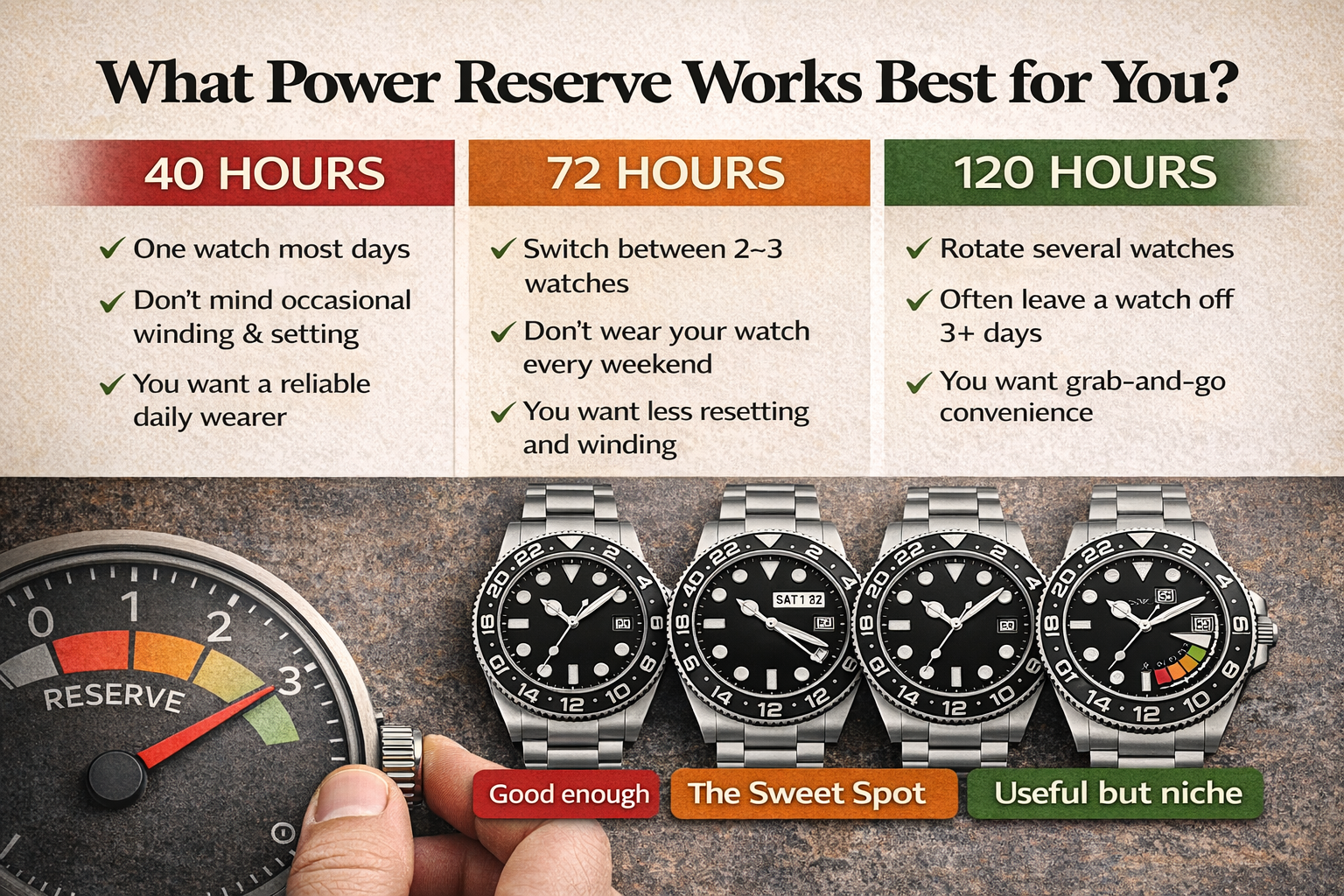
A 40-hour power reserve is usually enough for people who wear the same watch most days. A 72-hour power reserve is the real sweet spot for many modern buyers. A 120-hour power reserve is nice to have, especially for collectors or people who rotate watches often, but it is not something everyone needs.
In other words, longer power reserve is useful—but only when it matches how you actually wear your watch.
That distinction matters, because many first-time buyers assume “more is always better.” In real life, a longer reserve can be helpful, but it does not automatically make a watch a better daily choice. Fit, comfort, serviceability, and how the watch fits your routine still matter more.
If you are still comparing the basics, it helps to start with What Is an Automatic Watch? Pros, Cons & Who Should Buy One and Automatic Watch vs Quartz: Differences, Pros & Which to Choose. But if your question is specifically about power reserve, this guide is the practical version most buyers actually need.
What power reserve actually means
Power reserve is the amount of time a watch can keep running after it is fully wound and then left alone.
In an automatic watch, energy is stored in the mainspring. As you wear the watch, the rotor moves and winds that spring. Once you take the watch off, the movement begins using that stored energy until it runs down.
So when a brand says a watch has:
- 40 hours of power reserve, it can usually run for around a day and a half after being fully wound
- 72 hours of power reserve, it can often make it through a full weekend
- 120 hours of power reserve, it can run for roughly five days
That sounds straightforward, but daily use is messier than spec sheets.
A watch may not be fully wound just because you wore it for part of one day. Your activity level, how much you move, whether you sit at a desk, and how much manual winding you do can all affect how much reserve is actually built up.
This is one reason some people say, “My automatic watch stopped even though I wore it yesterday.” If that is a familiar problem, see Do Automatic Watches Stop If Not Worn? Power Reserve, Why It Happens & Easy Fixes, because the answer is often not just the published reserve number.
The short answer: which power reserve is best?
For most buyers, the ranking goes like this:
40 hours: enough for straightforward daily wear
A 40-hour reserve is perfectly fine if you wear the same watch Monday to Friday or most days of the week. It is the classic standard and still works well in real life.
72 hours: the real-world sweet spot
A 72-hour reserve is where many people start to feel the practical benefit. You can take the watch off Friday evening and often find it still running Monday morning.
120 hours: useful, but more niche
A 120-hour reserve is genuinely convenient if you rotate multiple watches, travel often, or simply dislike resetting time and date. But it is not mandatory for everyone, and it should not be treated as the only sign of a “better” watch.
Why 72 hours feels better than 40 hours in real life
This is where the difference becomes easy to understand.
A 40-hour automatic watch is fine if you wear it regularly. But many people do not wear one watch every day forever. Real routines are uneven.
You might wear your watch to work Thursday and Friday, leave it off over the weekend, and then pick it up Monday morning. That is where a 72-hour reserve becomes noticeably more convenient. It gives you more margin for normal life.
That margin matters because resetting an automatic watch is not always just about turning the crown a few times. Depending on the watch, you may also need to reset the time, date, or even be careful around the date-change period. That is why articles like How to Set an Automatic Watch Safely (Time, Date, and the “Danger Zone” Explained) become more relevant than many new buyers expect.
A longer reserve does not just buy runtime. It buys less interruption.
40 hours vs 72 hours vs 120 hours: what changes for the wearer?
Here is the easiest way to think about it.
40-hour power reserve
A 40-hour reserve works best for people who:
- wear one main watch most days
- do not mind winding and resetting occasionally
- care more about overall watch quality than reserve length alone
- are buying their first automatic and want a straightforward daily wearer
This is still enough for many owners. In fact, if you wear your watch consistently, 40 hours may never feel like a problem.
But it can become mildly annoying if you rotate watches or skip days.
72-hour power reserve
A 72-hour reserve works best for people who:
- switch between two or three watches
- want the watch to survive a normal weekend off-wrist
- value convenience but do not need extreme reserve length
- want a more forgiving everyday experience
This is why 72 hours is such a good “decision-point” feature. It is one of the few spec upgrades that many wearers actually notice in day-to-day life.
120-hour power reserve
A 120-hour reserve works best for people who:
- rotate several watches throughout the week
- may leave one watch untouched for a few days at a time
- dislike resetting watches
- enjoy the convenience of a longer-running automatic movement
It is useful. It is practical. But it is also something many buyers overvalue at the start.
If the watch is thick, uncomfortable, hard to service, or simply not a good fit, a five-day reserve will not save the ownership experience.
A simple real-life example
Imagine three buyers.
Case 1: one-watch daily wearer
James wears one automatic watch to work almost every weekday. He puts it on in the morning, takes it off at night, and usually wears the same piece again the next day.
For him, 40 hours is enough. A longer reserve would be nice, but it would not radically change how he uses the watch.
Case 2: casual rotation owner
Leo owns three watches: one dressier piece for the office, one casual weekend watch, and one diver for travel. He does not follow a strict rotation, but he changes depending on mood.
For him, 72 hours makes a real difference. It reduces the number of times he picks up a watch and finds it dead.
Case 3: collector with irregular use
Daniel rotates between five or six watches and may not return to the same one for several days. He enjoys ownership, but he does not enjoy resetting time and date constantly.
For him, 120 hours is genuinely useful. It aligns with his routine and removes friction.
That is the key: the “best” reserve depends less on the spec sheet and more on your lifestyle.
What matters more than power reserve alone
This is the part many watch buyers miss.
Power reserve matters, but it does not matter in isolation.
1. Your wearing pattern matters more
A shorter reserve is no problem if you wear the watch often. A long reserve is far more useful when your watch sits off the wrist.
2. The date complication matters
A simple no-date watch is much less annoying to restart than a watch with a date. Resetting the time is easy. Resetting both time and date takes more effort, especially if you have to avoid unsafe adjustment periods.
3. Winding behavior matters
Some owners are happy to give the crown a few turns and get on with their day. Others want grab-and-go convenience. Neither is wrong, but it changes how valuable power reserve feels.
If that part is still confusing, Manual Winding vs Automatic Winding: Differences, Pros, Cons & Best Practices is a useful companion read.
4. Accuracy still matters
A long reserve is helpful, but if a watch gains or loses time more than you expect, you may still end up adjusting it regularly anyway. That is why reserve and daily accuracy should be considered together, not separately. For that side of ownership, see Are Automatic Watches Accurate? Real-World Tolerances, Why They Drift & How to Improve Accuracy.
5. Thickness and wearability matter
Longer reserve sometimes comes with a movement design tradeoff, and in some watches that can affect case proportions. That does not mean longer reserve is bad—it just means the overall package still matters more.
What buyers often get wrong
A lot of first-time buyers read specs like this:
- sapphire crystal
- 200m water resistance
- 120-hour power reserve
And then assume the longest reserve is automatically the most practical choice.
But real ownership does not work like a spreadsheet.
A watch that wears well, suits your style, and fits your routine will usually feel like the better purchase—even if another model has a longer reserve on paper.
This is similar to how buyers sometimes over-focus on movement details before deciding what type of watch they actually need. A better buying order is:
- choose the category
- choose the fit
- choose the lifestyle match
- then compare specs like reserve
If you are still deciding between styles, these are good next steps:
- Best Automatic Watches for Beginners: Top Picks & Buying Tips
- Best Automatic Watches by Budget: $300 vs $500 vs $1000 — How to Choose the Right One
- Best Automatic Dress Watches Under $1000: Elegant Picks for Formal Style
- Best Automatic Dive Watches Under $1000: Durable, Reliable & Built for Adventure
A simple test: do you actually need more than 40 hours?
Before paying extra for a longer reserve, try this quick decision test.
Ask yourself these three questions
Do I wear the same watch at least 5 days a week?
If yes, 40 hours may be more than enough.
Do I often leave a watch off for 2 to 3 days?
If yes, 72 hours starts to make more sense.
Do I rotate multiple watches and dislike resetting them?
If yes, 120 hours may be worth prioritizing.
That is the simplest decision framework, and for most people it works surprisingly well.
Practical ownership scenario: Friday to Monday test
Here is a more hands-on way to decide.
Take your current watch—or imagine your likely routine—and run this scenario:
Friday evening
Take the watch off around 6 p.m.
Saturday
Do not wear it.
Sunday
Do not wear it.
Monday morning
Pick it up again at 8 a.m.
Now ask one question:
Would I be annoyed if the watch had stopped?
If the honest answer is yes, then you are exactly the type of wearer who benefits from around 72 hours or more.
This is why 72 hours is such a strong real-world feature. It is not marketing fluff. It solves a very normal weekend-use problem.
Does a longer power reserve mean a better movement?
Not necessarily.
A longer reserve can reflect thoughtful engineering, efficient energy use, or a design intended for greater convenience. But it does not automatically mean the movement is better in every way.
A shorter-reserve movement can still be:
- reliable
- accurate enough for daily wear
- easier to service
- housed in a thinner or more affordable watch
This matters because many buyers compare reserve numbers without asking what tradeoffs come with them. The right movement is the one that works well in the watch and suits how you live.
Where power reserve matters most by watch type
Dress watches
For a dress watch, reserve matters slightly more if you wear it only occasionally. Many people do not wear a dress watch every day, so a very short reserve may be less convenient here.
Daily casual watches
For a true everyday watch, 40 hours is often enough because the watch stays in regular rotation.
Weekend or rotation watches
This is where 72 hours and above begin to shine. If the watch is not your daily default, more reserve becomes more useful.
Travel watches
Longer reserve can help during travel, especially if your wearing schedule changes. That said, travel convenience is also shaped by ease of setting, legibility, and complications.
What about watch winders?
Some buyers see a shorter reserve and immediately assume they need a winder. Usually, that is not true.
A watch winder can be useful for people who wear the same automatic watch regularly or keep a watch with a calendar complication ready to go. But it is not required just because your watch has a 40-hour reserve.
In fact, many owners do perfectly well just winding and setting their watches when needed. If you are weighing that question, Watch Winder: Do You Need One? Pros, Cons, Best Use Cases & Safe Settings covers the practical side.
The buying takeaway most people need
For most buyers, the practical hierarchy looks like this:
40 hours = good enough
72 hours = genuinely convenient
120 hours = useful for some people, but not essential for all
That is the real answer.
If you wear one watch most of the time, do not reject a great watch just because it “only” has 40 hours of reserve.
If you rotate often and want less hassle, 72 hours is one of the best everyday upgrades you can get.
If you are a collector or a stop-and-start wearer, 120 hours can be genuinely satisfying—but it should still be weighed alongside size, comfort, service needs, and price.
FAQ
Is 40 hours of power reserve enough?
Yes, for many people it is. If you wear the same automatic watch most days, 40 hours is usually enough for normal ownership.
Is 72 hours the best power reserve for most buyers?
For many buyers, yes. It offers a meaningful convenience upgrade without being overkill, especially if you leave the watch off over the weekend.
Is 120 hours worth paying more for?
It can be, especially if you rotate watches often or dislike resetting them. But it is not automatically worth extra money for everyone.
Does a longer power reserve make a watch more accurate?
Not by itself. Power reserve and accuracy are separate things. A watch can have a long reserve and still need regulation, or a shorter reserve and still keep excellent time.
Should I avoid a watch with a 40-hour reserve?
No. A 40-hour reserve is still perfectly practical for many owners. The better question is whether it matches your wearing habits.
Final verdict
If you want the simplest real-world recommendation:
- choose 40 hours if you wear one watch most days and do not mind occasional resetting
- choose 72 hours if you want the best balance of convenience and practicality
- choose 120 hours if you rotate watches often and genuinely want longer off-wrist runtime
For most people, 72 hours is the sweet spot—not because it sounds impressive, but because it fits real life.
And that is the right way to think about power reserve: not as a trophy spec, but as a daily-use feature that should match the way you actually wear your watch.