Do Automatic Watches Stop If Not Worn? Power Reserve, Why It Happens & Easy Fixes
 If you’re new to mechanical watches, this quick overview helps first: What Is an Automatic Watch? Pros, Cons & Who Should Buy One
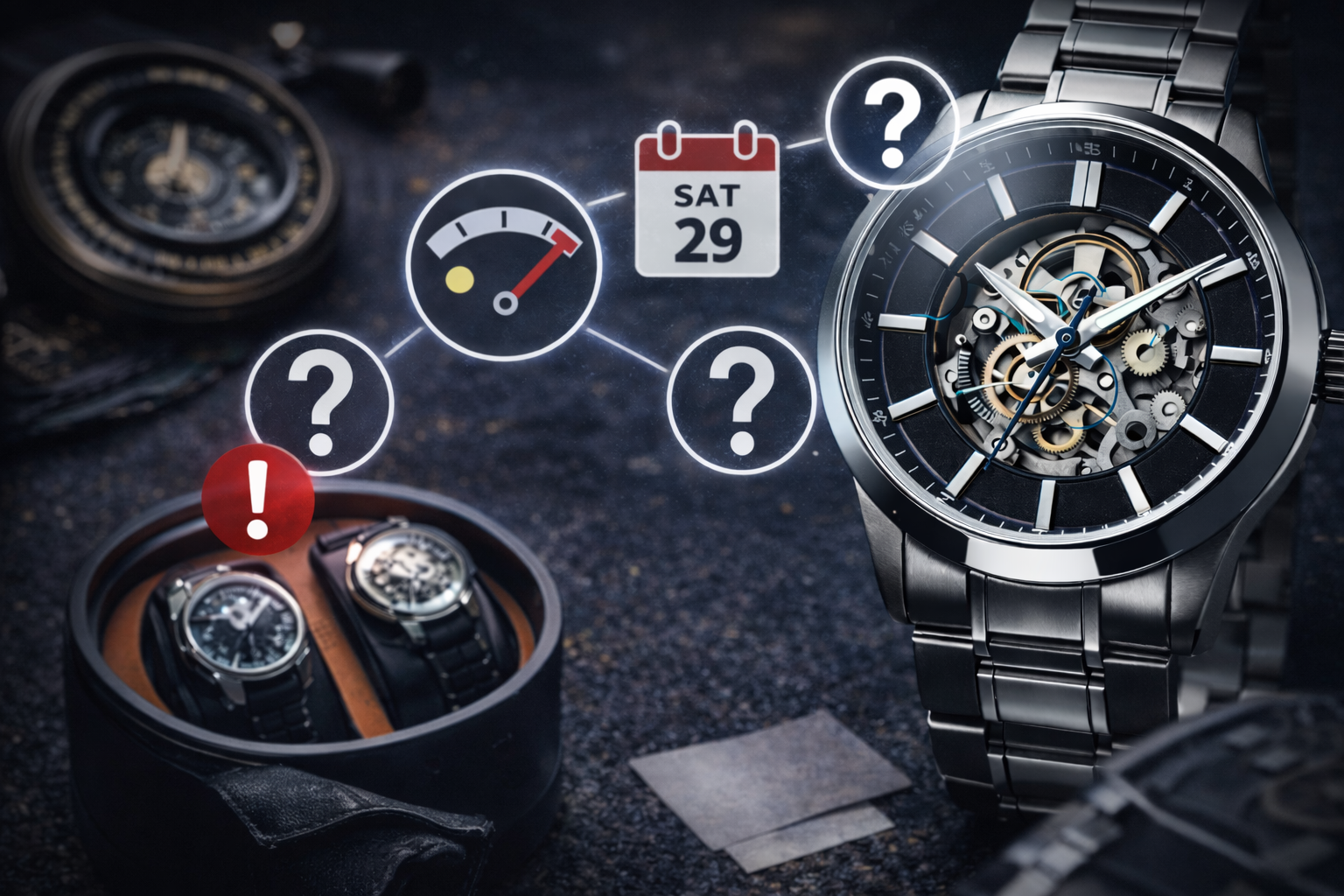
Quick Answer: How Long Can an Automatic Watch Run Off-Wrist?
Most automatic watches will run about 30–80 hours off-wrist (depending on the movement and how fully it’s wound). Some modern calibers can go longer, but if you leave an automatic watch untouched for a few days, it’s very likely to stop.
Want a simple explanation of what’s happening inside the case? Read: How Does an Automatic Watch Work? Simple Beginner Guide
What Is “Power Reserve” (And Why It Matters)
Power reserve is the amount of time a mechanical watch can run on stored energy after it’s fully wound.
-
In an automatic watch, energy is stored in the mainspring.
-
Wearing the watch moves the rotor, which winds the mainspring.
-
When you stop wearing it, the watch uses up that stored energy until it runs out.
This matters because it affects:
-
How often you’ll need to set the time/date
-
Daily consistency (many watches keep time best when not near empty)
-
Your overall experience with an automatic watch
If accuracy is your top concern, start with: Are Automatic Watches Accurate? Real-World Tolerances, Why They Drift & How to Improve Accuracy
Why Your Automatic Watch Stops (Even If You Wear It Sometimes)
1) You didn’t wind it enough
Many automatics benefit from a few manual winds to “top up,” especially if you’re starting from a dead stop.
2) Low-activity days don’t keep it fully wound
Desk days and light movement may not keep some watches optimally wound.
3) Short wearing time
Wearing it 1–2 hours may not be enough to build a healthy reserve depending on the movement.
4) The watch needs servicing
If lubrication is old or internal friction is high, the watch may not reach normal power reserve.
A practical care routine is here: How to Maintain an Automatic Watch: Daily Wear, Storage & Servicing
How to Prevent It From Stopping (Simple Fixes)
Fix #1: Give it a manual wind when you put it on
If it’s stopped, don’t rely only on wrist movement at the start. Wind it gently (if your watch supports manual winding) to get it running strongly.
Fix #2: Wear it longer on the first day back
If you’re switching watches, try to wear it for a longer block of time to rebuild reserve.
Fix #3: Store it consistently when not in use
How you place the watch overnight can affect both power reserve consistency and timekeeping.
Fix #4: Consider a watch winder (only for certain cases)
A winder can help if:
-
You rotate multiple watches frequently
-
The watch has a complication you don’t want to reset often (e.g., complex calendar)
-
You value convenience over simplicity
But many owners do not need one—manual resetting is normal mechanical-watch life.
Off-Wrist Runtime Guide (Quick Reference Table)
| Power Reserve (Typical) | What You’ll Experience | Best For |
|---|---|---|
| ~30–40 hours | Stops within 1–2 days off-wrist | Daily wear, simpler routine |
| ~50–70 hours | Often survives a weekend (maybe) | Rotating 2–3 watches |
| 80+ hours | Longer off-wrist time, fewer resets | Convenience-focused owners |
If It Stops: How to Restart and Set It Safely
-
Wind it gently (if supported) or wear it until it starts
-
Set the time
-
Set the date only when safe (avoid forcing date changes near the “danger zone” if your watch has one)
If you want a deeper foundation before you set anything, start with:
How Does an Automatic Watch Work? Simple Beginner Guide
Mechanical vs Quartz: If You Hate Resets
If you dislike resetting time/date, quartz might be a better match. If you enjoy mechanical craftsmanship and don’t mind occasional resets, automatic is the appeal.
Compare both here: Automatic Watch vs Quartz: Differences, Pros & Which to Choose
FAQ: Automatic Watches Stopping
Is it bad if my automatic watch stops?
No. It’s normal when power reserve runs out. It only becomes a concern if it stops too quickly even with normal daily wear.
How often should I wind an automatic watch?
If you wear it daily, you may never need to manually wind it. If you rotate watches, a small wind when you put it on can help.
Why does my automatic watch stop overnight?
Often it wasn’t fully wound or it has a shorter power reserve. If it used to last longer and suddenly doesn’t, servicing may be needed.
Will a watch winder damage my watch?
A quality winder used appropriately usually won’t, but it’s not necessary for most owners. Convenience is the main benefit.
Does a higher power reserve mean better accuracy?
Not always. But many movements keep time more consistently when they’re not near empty.