Watch Winder: Do You Need One? Pros, Cons, Best Use Cases & Safe Settings
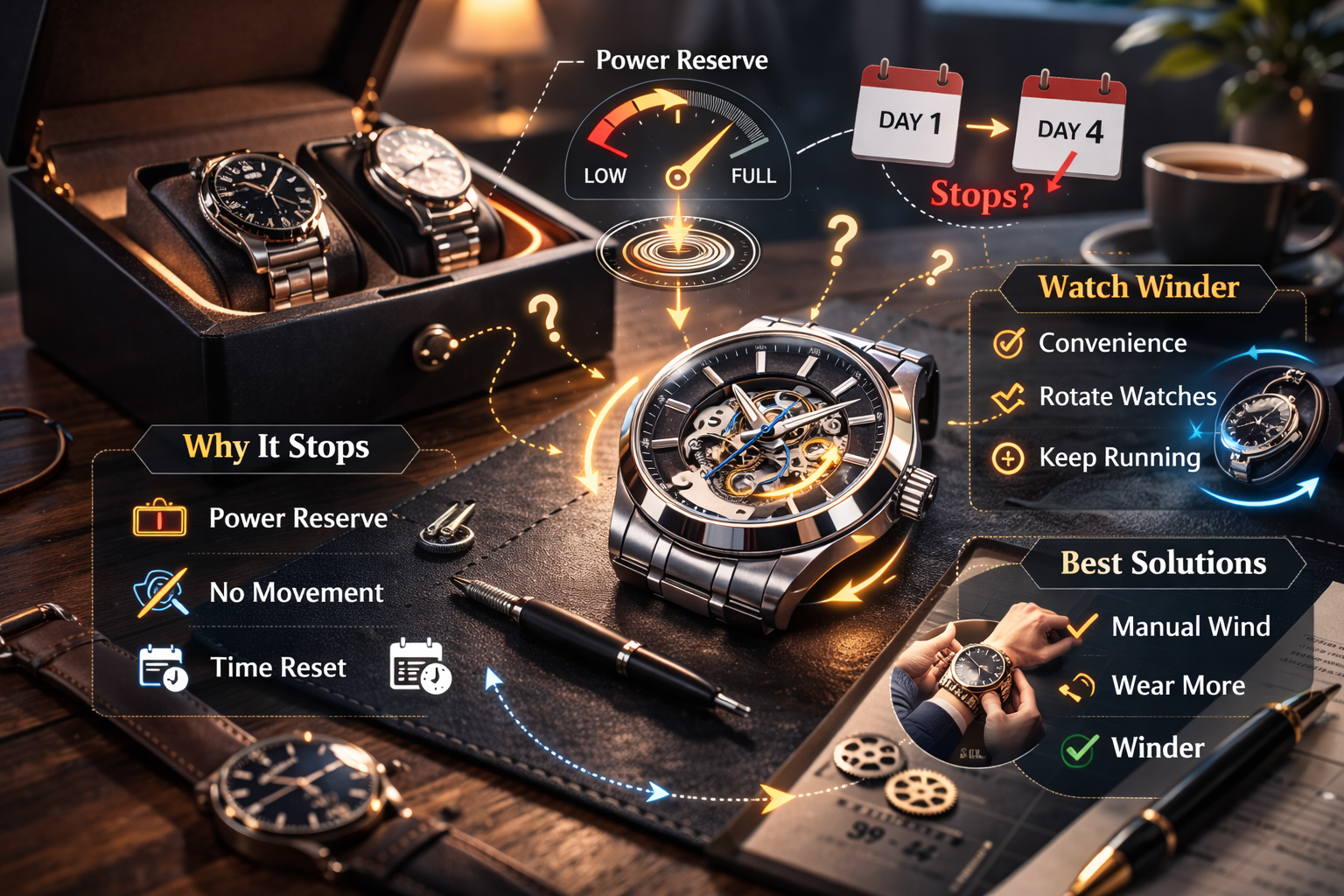 A watch winder can be convenient—but most automatic watch owners don’t actually need one. The right choice depends on your routine, your watch’s complications, and how often you rotate between watches.
If you’re new to mechanical watches, start here first: What Is an Automatic Watch? Pros, Cons & Who Should Buy One
Quick Answer
-
You probably don’t need a winder if you wear your watch regularly or don’t mind resetting the time/date.
-
A winder can be useful if you rotate multiple watches and your watch has complications you don’t want to reset often (especially certain calendar setups).
-
If your automatic watch stops when not worn, that’s normal—here’s why: Do Automatic Watches Stop If Not Worn? Power Reserve, Why It Happens & Easy Fixes
What a Watch Winder Actually Does
A winder gently rotates your automatic watch so the rotor winds the mainspring, helping the watch keep running while it’s off your wrist.
To understand the mechanics behind that, read: How Does an Automatic Watch Work? Simple Beginner Guide
When a Watch Winder Is Worth It (Best Use Cases)
1) You rotate multiple watches often
If you switch watches every day or two, a winder can reduce how often you reset.
2) You dislike frequent time/date resets
If your routine is “grab and go,” convenience may be worth it.
3) Your watch has a complication you don’t want to reset often
Some displays are simply annoying to re-set frequently (think: multiple indications that require several crown steps).
4) You track accuracy and prefer a consistent state of wind
Many movements keep time most consistently when they aren’t running near empty.
If accuracy is your priority, read: Are Automatic Watches Accurate? Real-World Tolerances, Why They Drift & How to Improve Accuracy
When You Do NOT Need a Watch Winder (Most People)
1) You wear your watch daily
Daily wear usually keeps it wound enough.
2) You only rotate occasionally
Resetting time/date once in a while is normal and not a problem.
3) Your watch has a simple date (or no date)
Simple resets are quick.
4) You prefer less mechanical “run time”
Some owners prefer letting a watch rest when not worn—less motion, less total running hours (not a guarantee of less wear, but many like the simplicity).
For a simple and safe routine, follow: How to Maintain an Automatic Watch: Daily Wear, Storage & Servicing
Does a Watch Winder Cause Extra Wear?
A winder keeps the watch running more hours, which can mean:
-
more total movement cycles
-
more time in motion for the rotor and gear train
But in practice, modern automatics are designed to run continuously when worn. The bigger risk is usually incorrect settings (too many turns per day) or a low-quality winder that jerks the watch.
Safe Winder Settings (Simple Rules)
If you don’t know your exact movement requirements, start conservatively.
Recommended starting point
-
Turns per day (TPD): 650–900
-
Direction: Bidirectional (if your winder supports it)
If the watch still stops
Increase gradually:
-
try 900–1200 TPD
-
test for 2–3 days
Avoid extremes
Running extremely high TPD constantly is usually unnecessary.
Tip: If your watch stays fully wound on-wrist, your winder doesn’t need to “overdo it” off-wrist.
Watch Winder Checklist (Before You Buy)
| Feature | Why It Matters |
|---|---|
| Quiet motor | Winders often sit in bedrooms/offices |
| Adjustable TPD | Helps prevent over-winding cycles |
| Direction control | Some movements prefer specific directions |
| Good pillow/holder | Prevents bracelet stress and slipping |
| Stable rotation | Smooth motion is better than jerky starts |
Winder vs Quartz: If Convenience Is Your Priority
If your main goal is never resetting time/date, quartz may be the better match (no winder needed).
Compare both here: Automatic Watch vs Quartz: Differences, Pros & Which to Choose
FAQ: Watch Winders
Will a watch winder overwind my automatic watch?
Most automatics have a slipping bridle that prevents true “overwinding.” The concern is more about unnecessary high TPD and extra run time.
Should I keep my watch on a winder all the time?
Only if you value maximum convenience. Many owners use a winder only during rotation periods.
Do I need a winder for a simple three-hand automatic?
Usually no—resetting is quick, and daily wear keeps it wound.
Is a winder necessary for accuracy?
Not necessary, but keeping a consistent state of wind can help stability on some movements.
What if I don’t use a winder—what’s the best alternative?
A simple routine: wind it a bit when you put it on, wear it longer on day one, store it safely.
Care guide here: How to Maintain an Automatic Watch: Daily Wear, Storage & Servicing