Rolex vs Omega: Which Brand Makes More Sense as Your First Luxury Watch?
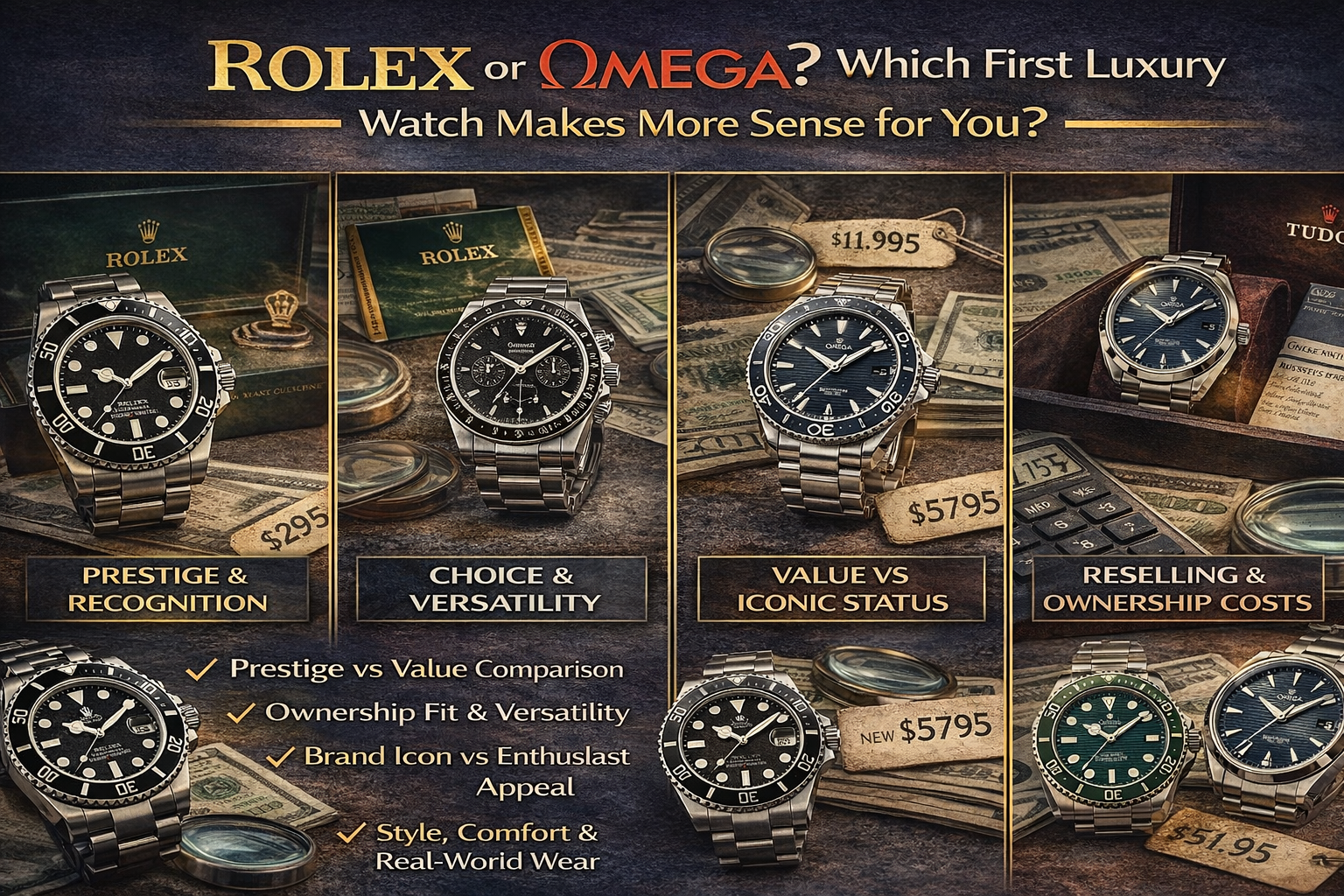 Rolex vs Omega: Which Brand Makes More Sense as Your First Luxury Watch?
If you are buying your first luxury watch, there is a good chance this is the comparison that keeps coming back.
Not because Rolex and Omega are identical. They are not. And not because every buyer is choosing between the exact same two models. They are not doing that either.
This comparison matters because Rolex and Omega sit at the center of the first serious luxury-watch decision for different reasons. Rolex is the brand many people think of first. Omega is the brand many buyers start looking at once they want to make a slightly more rational choice. One often feels more iconic. The other often feels more reachable, more varied, and sometimes better value for the money.
That is why this is not really just a brand comparison. It is a buyer psychology comparison.
Do you want the cleanest, most recognizable luxury-watch move? Or do you want the option that may give you more flexibility, more character, and sometimes less financial friction?
If you are deciding between Rolex and Omega as your first luxury watch, the smartest answer is not “Which brand is better?” It is “Which brand makes more sense for the way I actually dress, spend, travel, and wear a watch?”
Quick answer
Rolex usually makes more sense as a first luxury watch if you want maximum brand recognition, strong resale confidence, and a watch that feels easy to understand in the market. Omega usually makes more sense if you want more variety, better access at a lower price, stronger value per dollar, and a first luxury watch that feels a little less obvious. Rolex is often the safer prestige choice. Omega is often the smarter enthusiast choice. The right answer depends on whether you care more about status clarity or ownership value.
Why this comparison matters so much for first-time buyers
A first luxury watch is almost never just a watch.
It is usually part reward, part self-image, part financial decision, and part long-term experiment. You are not just buying steel, sapphire, and a movement. You are choosing the kind of ownership experience you want to live with.
That is why buyers get stuck here. Rolex and Omega can both lead to a satisfying first purchase, but they satisfy different instincts.
Rolex often appeals to the buyer who wants confidence. The designs are familiar, the market is easy to understand, and the brand signal is immediate. Omega often appeals to the buyer who wants substance with a little more breathing room. There is usually more room to explore different case shapes, dial personalities, and entry points without feeling locked into one narrow kind of luxury.
Before comparing brands, it helps to get honest about what you want from a daily watch in the first place. That is exactly why Best Everyday Automatic Watch Features: 8 Specs That Matter More Than Marketing is worth reviewing first. A luxury watch decision gets easier when you know whether you actually care most about comfort, thickness, bracelet quality, water resistance, legibility, or brand identity.
Rolex’s biggest strength: instant clarity
Rolex is powerful because it is simple in the mind.
Even people who know almost nothing about watches understand that Rolex is a luxury watch brand. That kind of instant recognition is rare, and it matters more than enthusiasts sometimes like to admit.
For a first-time buyer, that clarity can feel reassuring. You are less likely to wonder whether you made the “wrong” choice because the brand is already culturally validated. A Datejust, Submariner, Oyster Perpetual, or Explorer does not require much explanation. The design language is established, the resale market is well understood, and the ownership story feels easy to tell.
That is a real advantage, especially if this is your first step into watches and you do not want a complicated decision.
Rolex also tends to work well for buyers who want one watch that covers a lot of ground. That idea overlaps naturally with the logic behind Dress Watch vs Everyday Watch: What’s the Real Difference and Which Should You Buy First?, because Rolex has several references that sit right in the sweet spot between dressy enough and casual enough.
Omega’s biggest strength: breadth and value
Omega feels different.
Where Rolex often wins on instant brand signal, Omega often wins on choice. The brand gives buyers more room to decide what kind of luxury watch they want to live with. A Seamaster is not an Aqua Terra. An Aqua Terra is not a Speedmaster. A Constellation is not a De Ville. Even within those families, the watches can feel quite different on wrist.
That matters for a first-time buyer because many people do not actually want “a luxury watch.” They want a specific kind of luxury watch. Maybe they want something sporty but clean. Maybe they want something technical but not flashy. Maybe they want heritage without the pressure of the most obvious luxury logo in the room.
Omega often gives you more ways to solve that problem.
It also tends to make sense for buyers who want to maximize what they get for the money. That does not mean Omega is cheap. It means buyers often feel they are paying a little more for the watch itself and a little less for the pure status premium around it.
The real question: what kind of first luxury watch are you trying to buy?
This is the point where the comparison becomes useful.
If you want your first luxury watch to feel like a universally recognized milestone purchase, Rolex makes a lot of sense. If you want your first luxury watch to feel more personal, more exploratory, or more value-conscious, Omega often becomes very attractive.
The difference becomes clearer when you think in wearing scenarios instead of brand slogans.
If you want one polished watch for office wear, dinners, travel, and weekends, Rolex has a very strong argument. If you want a watch that feels a little more individual, a little less expected, and often easier to buy into, Omega may feel more natural.
That is also why case size and wearability matter so much here. A first luxury watch that technically fits your budget but never feels right on your wrist will lose its magic fast. If you are still narrowing down what size range actually suits you, Automatic Watch Size Guide: 36mm vs 38mm vs 40mm vs 42mm — What Actually Fits Your Wrist? is a smart reset before you decide that the “best” Rolex or Omega is automatically the best one for you.
Rolex usually wins if you care most about these four things
1) You want the cleanest luxury signal
This is the simplest reason people buy Rolex. They do not want ambiguity. They want a watch that the wider world already understands as successful, established, and desirable.
That is not shallow. It is just honest.
2) You want strong market confidence
A lot of first-time buyers worry about making an expensive mistake. Rolex feels safer because demand, recognition, and resale understanding are so strong. Even if you later change your taste, the path out usually feels clearer.
3) You want a one-watch answer
A well-chosen Rolex can often serve as a practical one-watch collection. If that is your goal, the logic overlaps with the thinking behind One-Watch Collection Explained: How to Choose the Single Automatic Watch You’ll Actually Keep Wearin, because the first luxury watch often becomes the watch you rely on most.
4) You want the watch to feel quietly inevitable
This is hard to explain, but many Rolex buyers are not looking for surprise. They are looking for a watch that feels like the obvious, polished, low-regret move.
Rolex is often very good at that.
Omega usually wins if you care most about these four things
1) You want more watch variety within one brand
Omega gives buyers more personality choices. Sporty, dressy, technical, vintage-inspired, modern, restrained, bold — there is more room to choose your angle.
2) You want stronger value per dollar
Many buyers looking at Rolex eventually ask themselves a hard question: “Am I paying for the watch, or am I paying for the Rolex effect?” Omega often feels more balanced on that front.
3) You want something a little less expected
There is something attractive about wearing a serious luxury watch that does not feel like the default answer. Omega often appeals to buyers who want legitimacy without feeling overly predictable.
4) You care about the enthusiast side of ownership
Some buyers enjoy the brand story, movement discussion, design nuance, and technical personality of a watch as much as the social signal. Omega often feels especially strong there.
Style and wardrobe: which brand actually fits your life better?
This part matters more than many first-time buyers expect.
A watch can be impressive and still feel wrong if it does not match the way you actually dress. Someone who wears tailoring, knitwear, and cleaner office clothes may respond very differently to a watch than someone who lives in T-shirts, denim, polos, and sportier layers.
Rolex tends to excel at polished versatility. Many of its best-known models feel balanced, tight, and socially adaptable. Omega tends to give you more variation in mood. Some models feel more technical, more expressive, or more obviously sporty.
That is why you should not compare brands in the abstract. Compare them against your own clothes and habits.
A practical example helps. A buyer who wears a shirt or knitwear four days a week and wants one watch for meetings, weekend trips, and occasional formal settings may find a Datejust or Oyster Perpetual easier to live with than a larger, sportier Omega diver. But a buyer who dresses casually most of the time, enjoys a bit more wrist presence, and wants a watch that feels less corporate may connect more easily with an Aqua Terra or Seamaster.
If you are still figuring out whether your long-term taste leans cleaner or more functional, Tool Watch vs Dress Watch: Which One Fits Your Lifestyle Better? is useful before you reduce the whole decision to brand alone.
Daily comfort matters more than prestige after the first week
This is where luxury-watch decisions become real.
The first week is about excitement. The next three years are about comfort, routine, and how often the watch actually gets wrist time. Bracelet feel, case thickness, clasp quality, balance, and overall weight matter a lot once the honeymoon phase passes.
That is one reason a first luxury watch should not be chosen only by reputation. It should also be chosen by how it lives on your wrist from morning to evening.
This is especially important when comparing watches in steel. Some buyers love the planted, substantial feel of a heavier watch. Others get tired of it fast and realize they care more about lightness and all-day ease than they expected. If that part of the equation still feels abstract, Titanium vs Stainless Steel Watches: Weight, Comfort, Durability & Which One Feels Better Daily is helpful because it forces you to think about physical ownership, not just visual desire.
Bracelet versus strap can also shift the whole decision. A buyer who thinks they want a bracelet-first luxury watch may realize later that a leather-ready model or more flexible strap option fits their life better. That is why Bracelet Watch vs Leather Strap Watch: Which One Is Better as Your First Automatic? is more relevant to this decision than it might first appear.
The dial question: Rolex simplicity or Omega variety?
A first luxury watch lives in your field of vision all day, which means dial design matters more than internet rankings suggest.
Rolex generally wins on calm, highly legible, proven dial language. Omega often gives buyers more dial personality, more texture options, and sometimes more visual complexity depending on the model.
This is where buyer temperament matters.
If you want the dial to feel timeless, restrained, and easy to wear with anything, Rolex often has the advantage. If you want the dial to feel a little more expressive, technical, or visually rich, Omega may be more satisfying.
That logic is similar to the choice many buyers make when comparing Black Dial vs White Dial Watch: Which One Is More Versatile for Everyday Wear?. Some people want easy versatility. Others want a little more personality. Neither instinct is wrong, but they usually point toward different watches.
The same goes for date complications. Some buyers want the cleanest dial possible. Others feel that a first luxury watch should be genuinely useful in day-to-day life. If you are torn there, Date Window vs No-Date Watch: Which One Is Better for Everyday Wear? is worth thinking through before comparing brands too abstractly.
A practical buying scenario
Imagine two buyers with roughly the same budget.
Daniel wants his first luxury watch to mark a promotion. He wants something he can wear to the office, on flights, to dinners, and on weekends without ever feeling like he chose the “wrong” watch. He likes cleaner proportions, quiet confidence, and the idea that ten years from now the watch will still make immediate sense.
For Daniel, Rolex probably makes more sense.
Now imagine Chris. He cares about watches, but he also dislikes obvious decisions. He wants a serious brand, but not necessarily the most expected one. He is open to more design personality, likes the idea of stronger value, and enjoys the enthusiast side of ownership. He wants the watch to feel like his decision, not just the market’s decision.
For Chris, Omega may be the better first luxury move.
Both buyers can be right. The important thing is that they are solving different emotional problems.
What about maintenance and long-term ownership?
This is where the conversation often becomes more practical.
A first luxury watch should not just look right on day one. It should feel manageable over time. Servicing, water resistance, magnetism, accuracy expectations, and general durability all matter once the purchase moves from fantasy into routine ownership.
That is why buyers should think beyond the brand aura and ask themselves whether they are prepared for mechanical ownership in general. If this still feels new, How Often Should You Service an Automatic Watch? Intervals, Costs, Warning Signs & What to Expect, Watch Magnetism: Signs Your Watch Is Magnetized, How to Test It, and Are Automatic Watches Accurate? Real-World Tolerances, Why They Drift & How to Improve Accuracy are all worth reading before you spend luxury-watch money and assume ownership will be frictionless.
This is not a reason to avoid Rolex or Omega. It is a reason to make sure you are buying with adult expectations rather than pure excitement.
What if you are tempted by the brand, not the watch?
This happens all the time.
A buyer says they want a Rolex, but when you ask what kind of watch they actually want, the answer becomes vague. Another says they are leaning Omega, but what they really mean is that they want something luxurious without looking too obvious.
That is why the most useful question is often this: if the dial were covered, which watch shape, size, and wearing experience would you actually prefer?
If your answer changes once the logo disappears, that tells you something important.
Brand matters. Of course it does. But if your first luxury watch is going to live on your wrist rather than in a spreadsheet, the watch itself has to be good for you before the brand can matter in a healthy way.
Which brand makes more sense financially?
Rolex usually feels more financially secure in the mind because the market is so clear and the demand story is so established. That can make a first buyer feel more comfortable.
Omega often feels more financially rational in the purchase itself because buyers frequently feel they are getting more watch relative to what they paid.
Those are different kinds of financial comfort.
Rolex comfort often comes after the purchase: “I can understand what this is worth.” Omega comfort often comes during the purchase: “This feels like strong value right now.”
Again, neither instinct is wrong. It depends on which kind of peace of mind matters more to you.
A simple decision test
If you are still stuck, use this quick test.
Choose Rolex if these sentences sound more like you:
- I want the safest luxury-watch answer.
- I care about broad recognition and long-term confidence.
- I want one watch that feels immediately validated.
- I would rather make the obvious strong choice than the interesting maybe-better-value choice.
Choose Omega if these sentences sound more like you:
- I want more room to choose a watch that fits my exact taste.
- I care about value, variety, and enthusiast appeal.
- I do not need my first luxury watch to be the most obvious luxury watch.
- I would rather buy the watch that feels smartest for me than the brand that feels easiest for everyone else to understand.
Final verdict
If your top priority is prestige clarity, brand recognition, and a first luxury watch that feels easy to justify from every angle, Rolex usually makes more sense.
If your top priority is variety, value, and choosing a watch that feels a little more personal and less automatic, Omega often makes more sense.
The truth is that neither brand wins universally. They simply win for different kinds of first-time buyers.
Rolex is often the cleaner answer. Omega is often the more thoughtful answer.
The smartest move is to stop asking which brand is better in general and start asking which brand solves your specific first-luxury-watch problem with the least regret.
FAQ
Is Rolex always the better first luxury watch because it holds value better?
Not always. Strong resale confidence matters, but it is only one part of ownership. A first luxury watch should still fit your style, comfort preferences, and daily life.
Is Omega a better value than Rolex?
For many buyers, yes. Omega often feels stronger on value per dollar, especially for buyers who care as much about the watch itself as the social signal around the brand.
Which brand is more versatile for everyday wear?
That depends more on the specific model than the logo alone, but Rolex often feels more naturally all-round in a polished, one-watch sense. Omega offers more variation, which can be a strength if you know exactly what kind of everyday watch you want.
Should my first luxury watch be sporty or dressy?
That depends on your wardrobe and habits. Buyers who want maximum flexibility should think carefully about where they sit between dress and tool-watch preferences before choosing a brand.
Is Omega the smarter choice for watch enthusiasts?
Often, yes. Omega tends to appeal strongly to buyers who enjoy variety, technical character, and a slightly less predictable luxury-watch path.