Titanium vs Stainless Steel Watches: Weight, Comfort, Durability & Which One Feels Better Daily
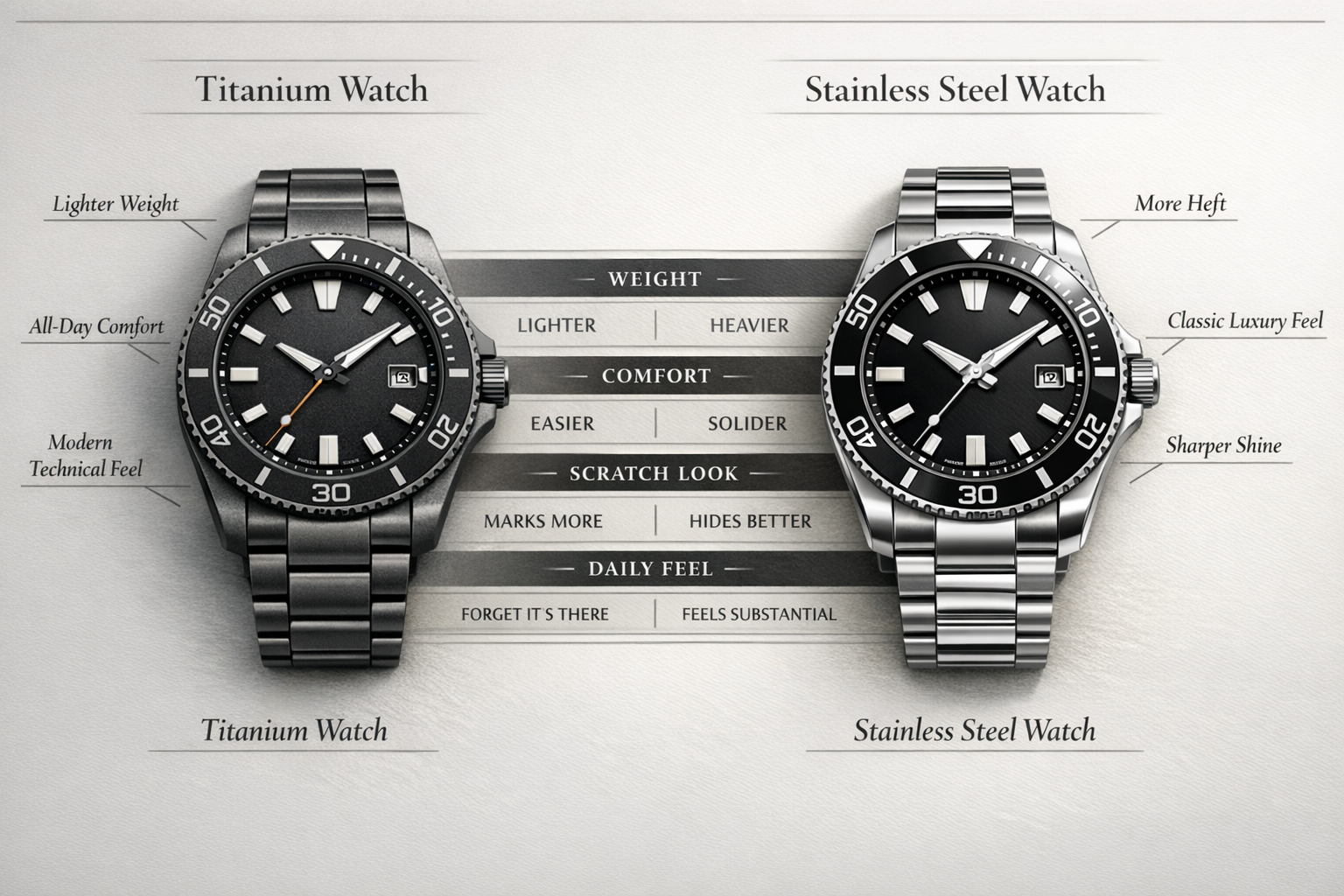 A lot of watch buyers think they are choosing between two metals.
In real life, they are usually choosing between two wearing experiences.
That is why the titanium vs stainless steel debate matters more than it first appears. On a spec sheet, the difference looks simple: titanium is lighter, stainless steel is heavier. But once you actually wear both, the decision becomes much more personal.
One watch may feel reassuring and substantial.
The other may feel easy, airy, and much more comfortable after a full day on the wrist.
So here is the practical answer first:
Choose titanium if you care most about low weight, all-day comfort, and a more effortless wearing experience. Choose stainless steel if you prefer a more solid feel, stronger visual sharpness, and the classic watch look most buyers already know.
That is the short version. But the better answer depends on how you dress, how long you wear your watch each day, and whether you care more about comfort, scratch appearance, or overall feel.
If you are still early in the buying process, it helps to start with What Is an Automatic Watch? Pros, Cons & Who Should Buy One and Automatic Watch vs Quartz: Differences, Pros & Which to Choose. But if your real question is “which metal will I actually enjoy wearing more every day,” this guide is the practical version.
The short answer: which feels better daily?
For most people:
- Titanium feels better on the wrist
- Stainless steel often looks more familiar and more substantial
That is why this is not just a material question. It is a personality question.
Titanium usually wins on:
- weight
- long-day comfort
- hot-weather wear
- “forget it’s there” ease
- larger watches that would otherwise feel heavy
Stainless steel usually wins on:
- heft and perceived solidity
- classic luxury feel
- sharper finishing contrast
- scratch appearance on many watches
- value familiarity for first-time buyers
So if you want the simplest buying rule:
If comfort is your top priority, start with titanium. If you like a watch to feel solid and traditional, start with stainless steel.
What titanium watches feel like in real life
The first thing most people notice is not the look. It is the lack of weight.
You put on a titanium watch, especially if you are used to steel, and your immediate reaction is often something like:
“Wow, that’s lighter than I expected.”
Some people love that instantly. Others need a few days to adjust because they associate weight with quality. But once you wear a titanium watch through a full workday, commute, dinner, and evening, the appeal becomes very clear.
Titanium often feels:
- easier on the wrist
- less tiring in hot weather
- better balanced over long hours
- especially good on larger sports watches
That makes it very attractive for buyers who want a watch they can wear from morning to night without constantly noticing it.
What stainless steel watches feel like in real life
Steel feels more familiar to most buyers because it is still the default material for so many watches.
A stainless steel watch often feels:
- more substantial
- denser
- more traditional
- more “watch-like” in the classic sense
That does not mean it is less comfortable. A well-sized steel watch can be extremely comfortable. But it usually reminds you that it is there more than titanium does.
Some owners actually prefer that.
A certain amount of weight can make a watch feel reassuring, serious, and well-made. That feeling matters, especially in categories where the emotional side of ownership is strong.
If you like watches because they feel mechanical, substantial, and intentional, steel may still be the more satisfying material.
Titanium vs stainless steel: the real-life comparison
Let’s break it down in the way buyers actually experience it.
| Category | Titanium | Stainless Steel |
|---|---|---|
| Weight | Much lighter | Heavier |
| Daily comfort | Excellent for long wear | Good, but more noticeable |
| Wrist fatigue | Lower | Higher on larger watches |
| Look | Slightly darker, more muted | Brighter, more classic |
| Scratch behavior | Can mark more easily on some watches | Often hides daily wear better |
| Luxury feel | Modern, technical, understated | Traditional, substantial |
| Best for | Comfort-first buyers, larger watches, active wear | Classic all-round buyers, dressier everyday wear |
| First impression | “Light” | “Solid” |
That chart covers the basics. But the real decision happens in the details.
Weight: the biggest difference, and the one you feel immediately
This is the easiest difference to understand.
Titanium is lighter, and that changes daily wear more than most spec-sheet features do.
If two watches are the same size, the titanium version will usually feel:
- less top-heavy
- less tiring over time
- more natural on smaller wrists
- easier to wear in warm weather
This is especially relevant for sports watches, divers, and anything on a bracelet. A larger steel watch can feel great in the first 15 minutes and then become more noticeable by late afternoon. A titanium watch often keeps the same easy feel all day.
That is why titanium can be a surprisingly smart choice in categories that tend to run bigger, especially if you already know you like the look of tool watches but do not love the weight that usually comes with them.
If you tend to like more rugged daily pieces, that overlaps with the same kind of buyer who often ends up browsing Best Automatic Dive Watches Under $1000: Durable, Reliable & Built for Adventure or Best Automatic Field Watches Under $1000: Rugged, Minimal & Built to Last.
Comfort: what feels better after 10 hours, not 10 minutes
This is where titanium earns its reputation.
A lot of watches feel fine when you first try them on. The better comfort test is whether they still feel fine after a full day.
Titanium usually performs better here because lower weight reduces the small annoyances that build over time:
- less downward pull on the wrist
- less bracelet movement fatigue
- less awareness during typing, walking, or commuting
- less discomfort in summer
For people who wear one watch all day, every day, this matters a lot.
If you are the kind of buyer who wants one easy daily automatic, comfort may matter more than movement specs, and definitely more than marketing language. That is why many first-time owners do best by starting with practical guides like Best Automatic Watches for Beginners: Top Picks & Buying Tips rather than chasing prestige terms too early.
Durability: which one actually holds up better?
This is the part buyers often oversimplify.
They assume heavier means tougher, or lighter means weaker. Real ownership is more nuanced than that.
Stainless steel
Steel often feels tougher because it is heavier and more familiar. It also tends to maintain a crisp, classic appearance that many people associate with durability.
Titanium
Titanium is absolutely durable enough for serious daily wear. In fact, one reason it is so popular in tool-oriented applications is that it offers strong performance with much less weight.
But the real-world question is not only “which one is durable?”
It is also “how does wear show up?”
That is where buyers need to think a little more practically.
Scratches: which one looks better after months of normal wear?
This is one of the most important ownership questions.
Because durability is not just about surviving impact. It is also about how a watch ages visually.
Stainless steel and scratches
Steel often develops small desk-diving marks and hairlines over time, but many buyers find these more familiar and easier to accept. On some finishes, they blend into normal use reasonably well.
Titanium and scratches
Titanium can show wear differently. Depending on the grade and finish, it may pick up marks that are more visible to some eyes, especially if the owner expects the surface to stay pristine.
That does not mean titanium ages badly. It means it ages with a different visual character.
A lot of owners who love titanium stop caring after a few weeks, because the comfort advantage is so strong. But if you are the kind of person who inspects your watch under direct light and fixates on surface marks, steel may feel emotionally easier to live with.
Appearance: titanium looks more modern, steel looks more classic
This is another difference people notice more in person than online.
Titanium often has:
- a darker tone
- a softer grey look
- a more technical, subdued presence
- a less shiny overall feel
Stainless steel usually has:
- a brighter look
- stronger polished/brushed contrast
- a more traditional watch-luxury appearance
- more visual crispness on many cases and bracelets
So if your taste leans clean, modern, understated, and slightly tool-like, titanium can be very appealing.
If your taste leans classic, versatile, and a little more refined, steel still has a powerful advantage.
This becomes especially relevant if you want a watch that needs to work with office wear, dinners, and smarter clothing. Buyers leaning dressier often naturally prefer the kind of feel and look seen in Best Automatic Dress Watches Under $1000: Elegant Picks for Formal Style.
Real-world buyer case #1: the desk worker who wears one watch all day
Let’s say someone wears a watch from 8 a.m. to 10 p.m. most days. They work at a desk, commute, spend time on a laptop, and want a watch they do not have to think about physically.
For this buyer, titanium often feels better.
Why? Because the advantage is not dramatic in the first five minutes. It shows up in the seventh hour.
By late afternoon, the lighter case and bracelet usually feel easier. Less wrist fatigue. Less awareness. Less need to adjust the watch position.
If comfort is the entire point of the purchase, titanium is hard to ignore.
Real-world buyer case #2: the buyer who equates weight with quality
This buyer tries on a titanium watch, then a steel watch, and immediately says:
“The steel one feels better made.”
What they usually mean is: the steel one feels heavier.
That reaction is common, especially for first-time buyers. And it is not irrational. Weight often creates a sense of value and solidity.
For this buyer, steel may genuinely be the better choice—not because it is objectively better, but because it matches what they want emotionally from ownership.
The wrong move here is forcing yourself into titanium if you know you enjoy heft.
Real-world buyer case #3: the larger sports-watch buyer
This buyer likes bigger watches: divers, field-style pieces, travel watches, or chunkier everyday models. They love the look, but sometimes steel watches in that size range feel a bit too heavy after long wear.
This is where titanium becomes extremely compelling.
A larger watch that might feel borderline in steel can suddenly feel easy in titanium. The size still looks strong, but the wearing experience becomes much more relaxed.
That is one of the best real-life arguments for titanium.
Which one is better for hot weather?
Titanium usually wins.
In warmer weather, people tend to notice weight more. A lighter watch is often more comfortable when your wrist is slightly swollen, your skin is warmer, or you are moving more.
That does not mean steel becomes uncomfortable. But if you live in a warm climate or plan to wear the watch all summer, titanium’s comfort advantage becomes easier to appreciate.
Which one is better for smaller wrists?
Titanium often has the edge, especially when the watch is not small.
For smaller wrists, the issue is not just case diameter. It is total wearing mass. A steel watch can technically fit but still feel more dominant than you want. Titanium reduces that problem.
That said, material does not replace sizing. A badly proportioned light watch can still wear poorly. Fit still comes first, which is why buyers should always think about size before materials, budget before hype, and daily use before spec-sheet bragging.
Practical operation: how to compare titanium and steel the right way
If you are choosing between the two, do not rely only on product photos. Use this five-minute test.
Step 1: hold both watches in your hand
Before you even strap them on, notice your immediate reaction. Which one feels more appealing? Some buyers instantly prefer the lightness of titanium. Others instantly prefer the heft of steel.
Step 2: put each one on for at least two full minutes
Do not just glance at the mirror. Move your wrist. Let the bracelet settle. Rest your arm naturally.
Step 3: type or simulate desk movement
This is where comfort differences often show up. Does one watch slide more? Does one feel heavier on the outside of the wrist?
Step 4: check the emotional response
Ask yourself:
- Does this feel reassuring?
- Does this feel too heavy?
- Does this feel premium?
- Does this feel effortless?
Step 5: imagine the seventh hour, not the first minute
This is the most important one. Which watch would you rather still be wearing after a full workday, dinner, and evening?
That is usually the better choice.
Which one is better for first-time buyers?
For many first-time buyers, stainless steel is still the safer default.
Why?
Because it is familiar, versatile, easy to understand visually, and widely available across styles and budgets. It also fits very naturally into the kind of options buyers compare in Best Automatic Watches by Budget: $300 vs $500 vs $1000 — How to Choose the Right One.
But safer does not always mean better.
If a buyer already knows comfort matters more than heft, titanium can actually be the smarter first purchase. It often solves a problem many people do not even realize they have until after months of wearing a heavier watch.
Which one feels more luxurious?
This depends on what “luxury” means to you.
Steel luxury feels like:
- density
- polish
- shine
- classic prestige
- visual sharpness
Titanium luxury feels like:
- modern engineering
- understated confidence
- technical sophistication
- comfort-first design
- less obvious flash
So steel feels more traditionally luxurious. Titanium often feels more quietly premium.
Neither is wrong. They just speak different visual languages.
Maintenance and long-term ownership
Neither material removes the need for normal watch care.
You still need to:
- keep the watch clean
- rinse it after saltwater exposure if appropriate
- pay attention to bracelet fit
- service the movement when needed
- store it sensibly
That bigger ownership picture matters more than many new buyers expect. If you want the long-term practical side, How to Maintain an Automatic Watch: Daily Wear, Storage & Servicing and How Long Do Automatic Watches Last? Lifespan, Durability, and What Really Determines Longevity are worth reading alongside any material comparison.
Common buyer mistakes
1. Assuming lighter means cheaper
It does not. Titanium often feels lighter, but that is the point—not a flaw.
2. Assuming heavier means better
Not always. Heavier may feel more substantial, but it can also feel more tiring.
3. Ignoring your daily routine
A watch that feels great for ten minutes in a store may feel very different after ten hours.
4. Choosing based only on specs
Material choice is deeply physical. You really need to think about feel, not just numbers.
What should most buyers choose?
Here is the most honest recommendation.
Choose titanium if:
- comfort is your top priority
- you wear your watch for long hours
- you prefer lighter sports watches
- you have a smaller wrist and want less wrist fatigue
- you like understated, technical style
Choose stainless steel if:
- you like a solid, substantial feel
- you want a classic all-round watch material
- you prefer brighter, sharper visual finishing
- you are buying your first automatic and want the safest default
- you emotionally enjoy heft
Choose based on style category too
- For sporty, larger, more active watches, titanium often makes more sense
- For classic everyday or dress-leaning pieces, steel often feels more natural
A 30-second buying checklist
If you are stuck between the two, use this:
Pick titanium if your main thought is:
“I want to forget I’m wearing it.”
Pick steel if your main thought is:
“I want it to feel solid and substantial.”
That one question gets surprisingly close to the right answer.
FAQ
Is titanium better than stainless steel for watches?
Not universally. Titanium is usually better for comfort and lightness. Stainless steel is usually better for buyers who want heft, classic feel, and a more traditional appearance.
Do titanium watches feel cheap because they are light?
Not to everyone. Some first-time buyers may read lightness that way at first, but many owners quickly realize the low weight is a major comfort advantage, not a quality issue.
Which scratches more easily, titanium or stainless steel?
In daily life, titanium can show wear differently and may bother buyers who are very sensitive to surface marks. Stainless steel often feels easier for some owners to live with visually.
Is titanium better for daily wear?
For many people, yes—especially if all-day comfort matters. But buyers who prefer heft may still enjoy steel more.
Which is better for a larger watch?
Titanium often makes more sense for larger watches because it reduces wrist fatigue and makes the watch easier to wear over long periods.
Which is more luxurious, titanium or stainless steel?
Steel usually feels more traditionally luxurious. Titanium often feels more modern, technical, and quietly premium.
Final verdict
If you want the simplest real-world answer:
- Titanium feels better if comfort is the goal
- Stainless steel feels better if substance is the goal
Titanium is usually the smarter pick for buyers who want lightness, ease, and long-day wearability.
Stainless steel is usually the better pick for buyers who want classic watch character, reassuring heft, and the traditional feel most people already associate with quality.
So the real question is not “which metal is better?”
It is:
Do you want your watch to feel lighter, or do you want it to feel more solid?
That is the choice you actually live with.