Rolex Explorer 36 vs 40: Which Size Actually Wears Better?
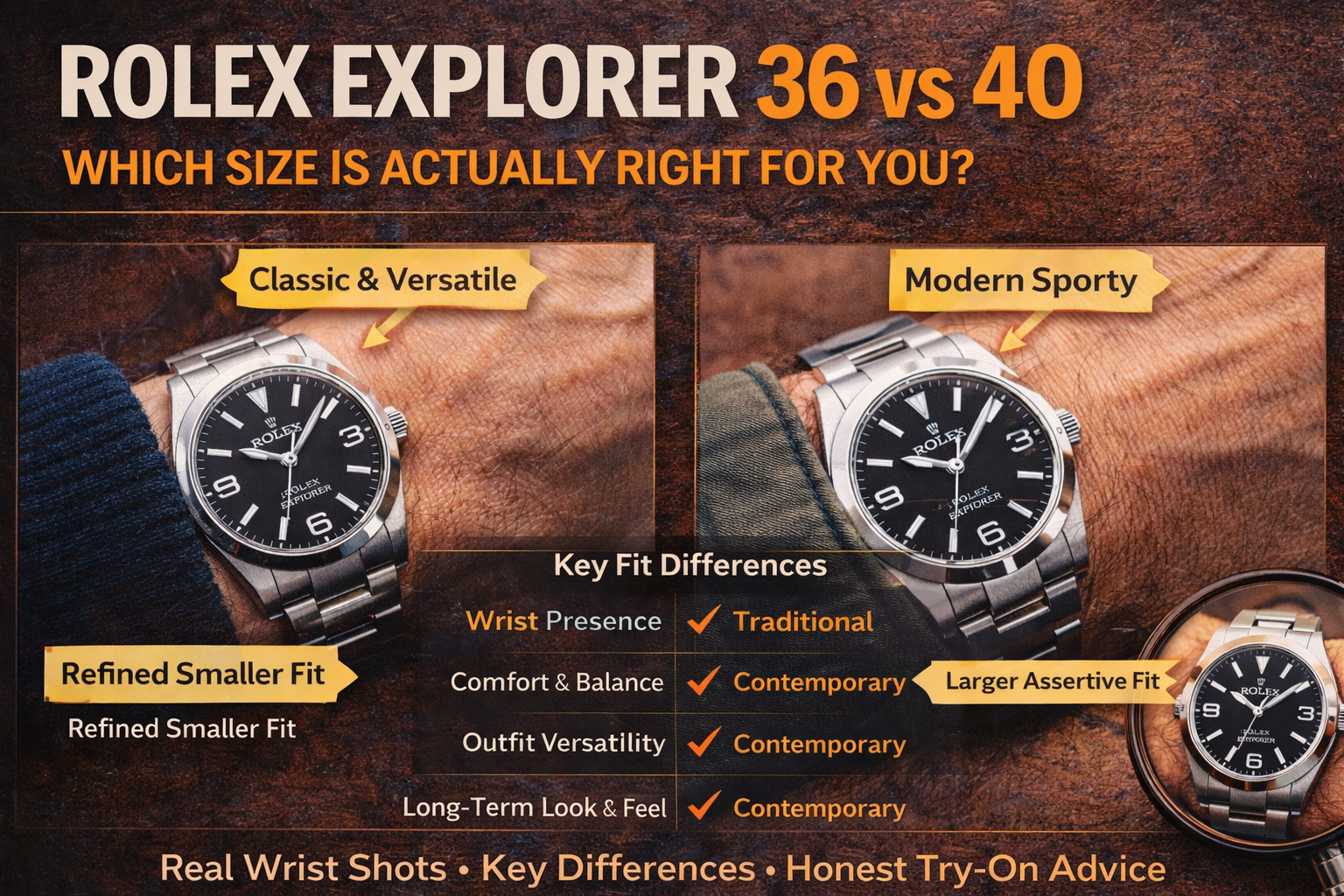
The Rolex Explorer is one of those rare watches that becomes more complicated the simpler it looks.
On paper, the choice seems easy. One is 36 mm. One is 40 mm. Same basic design, same black dial, same smooth bezel, same Oyster bracelet, same movement family, same no-date layout. Rolex currently offers the Explorer in those two sizes, and both steel versions use calibre 3230 with approximately 70 hours of power reserve, 100 metres of water resistance, and the brand’s Easylink-equipped Oyster bracelet.
In real life, though, this is not a spec-sheet decision.
It is a wearing decision.
That is why so many buyers get stuck. They do not actually want to know which Explorer is “better.” They want to know which one will feel right when they put it on at 8 a.m., look down at it all day, wear it with a T-shirt on Saturday, a knit sweater on Sunday, and a jacket on Monday.
And that answer is not the same for everyone.
The short version is this: the Explorer 36 usually wears better if you want the most classic, versatile, and long-term elegant version of the Explorer idea. The Explorer 40 usually wears better if you want more dial presence, a stronger sport-watch feel, and a more contemporary look on the wrist.
But that still leaves the actual buying question: which one wears better for you?
That is what this guide is for.
Why this choice is harder than it looks
The Explorer is not like choosing between two wildly different watches.
You are not deciding between a diver and a dress watch. You are not deciding between steel and gold. You are not even deciding between bracelet and strap.
You are deciding between two very similar watches where a small numerical change creates a surprisingly large emotional difference.
Rolex itself frames the current Explorer as available in 36 mm, identical to the original model, or in a 40 mm version, while keeping the same essential identity of the line.
That is exactly why this comparison matters.
The 36 is not just “smaller.” It feels more faithful, more discreet, and often more refined.
The 40 is not just “bigger.” It feels broader, more assertive, and usually more overtly sporty.
Neither one is wrong. But they do not land the same way on the wrist.
First, what is actually the same?
Before talking about fit, it helps to remove the distractions.
For the current steel Explorer 36 and Explorer 40, Rolex gives you the same core recipe: black dial, the characteristic 3-6-9 numerals with Chromalight display, smooth bezel, Oystersteel case, Oyster bracelet, Oysterlock clasp, Easylink comfort extension, calibre 3230, about 70 hours of power reserve, and 100 m / 330 ft water resistance.
That matters because it means this is not really a movement discussion or a functionality discussion.
It is mostly about these things:
- how the watch sits on your wrist
- how much dial you want to see
- how you want the Explorer to feel in your life
- whether you want more vintage restraint or more modern presence
That is also why this comparison is more important than many first-time buyers expect. The wrong Explorer size will not feel bad, exactly. It will just feel slightly off every time you wear it.
And with a watch this simple, “slightly off” becomes a big deal.
The Explorer 36: why so many people end up preferring it
The Explorer 36 has one huge advantage that does not show up properly in photos:
It feels finished.
Not finished as in complete. Finished as in resolved. Calm. Nothing extra.
There is a reason the 36 keeps pulling people back in, even after they spend weeks convincing themselves they should want the larger one. Rolex explicitly ties the 36 mm size to the original Explorer format, and you can feel that in the proportions.
On the wrist, the 36 tends to do three things extremely well.
1. It wears cleaner
The dial feels tighter, the bezel feels more in proportion, and the whole watch tends to read as one shape instead of a dial plus a case plus a bracelet.
2. It dresses up more easily
The Explorer is not a dress watch, but the 36 gets closer to that elegant middle ground. It slips into the kind of versatility that makes people use words like “one-watch collection” and “GADA” without sounding ridiculous. If that idea is part of why you are drawn to the model, GADA Watch Explained: What It Means, Why It Matters, and How to Choose One That Actually Fits Your Life fits naturally here.
3. It ages better for a lot of buyers
This is not about resale. It is about taste.
A watch that feels slightly too large usually gets more noticeable over time. A watch that feels slightly restrained often becomes more satisfying with age.
That does not make the 36 universally better. It just means the 36 often wins the long game.
The Explorer 40: why it makes more sense than traditionalists admit
The Explorer 40 exists because not everyone wants subtlety to be the whole point.
And honestly, that is fair.
The current Explorer 40 keeps the same basic Explorer formula as the 36, but Rolex says it gives the model a “fresh elan” while preserving the clean lines that established it as an icon.
In practice, the 40 appeals to buyers who do not want their Explorer to feel vintage-coded or understated to the point of invisibility.
On the wrist, the 40 usually does three things better.
1. It gives the dial more room to breathe
Some buyers simply prefer more open dial space. The 3-6-9 layout looks bolder, the minute track reads more easily, and the whole watch feels more visually present at a glance.
2. It feels more like a modern sports watch
If your mental picture of a Rolex sports watch is shaped by Submariners, GMTs, and modern Oyster-case proportions, the 40 will often feel more immediately familiar.
3. It balances larger wrists more naturally
Not everyone wants an Explorer to disappear. Some people want the clean Explorer design but still want wrist presence.
That is exactly where the 40 earns its place.
Which one actually wears better by wrist size?
This is where people usually want a hard rule. The truth is softer than that, but still useful.
If your wrist is small or slim
The Explorer 36 is usually the safer choice.
Not because small wrists cannot wear 40 mm watches, but because the entire point of the Explorer is balance. On a smaller wrist, the 36 often preserves that better.
This also overlaps with the logic in Best Automatic Watches for Small Wrists: What to Look for Before You Buy, even though that article is broader than just Rolex.
If your wrist is medium
You are the danger zone buyer.
You can probably wear both. Which means you are more likely to overthink it.
If your taste leans classic, choose the 36.
If your taste leans sporty, choose the 40.
If you want the more “Rolex enthusiast” answer, you will probably lean 36.
If you want the more “normal modern buyer” answer, you may lean 40.
If your wrist is larger
The Explorer 40 usually makes the more intuitive first impression.
That does not automatically mean it is the better one. Some larger-wrist buyers still prefer the 36 because they like the old-school restraint. But if the 36 immediately looks too quiet on you, the 40 usually solves that without changing the Explorer character too much.
The easiest way to decide in under five minutes
If you are stuck, do this.
Ask yourself which sentence sounds more like you.
“I want the Explorer in its purest, most timeless form.”
That is usually the 36.
“I want the Explorer, but I want it to feel like a modern sports Rolex.”
That is usually the 40.
That sounds almost too simple, but it works because most buyers are not actually undecided about size. They are undecided about identity.
The size is just the visible symptom.
Real-world wearing scenarios
This is where the choice becomes clearer.
Scenario 1: You want a true one-watch Rolex
Go 36 more often than not.
If the watch needs to work across office wear, casual weekends, travel, dinners, and years of shifting taste, the Explorer 36 usually has the edge. It is easier to live with and harder to get tired of.
That is part of why buyers who care about long-term balance often end up cross-shopping it with simpler models in pieces like Rolex Explorer vs Oyster Perpetual: Which Simpler Luxury Watch Ages Better?.
Scenario 2: You already own smaller or more restrained watches
Go 40 more often than not.
If your box already includes compact, elegant pieces, the Explorer 40 may give you something genuinely different without pushing you into full diver-watch territory.
Scenario 3: You wear mostly casual clothes
This one is closer than people think.
A lot of buyers assume casual clothing automatically means 40 mm. But if your casual style is clean, minimal, and sharp, the 36 often looks better. If your casual style is chunkier, sportier, or more rugged, the 40 may make more sense.
Scenario 4: You care a lot about “looking expensive”
Be careful here.
The bigger watch is not always the more luxurious-looking watch. In fact, restrained proportions are often what make a watch look expensive in the first place. That idea shows up strongly in What Makes a Watch Look Expensive? 9 Design Details Buyers Notice First.
The 36 often looks more intentional.
The 40 often looks more obviously substantial.
Those are not the same thing.
What most buyers get wrong when trying them on
They focus too much on the mirror and not enough on the feeling.
In-store, the 40 often wins the first thirty seconds because it is easier to notice. It gives immediate presence. It photographs larger. It can feel more “worth the money” to someone equating size with impact.
But after the honeymoon effect, many buyers start realizing that the Explorer is supposed to be easy, not impressive.
That is where the 36 starts to make more sense.
The reverse can also happen. Some buyers walk in already convinced that the 36 is the connoisseur choice, then put it on and realize it feels smaller than they genuinely enjoy. In that case, forcing yourself into the “tasteful” answer is just another way of buying the wrong watch.
A practical try-on checklist
If you are trying both sizes in person, do this instead of just staring at your wrist in boutique lighting.
Step 1: Look at each one from arm’s length
Not nose distance. Real-life distance.
That is how you actually see your watch most of the time.
Step 2: Move your wrist around
The Explorer is a bracelet watch. It needs to feel right in motion, not just in still photos.
Rolex equips both current sizes with the Oyster bracelet, Oysterlock clasp, and Easylink extension, which helps with day-to-day comfort adjustment.
Step 3: Put on a jacket or long sleeve if possible
A watch can look great with a bare forearm and very different with real clothes.
Step 4: Ask yourself which one disappears in the good way
Not disappears as in vanishes. Disappears as in stops demanding explanation.
That is usually your answer.
Three buyer profiles, and the size I would recommend
The classic buyer
You like proportion, understatement, and watches that get better the less they try.
Buy the Explorer 36.
The modern daily-wear buyer
You want one of the cleanest Rolex sports watches, but you still want visible wrist presence and a contemporary feel.
Buy the Explorer 40.
The uncertain buyer who is torn 50/50
Buy the Explorer 36, unless your wrist is clearly on the larger side and you already know you prefer more presence.
Why?
Because regret tends to run in one direction here. Buyers more often regret buying an Explorer that feels slightly too large than one that feels slightly too restrained.
Not always. But often.
The hidden question behind Explorer 36 vs 40
For many people, this is not really a size debate.
It is a taste debate.
Do you want your Explorer to behave like a tool-rooted classic?
Or do you want it to behave like a current luxury sports watch?
The 36 answers the first question better.
The 40 answers the second question better.
That is why two people with the same wrist size can land on opposite answers and both be right.
Final verdict: which size actually wears better?
For most buyers, the Rolex Explorer 36 wears better.
It usually looks more balanced, feels more timeless, dresses up more easily, and captures the Explorer idea in its cleanest form. Rolex itself ties the 36 mm size to the original model, and that heritage shows in the way the proportions land.
But the Rolex Explorer 40 wears better for the buyer who wants more presence, a more modern sports-watch stance, and a cleaner fit on a larger wrist. Since Rolex gives both sizes the same core technical package, the real decision is not about movement or quality. It is about how much watch you want to feel on your wrist every day.
So here is the honest answer:
If you want the more classic Explorer, buy the 36.
If you want the more modern Explorer, buy the 40.
If you are still truly split, the 36 is usually the smarter bet.
Because with a watch this simple, proportion is not a detail.
It is the whole game.
FAQ
Is the Rolex Explorer 36 more faithful to the original?
Yes. Rolex states that the current Explorer is available in a 36 mm diameter “identical to the original model,” alongside a 40 mm version.
Do the Explorer 36 and Explorer 40 use the same movement?
Yes. Rolex says both the Explorer 36 and Explorer 40 are fitted with calibre 3230.
Do the Explorer 36 and 40 have the same power reserve?
Yes. Rolex lists calibre 3230 as offering approximately 70 hours of power reserve.
Is the Explorer 40 better for large wrists?
Usually, yes. It tends to give more visual balance and presence on larger wrists, although some larger-wrist buyers still prefer the more restrained look of the 36.
Which Explorer is better as a one-watch collection?
For most buyers, the Explorer 36. It is usually the more versatile and less tiring size over the long term.
Are both current Explorers water-resistant to 100 metres?
Yes. Rolex lists both current Explorer sizes as waterproof to 100 metres / 330 feet.
Suggested Featured Excerpt
The Rolex Explorer 36 usually wears better if you want the most classic, balanced, and versatile version of the Explorer. The Explorer 40 wears better if you want more wrist presence and a more modern sports-watch feel. Since both sizes share the same core Rolex technical package, the real decision is all about proportion, style, and how you want the watch to feel every day.