How to Spot a Fake Rolex Datejust Online: 11 Red Flags Buyers Miss
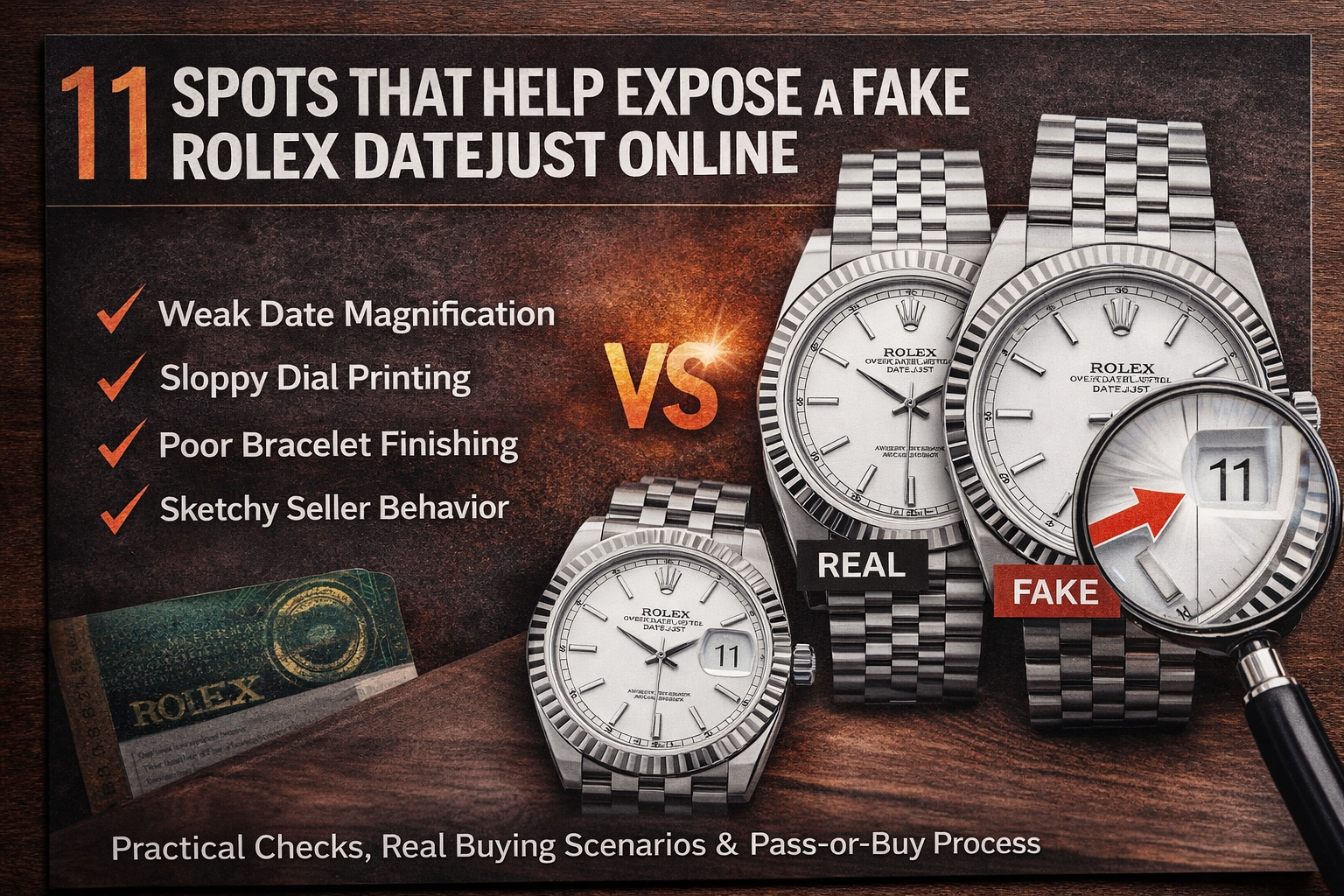
A fake Rolex Datejust usually gives itself away long before you ever open the case. The fastest tells are often surprisingly simple: a weak date magnification, sloppy dial printing, poor bracelet finishing, mismatched parts, and a seller who avoids basic questions.
That sounds easy on paper. In real life, it is not.
The reason so many buyers get caught is that modern fake Datejusts are no longer obviously bad. The worst ones are not the shiny, cartoonish fakes everyone laughs at. The dangerous ones are the listings that look almost right in photos, especially when the seller knows how to stage them well.
And that is exactly why the Datejust is such a common trap. It is one of the most recognized Rolex designs ever made, it comes in many dial colors and configurations, and it attracts first-time luxury buyers who want a watch they can wear every day. If you are still deciding whether the Datejust is even the right Rolex for you, read Rolex Datejust vs Oyster Perpetual: Which One Is the Better One-Watch Luxury Choice?. But if you are already browsing listings, this guide is the one to keep open.
This article is practical on purpose. We are not going to pretend every buyer has a loupe, a timegrapher, and a Rolex-trained watchmaker on standby. We are going to look at what you can actually do from a laptop or phone before you send money.
Why the Rolex Datejust gets faked so often
The Datejust sits in a sweet spot that counterfeiters love.
It is famous enough that almost everyone recognizes it. It is versatile enough to appeal to both dress-watch buyers and daily-wear buyers. And it comes in so many combinations—36mm, 41mm, fluted bezel, smooth bezel, Jubilee, Oyster, black dial, white dial, blue dial, Roman numerals, baton markers—that many buyers are not fully sure what is “normal” for a real one.
That confusion helps fake listings survive.
A seller can hide behind lines like “rare configuration,” “custom dial,” or “aftermarket upgrade,” and a first-time buyer may not know whether that means special, modified, or simply wrong. That is also why understanding the difference between a homage, a replica, and a counterfeit matters. We broke that down clearly in Homage vs Replica vs Counterfeit Watch: What’s the Difference and What Should You Actually Buy?.
The first rule: do not start with the box and papers
A lot of beginners make the same mistake. They see “full set” in the title and relax too early.
That is backwards.
Yes, paperwork matters. Yes, original box and warranty card can add confidence. But they should support the watch, not rescue it. A bad watch with a nice set of accessories is still a bad watch.
If you want the longer version of that argument, this article covers it well: Box, Papers, Warranty, and Service History: What Really Matters When Buying Pre-Owned?.
When I look at a Datejust listing, I always judge the watch first, the seller second, and the extras third.
11 red flags that a Rolex Datejust listing is fake, altered, or not worth the risk
1. The date magnification looks weak or awkward
The Datejust’s date display is one of the first things to inspect because it is also one of the first things counterfeiters get wrong.
On a suspicious listing, the date may look too small, too far from the center of the window, or oddly distorted under the Cyclops. Sometimes the magnification looks weak. Sometimes the date font itself looks thin, fat, or poorly spaced.
This matters because on a Datejust, the date is not a minor detail. It is the visual center of the dial layout. If it looks off, do not talk yourself out of that instinct.
This is also why buyers who normally prefer cleaner watches often end up choosing something simpler after comparing daily wear options. If that is you, Date Window vs No-Date Watch: Which One Is Better for Everyday Wear? is worth reading.
2. The dial printing looks too heavy, too bright, or too flat
Bad dial printing is still one of the easiest fake tells, even when the overall watch looks decent.
Look closely at the Rolex coronet, the text lines, the minute track, and the lume marker edges. On weaker fakes, the text can look too bold or too glossy. On others, the opposite happens: the print looks thin and lifeless, especially in high-contrast photos.
A real Datejust dial tends to look clean, balanced, and controlled. It should not feel noisy.
A good shortcut here is to ask yourself a simple question: does the dial look expensive for the right reasons, or is it just trying very hard to look expensive? That difference is subtle, but important. We explored it more broadly in What Makes a Watch Look Expensive? 9 Design Details Buyers Notice First.
3. The rehaut engraving does not line up cleanly
On many modern Rolex models, the inner bezel area—the rehaut—has engraved “ROLEX” text repeating around it. On suspect watches, that engraving often becomes a giveaway.
Sometimes it is too deep. Sometimes it is too light. Sometimes the alignment is inconsistent, especially around the coronet at 12 o’clock or near the minute markers.
Here is the practical part: do not obsess over one blurry photo. Ask for one straight-on, high-resolution dial shot taken in daylight. If the seller cannot provide that, the problem may not be the camera.
4. The bracelet finishing looks soft, sharp, or cheap in the wrong places
A Datejust bracelet should not feel like costume jewelry. Even in photos, finishing quality says a lot.
Jubilee links should look crisp without appearing rough. Center links should not look wavy. The clasp should not appear stamped like a bargain-market accessory. The end links should sit properly against the case.
Poor finishing is often more obvious when the seller photographs the watch at an angle rather than straight on. That is why you should always ask for side shots and bracelet close-ups, not just glamor shots of the dial.
5. The watch configuration does not make sense as a real reference
This is where many buyers get burned by watches that are not fully fake, but still wrong.
Maybe the case is genuine, but the dial is aftermarket. Maybe the bracelet is replacement. Maybe the bezel style and dial combination are inconsistent with the reference the seller claims. Maybe the seller calls it “factory” when it clearly is not.
This is not always counterfeit in the strict sense. Sometimes it is a modified or “Franken” watch. But for a buyer paying full-market money, the outcome is the same: disappointment.
6. The seller avoids direct, boring questions
Fraudulent sellers hate boring questions because boring questions force specific answers.
Ask these:
- What is the exact reference?
- Has the dial, bezel, crystal, bracelet, or clasp been replaced?
- Are any parts aftermarket?
- Is the watch running within normal timekeeping range?
- Can you send a date-change video and a crown-setting video?
- Can you send a straight-on dial photo in natural light?
An honest seller may be slow. They may not know everything. But they usually do not get weird when asked normal buying questions.
A dishonest seller often becomes evasive right when the questions stop being emotional and start becoming technical.
A simple 10-minute screening process I would use before contacting any seller
This is the part most buyers skip, and it saves more money than any “luxury watch secret” ever will.
Step 1: Look at the listing photos without reading the description
I do this on purpose. Before the seller’s words influence you, just look.
Does the watch feel coherent? Does anything immediately seem off about the date, hands, dial balance, bracelet, or bezel? First instincts are not proof, but they are useful.
Step 2: Read the description and circle vague phrases
Words like “rare,” “custom,” “special edition,” “unworn style,” and “100% authentic to the best of my knowledge” deserve extra caution.
That last phrase is especially useful. Honest private sellers sometimes use it innocently, but it also gives a dishonest seller room to retreat later.
Step 3: Match the watch components to the story being told
If the listing says it is a clean, original, lightly worn Datejust, but the case looks heavily polished and the bracelet looks different in color or finish, stop.
If the seller claims it is all original, but avoids showing the clasp, the rehaut, or the date window close-up, stop again.
Step 4: Ask for six specific photos and two short videos
This one step filters out a huge number of bad listings.
Ask for:
- A straight-on dial photo in natural light
- A side profile of the case
- A clasp photo
- A bracelet close-up
- A photo of the watch on the wrist or in hand
- A photo showing the rehaut clearly
Then ask for two short videos:
- One video of the crown being unscrewed and the hands being set
- One video showing the date changing around midnight
A seller with the actual watch can usually provide this. A seller using borrowed images often cannot.
Step 5: Judge the seller as hard as you judge the watch
This part matters more than many people admit.
A real watch in the hands of a bad seller can still become a bad transaction. A fake watch in the hands of a confident seller becomes even more dangerous.
Check whether their story is consistent. Check whether their tone changes when you ask precise questions. Check whether they push urgency too quickly.
If someone needs your deposit in the next hour, you probably need that watch a lot less than they need your money.
Before sending any payment, the broader checklist in How to Buy a Used Luxury Watch Online: 12 Checks Before You Pay is a smart companion to this article.
Three real-world buying scenarios that show how this plays out
The examples below are based on common pre-owned buying situations and simplified for clarity.
Case 1: The “great deal” that fell apart in five minutes
A buyer found a Datejust 41 listing priced well below what comparable clean examples usually ask. The photos looked polished and sharp. The seller used all the right words: full set, lightly worn, collector owned, no issues.
The problem showed up as soon as more photos were requested.
The date magnification looked weak. The dial text looked slightly thick. The rehaut shot was blurry for no good reason. When asked for a video of the hands being set, the seller replied that the crown felt “a little stiff” and changed the subject.
That is a pass.
Not because one single detail proved it was fake beyond all doubt, but because several small problems piled up in exactly the wrong way.
Case 2: The genuine watch with terrible listing photos
This one is important because not every bad listing is a bad watch.
Another buyer found a Datejust 36 from a private seller whose original photos were dim, yellow, and honestly not very flattering. At first glance, the watch looked suspicious simply because nothing looked crisp.
But once asked, the seller provided daylight photos, a clear rehaut shot, a date-change video, and a straightforward explanation of prior servicing. The watch turned out to be genuine, honest, and simply poorly marketed.
That is why you should not reject every weak listing instantly. Ask better questions first.
Case 3: The Franken watch that was not technically “fake”
A third buyer found a Datejust listing that passed the basic fake checks. The case looked right. The bracelet looked right. The movement was described as genuine.
But the dial had been replaced with an aftermarket diamond dial, and the watch had been heavily polished. The seller still priced it like a clean original example.
That is not the same problem as a total counterfeit, but it is still a problem. For many buyers, originality matters because originality supports long-term value, resale confidence, and simple peace of mind.
This is exactly why “real vs fake” is not the only question. Sometimes the better question is: Is this watch honest?
What photos matter most when checking a Datejust online
If a seller will only send one extra photo, ask for the straight-on dial shot.
If they will send three, ask for:
- straight-on dial
- clasp
- case side
If they will send more, add:
- rehaut close-up
- bracelet close-up
- date window macro
- wrist shot
- video of the hands and date being set
The reason is simple: fakes often survive wide-angle lifestyle shots. They struggle under specific, boring, close-up scrutiny.
A note on size: 36mm vs 41mm can affect how details look in photos
This sounds minor, but it matters.
Buyers sometimes think a 36mm Datejust looks “less sharp” in a photo compared with a 41mm example, when in reality they are just reacting to scale. Small details can look visually tighter or denser depending on the case size and the crop of the image.
So before you declare something wrong because the dial feels crowded or the date window looks different, be sure you know which size you are looking at. For the broader size conversation, Automatic Watch Size Guide: 36mm vs 38mm vs 40mm vs 42mm — What Actually Fits Your Wrist? helps put that in context.
When to walk away immediately
There are moments when more research is not the answer.
Walk away if:
- the seller refuses fresh photos
- the description changes after questioning
- the watch cannot be matched to a plausible reference
- the seller pressures you into fast payment
- the price is low enough to override your judgment
- the watch is described as original but clearly contains aftermarket parts
A lot of fake-watch mistakes do not happen because the buyer saw nothing wrong. They happen because the buyer saw enough wrong, then kept going anyway.
What to do instead if you love the Datejust look but hate the risk
Not every buyer needs to win the “private listing hunt.”
If you are buying your first Rolex and you know uncertainty will bother you, your best move may be one of these:
Buy from a reputable dealer with a return window.
Pay a little more, but buy a cleaner transaction.
Choose a simpler Rolex model with fewer variables.
Or pause and decide whether the Datejust is actually your best one-watch choice in the first place.
Some buyers eventually realize they want the versatile Rolex feel without the extra complexity of fluted bezels, bracelet choices, and dial combinations. That is part of why the Rolex Explorer vs Oyster Perpetual: Which Simpler Luxury Watch Ages Better? debate is so popular.
Final verdict: how to spot a fake Rolex Datejust online
The smartest way to spot a fake Rolex Datejust online is not to hunt for one magical detail. It is to look for consistency.
A real, honest Datejust listing usually feels coherent. The dial, date, bracelet, finishing, seller story, and extra photos all point in the same direction.
A bad listing usually does the opposite. One detail looks okay. Another looks strange. The seller sounds confident, but avoids specifics. The photos are polished, but never quite show the right angles. Nothing is terrible on its own, yet the whole thing does not settle.
That uneasy feeling is often the correct one.
The best buyers are not the ones who know every Rolex reference by memory. They are the ones who slow down, ask plain questions, and refuse to let excitement make the decision for them.
FAQ
Is a fake Rolex Datejust easy to spot?
Sometimes yes, sometimes no. Cheap fakes are usually obvious. The harder ones are the listings that look almost right in edited photos but become suspicious once you ask for specific close-ups and videos.
What is the biggest fake Rolex Datejust giveaway?
The date area is one of the most common giveaways: weak magnification, poor alignment, and odd date font shape. But you should never rely on just one detail.
Can a Rolex Datejust be real but still not worth buying?
Absolutely. A watch can be genuine but heavily polished, modified, fitted with aftermarket parts, or overpriced for its condition.
Do box and papers prove a Rolex Datejust is real?
No. They help, but they do not prove the watch is right. Always judge the watch first.
Is a Franken Datejust the same as a fake?
Not exactly. A Franken watch may use some genuine parts and some replaced or aftermarket parts. It is different from a full counterfeit, but it can still be a bad buy if priced like an original example.
Should I buy a cheap Datejust listing if the seller says they inherited it?
Only after the same checks you would use on any other listing. A sentimental story is not authentication.
Suggested featured excerpt:
A fake Rolex Datejust usually reveals itself through weak date magnification, inconsistent dial printing, poor bracelet finishing, mismatched parts, and a seller who avoids specific photo requests. The safest way to buy is to check for overall consistency, not just one “magic” fake tell.