- Home
- How to Spot a Fake Cartier Santos: Photo Checks Before You Buy
How to Spot a Fake Cartier Santos: Photo Checks Before You Buy
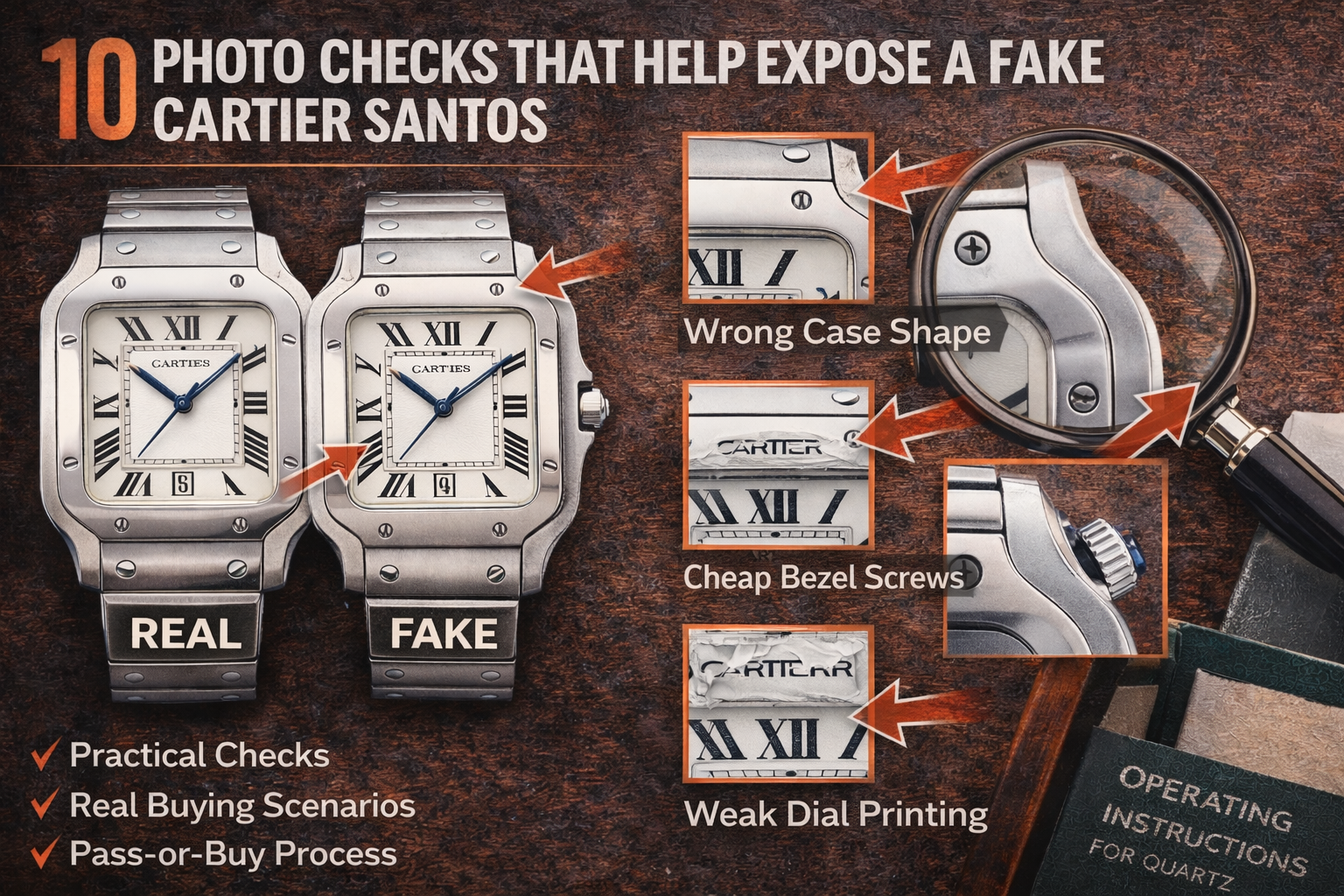
A fake Cartier Santos usually gives itself away in photos before it ever reaches your wrist.
The most common warning signs are wrong case proportions, rough bezel screws, weak dial printing, cheap-looking bracelet finishing, poor crown detail, and a seller who somehow has every angle except the ones you actually need.
That said, the Santos is not a watch you should judge lazily.
This is where people make mistakes.
They assume every real Cartier Santos should look exactly the same, then either reject a real one because it is from a different generation, or worse, approve a fake because the seller chose flattering photos. The Santos has been around for a long time, and different versions can look meaningfully different. So the goal is not to memorize one “perfect” Santos. The goal is to check whether the watch in front of you makes sense as the Santos the seller claims it is.
This article is built for real buyers, not keyboard experts. We are not pretending you have the watch in hand, a case opener, and a Cartier service center at your disposal. We are talking about what you can actually do from listing photos, seller replies, and a few smart follow-up requests before you send money.
If you are still figuring out whether the Santos is even the right Cartier for you, start with Cartier Tank vs Santos: Which One Fits Your Style, Wrist, and Budget?. But if you already love the Santos and are watching listings, this is the guide to keep open in another tab.
Why the Cartier Santos gets faked so often
The Santos is one of those watches that counterfeiters love for the same reason buyers love it: it is instantly recognizable.
It has a square case, exposed bezel screws, Roman numerals, a strong bracelet identity, and a reputation for being one of the rare luxury watches that can work as a true daily wearer. In other words, it does not just look expensive. It looks specific.
That makes it dangerous.
A fake Santos does not need to convince everyone. It only needs to convince the buyer who has wanted one for months, has compared prices all week, and suddenly sees a listing that looks “close enough.”
That is why the Santos often attracts the same buyer mindset as other iconic everyday luxury watches. People do not just want a nice watch. They want a watch that can carry a whole wardrobe, a whole travel schedule, maybe even a one-watch collection. If that sounds familiar, One-Watch Collection Explained: How to Choose the Single Automatic Watch You’ll Actually Keep Wearing is worth reading too.
First rule: identify which Santos the seller is claiming to sell
Before you zoom into the screws or the dial, do one simple thing:
Figure out what the watch is supposed to be.
This matters more with Cartier than many beginners realize. Older Santos models, modern Santos models, larger variants, smaller variants, quartz versions, automatic versions, and heavily polished pre-owned pieces can all create visual differences that confuse buyers.
A lot of bad authentication advice starts with a universal statement like, “A real Santos always has X.” That is exactly how people get fooled.
Instead, ask this:
- What exact Santos model or reference is this supposed to be?
- What size is it?
- Is it quartz or automatic?
- Is it all original?
- Has anything been replaced, refinished, or polished?
Once the seller gives an answer, then you evaluate whether the photos support that story.
Do not start with the box and papers
This mistake keeps happening because buyers want emotional reassurance too early.
They see “full set,” “original box,” or “papers included,” and they relax before they have even looked at the watch properly.
That is backwards.
Box and papers can support a good watch. They do not rescue a bad one. A suspicious Santos with a nice box is still a suspicious Santos. A fake with copied paperwork is still fake.
That is why Box, Papers, Warranty, and Service History: What Really Matters When Buying Pre-Owned? is such an important mindset piece. The watch comes first. The story comes second. The accessories come third.
10 photo checks that help expose a fake Cartier Santos
1. The case proportions feel wrong before you can explain why
A real Santos usually feels balanced.
The square case should look deliberate, not chunky in a clumsy way. The bezel should sit naturally within the case shape. The bracelet or strap should connect in a way that feels designed, not adapted.
Fakes often fail here first. They may be too thick, too broad, too soft around the edges, or oddly blocky when viewed from the side.
This is one of those checks that sounds vague until you start doing it. But experienced buyers rely on it all the time. Before you even inspect details, ask yourself: does the watch look like a coherent luxury object, or does it look like a rough imitation of one?
That instinct is often more useful than people admit. It is also closely related to the broader design question in What Makes a Watch Look Expensive? 9 Design Details Buyers Notice First.
2. The bezel screws look cheap, shallow, or inconsistent
The Santos bezel screws are one of the biggest visual signatures of the watch, which means they are also one of the easiest places for fakes to go wrong.
Here is the important part: do not rely on internet myths.
A lot of people think all bezel screw slots on a real Santos must line up perfectly in the same direction. That is not a reliable shortcut. What matters more is whether the screws look well-machined, properly seated, consistent in shape, and correctly integrated into the overall finishing.
On suspicious watches, the screw heads may look:
- too soft around the edges
- too deep or too shallow
- oddly stamped
- uneven from one screw to the next
- overly bright or oddly matte compared with the bezel
When a seller provides only distant photos, ask for a straight-on bezel close-up and one angled shot in natural light. Cheap machining often hides in wide shots and appears instantly in a close-up.
3. The dial printing feels heavy, blurry, or lifeless
Cartier dials are often cleaner than fake makers seem to understand.
On a fake Santos, the Roman numerals may look too thick, too dark, too close together, or just slightly awkward. The minute track may appear uneven. The central text may feel too bold or too weak. Even when the dial is technically “close,” it often lacks the calm, crisp look a real Cartier dial tends to have.
This is one of the biggest tells in listing photos.
A real dial does not need to shout. If the print feels loud, muddy, or nervous, slow down.
And if the seller uses only aggressively edited contrast-heavy photos, ask for plain daylight shots. Editing can make a mediocre dial look sharper than it really is.
4. The hands do not match the refinement of the rest of the watch
The Santos is an elegant watch, even in sportier configurations. So the hands should look precise, not generic.
On suspicious examples, the hands can look too thick, too flat, too shiny in the wrong way, or poorly finished at the edges. Sometimes they appear like the kind of handset you would expect on a much cheaper fashion watch.
This is a good check because counterfeiters often spend energy getting the broad shape right and less energy getting the fine finishing right.
A useful buyer habit is this: zoom in on the hands and ask whether they look worthy of the price category the seller is asking you to believe.
5. The crown and cabochon area looks careless
The crown is another place where fakes expose themselves quickly.
On many Santos models, the crown detail is an important part of the watch’s visual identity. When that area looks cheap, oversized, badly finished, or oddly attached, the watch usually gets harder to trust.
What you are looking for is not just color. You are looking for proportion, neat finishing, and a sense that the crown belongs to the case rather than being stuck onto it.
Ask for one close-up of the crown side in natural light. A seller avoiding that photo is often telling you something without saying it.
6. The bracelet finishing looks stamped rather than engineered
This matters a lot because the Santos bracelet is one of the reasons people buy the watch in the first place.
A fake bracelet often gets the general silhouette right but misses the feel. In photos, that usually shows up as:
- soft or uneven brushing
- sloppy transitions between brushed and polished surfaces
- screws that look crude or mismatched
- links that seem too loose, too flat, or too sharp
- end links that do not sit quite right against the case
This is a particularly important check for the Santos because so many buyers choose it over the Tank specifically for the bracelet and more everyday-wear personality. If that comparison still matters to you, Cartier Tank vs Santos: Which One Fits Your Style, Wrist, and Budget? will probably feel even more useful after reading this.
7. The caseback engravings look generic or overdone
Casebacks are not magic proof, but they are useful.
Ask for a clear photo of the caseback, not a blurry half-angle shot. Look for sharpness, spacing, and overall quality of engraving. Suspicious examples often look either too light and generic or too aggressively etched.
This is also where lazy counterfeiters sometimes expose themselves with mismatched serial-style markings, wrong formatting, or simply poor execution.
Still, do not over-trust the caseback alone. A fake can copy engravings. A polished genuine watch can soften them. Treat the caseback as one piece of the puzzle, not the whole answer.
8. The seller’s photos somehow miss the exact angles you need
This is one of the most useful fake checks because it is not about the watch. It is about the listing.
A bad seller often provides:
- dramatic wrist shots
- moody lifestyle photos
- close-ups that are artistic but not useful
- one sharp dial image and five soft ones
- no straight-on photo
- no crown-side photo
- no caseback shot
- no bracelet close-up
That pattern matters.
A real watch can still have bad photos, but a dishonest listing often has a very specific kind of bad photography: enough to create desire, not enough to create confidence.
9. The price is doing too much of the convincing
This is not a photo check in the strict sense, but it changes how you should read the photos.
A lot of fake or heavily altered Santos listings work because the price does half the manipulation. Buyers want the deal to be real, so they stop judging the listing neutrally.
When a Santos listing is dramatically cheaper than comparable clean examples, every photo deserves more skepticism, not less.
A low price is not proof of a fake. But it does mean your threshold for confidence should go up, not down.
10. The watch looks “almost right” in every photo, but never fully right in any one of them
This is the pattern that traps people.
The case looks okay. The dial looks mostly okay. The bracelet seems fine from one angle. The crown is never shown properly. The caseback is soft. The seller sounds confident. Nothing completely collapses, yet nothing completely settles either.
That is usually when buyers talk themselves into a mistake.
A real, honest Santos listing normally becomes more convincing as you ask for more information. A bad one becomes foggier.
A 12-minute screening process I would use before messaging any Santos seller
This is the practical part. If I were shopping Santos listings tonight, this is exactly how I would screen them.
Step 1: Look at the photos before reading the description
Do not let the seller’s words shape your first impression.
Just look at the watch. Does it feel balanced? Clean? Coherent? Or do you already feel slight discomfort around the case, bezel, or bracelet?
Step 2: Read the seller’s wording carefully
Circle vague phrases like:
- “looks authentic to me”
- “estate piece”
- “rare model”
- “customized”
- “upgraded dial”
- “same as boutique style”
- “aftermarket but high quality”
Those phrases do not automatically kill a deal, but they should slow you down.
Step 3: Ask for six specific images
Ask for:
- straight-on dial photo
- bezel close-up
- crown-side case photo
- bracelet close-up
- caseback photo
- wrist shot in daylight
A seller with the actual watch should be able to provide these.
Step 4: Ask the boring originality questions
Ask:
- Is the dial original?
- Is the bracelet original?
- Has the watch been polished?
- Has the crystal been replaced?
- Is it quartz or automatic?
- Has it been serviced?
- Are there any aftermarket parts at all?
Dishonest sellers hate boring questions because boring questions create accountability.
Step 5: Compare the answers to the photos
This is the key step.
Do not just collect answers. Compare them. If the seller says the watch is sharp and unpolished, but the edges look soft, note it. If they say the bracelet is original, but the finishing looks wrong, note it. If they say it is fully authentic but resist showing the caseback or crown, note that too.
You are not looking for perfection. You are looking for consistency.
Three common buying scenarios
Case 1: The “good deal” that gets worse the longer you look
A buyer finds a Santos priced noticeably below the usual range. The seller says it came from a relative and “should be real.” The first photo looks surprisingly good.
Then the follow-up photos arrive.
The bezel screws look weak. The dial print feels heavy. The crown close-up never comes. The bracelet shot is soft. The caseback image is somehow blurrier than every other photo.
That is a pass.
Not because one single thing proves the watch is fake beyond debate, but because the listing keeps moving away from clarity instead of toward it.
Case 2: The real watch with bad original photos
This is the flip side, and it matters.
A genuine Santos can start with terrible listing photos, especially from a private seller who is not good at photographing watches. The original upload may look dim, yellow, and unconvincing.
But when asked, the seller provides daylight dial shots, a clean bracelet close-up, a readable caseback photo, and direct answers about service history and polishing.
That listing often becomes stronger with scrutiny, which is what you want.
Case 3: The genuine-but-not-great buy
Some Santos listings are not fake, but still not smart purchases.
Maybe the watch is real, but over-polished. Maybe the bracelet is stretched or mismatched. Maybe the dial has been replaced. Maybe it is priced like a clean original piece even though it is no longer one.
This is why “Is it fake?” is not the only question that matters.
A bad buy can still be genuine.
That is exactly why How to Buy a Used Luxury Watch Online: 12 Checks Before You Pay matters so much in this category.
What not to do when checking a Cartier Santos
Do not authenticate from one cropped photo.
Do not trust a box more than the watch.
Do not assume every Santos generation should look identical.
Do not let a low price replace judgment.
Do not confuse “not proven fake” with “safe to buy.”
Do not buy because you are tired of searching.
That last one is real.
A lot of luxury watch mistakes happen after mental fatigue, not ignorance. The buyer has already compared twenty listings, already lost two deals, already emotionally committed to the model, and now just wants the hunt to end.
That is exactly when a mediocre or suspicious Santos starts to feel acceptable.
If you love the Santos look but hate the counterfeit risk
There is nothing wrong with admitting that the buying process itself may not be worth the stress.
Some buyers truly love the Santos because it sits in a rare middle ground: elegant but sporty, dressy but wearable, iconic but not boring. It is one of the better examples of what people now call a GADA-style luxury watch. If that broader idea appeals to you, GADA Watch Explained: What It Means, Why It Matters, and How to Choose One That Actually Fits Your Life is highly relevant.
But if fake listings, altered examples, and seller uncertainty are draining the joy out of the search, then be honest with yourself. You may be better off buying from a more reputable source, paying a bit more, and getting a cleaner transaction.
And if you find yourself being tempted by replicas or “super fake” listings because the real market feels frustrating, pause and read Homage vs Replica vs Counterfeit Watch: What’s the Difference and What Should You Actually Buy?. That article exists for exactly this moment.
Final verdict: how to spot a fake Cartier Santos
The smartest way to spot a fake Cartier Santos is not to chase one mythical giveaway.
It is to check whether the case shape, bezel screws, dial printing, hands, crown, bracelet, caseback, seller behavior, and pricing all tell the same story.
A real, honest Santos listing usually becomes more believable the more questions you ask.
A fake or compromised listing usually does the opposite. It stays vague. It gets blurrier. It keeps looking almost right, never fully right.
That is your answer more often than people want to admit.
You do not need to be a Cartier archivist to avoid most bad Santos listings. You just need to slow down, ask for the right angles, and refuse to let excitement do the buying for you.
FAQ
How can you tell if a Cartier Santos is fake from photos?
Start with overall case proportions, then inspect the bezel screws, dial printing, hands, crown, bracelet finishing, and caseback quality. Also judge the seller’s photo choices. Bad listings often avoid the most useful angles.
What is the biggest fake Cartier Santos giveaway?
There usually is not just one. The most common pattern is a combination of wrong proportions, rough screw finishing, weak dial printing, and a bracelet that looks cheaper than the price category suggests.
Do Cartier Santos bezel screws need to line up perfectly?
Do not rely on that myth as your main test. What matters more is the quality, consistency, and execution of the screws and bezel finishing overall.
Can a Cartier Santos be real but still a bad buy?
Yes. A real Santos can still be over-polished, overpriced, altered, or fitted with non-original parts.
Do box and papers prove a Cartier Santos is real?
No. They help, but they do not prove the watch itself is correct. Always judge the watch first.
Is it safe to buy a Cartier Santos online?
It can be, but only if you treat the listing seriously, ask for specific photos, verify consistency, and stay willing to walk away.
Suggested Featured Excerpt
A fake Cartier Santos often reveals itself through wrong case proportions, rough bezel screws, weak dial printing, poor bracelet finishing, and seller photos that avoid useful angles. The safest way to evaluate one online is to look for overall consistency, not just one dramatic fake tell.