One-Watch Collection Explained: How to Choose the Single Automatic Watch You’ll Actually KeepWearing
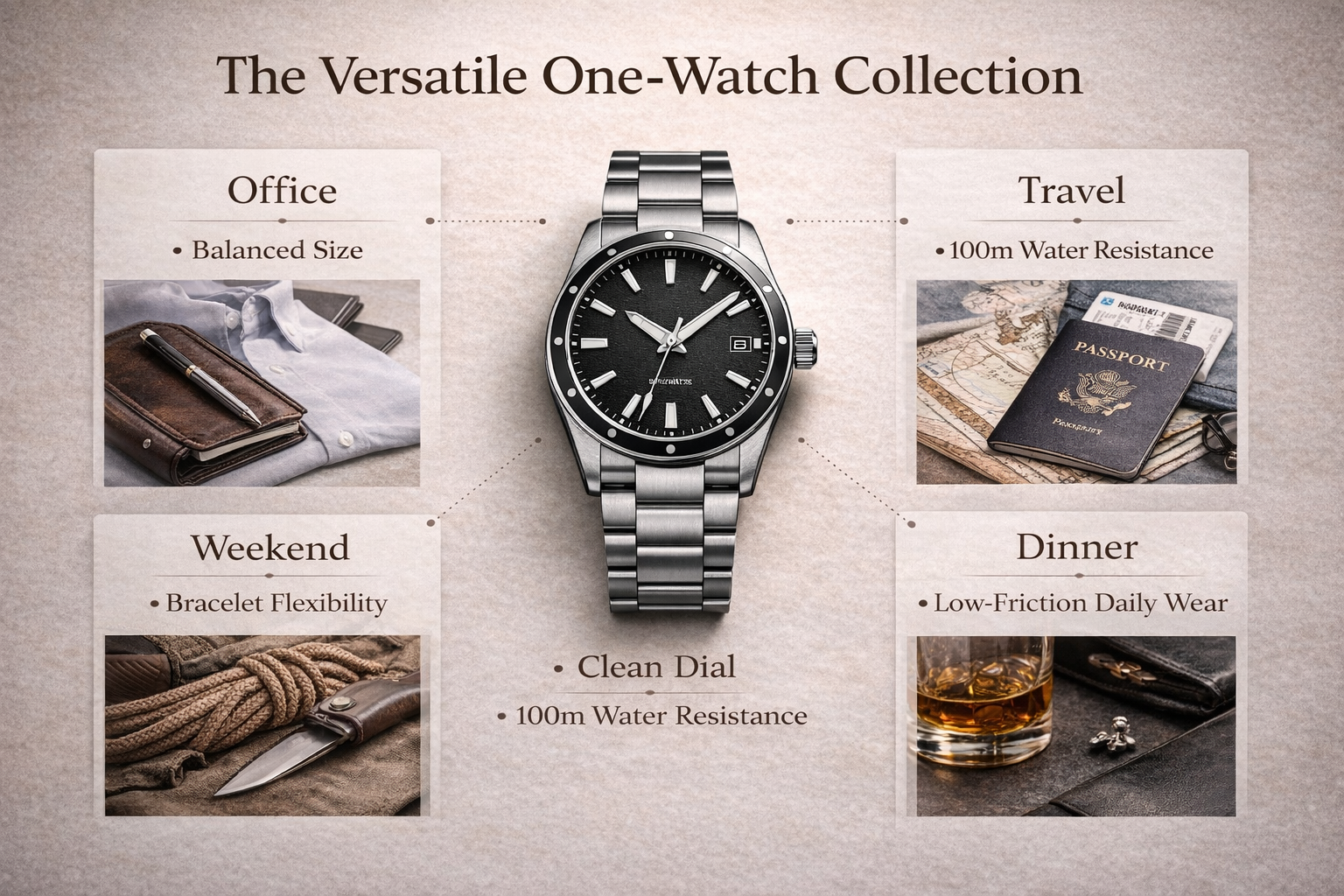
One-Watch Collection Explained: How to Choose the Single Automatic Watch You’ll Actually Keep Wearing
A one-watch collection sounds simple.
In real life, it is one of the hardest watch decisions to get right.
That is because the challenge is not finding a watch you like. It is finding a watch that still makes sense on a Monday commute, a casual Saturday, a dinner out, a work meeting, and a short trip—without feeling too dressy, too sporty, too fragile, or too awkward.
That is what makes a real one-watch collection so difficult.
You are not buying a watch for one perfect moment. You are buying a watch that has to survive ordinary life.
So here is the practical answer first:
The best one-watch automatic is usually a balanced, medium-sized, easy-to-read, reasonably durable watch that works with most of your clothes and does not create friction in daily life.
That is the real goal.
Not the most impressive spec sheet.
Not the most niche design.
Not the watch that gets the most compliments online.
The best one-watch collection starts with a watch you keep reaching for—without having to justify the choice every morning.
If you are still early in the learning process, it helps to start with What Is an Automatic Watch? Pros, Cons & Who Should Buy One and Best Automatic Watches for Beginners: Top Picks & Buying Tips. But if your real question is how to choose one automatic watch that can do most of life well, this guide is the practical version.
What is a one-watch collection?
A one-watch collection is exactly what it sounds like: owning a single watch and expecting it to cover most or all of your real-life needs.
That means the watch needs to work across:
- casual wear
- work or office use
- weekends
- travel
- weather changes
- normal daily wear
- occasional dressier moments
A one-watch collection is not about having the “best” watch in one category. It is about having the least limiting watch overall.
That is why so many buyers get this wrong at first.
They choose:
- something too formal
- something too sporty
- something too large
- something too delicate
- or something too style-specific
Then they realize the watch is good—but not good enough for the life they actually live.
Why a one-watch collection is harder than it sounds
Because single-watch ownership exposes every weakness.
If you own six watches, each one only needs to be good at one role.
If you own one watch, it has to survive every role you ask from it.
That means the wrong choice becomes obvious very quickly.
A dress watch may look elegant, but start feeling too limited.
A big diver may look robust, but start feeling too bulky or too casual.
A minimalist watch may look clean, but start feeling too plain or too fragile for real life.
A pilot watch may be readable, but too visually specific for daily versatility.
A one-watch collection does not reward extremes very well.
It rewards balance.
The short answer: what makes a good one-watch automatic?
For most buyers, a good one-watch automatic has:
- wearable size
- moderate thickness
- clean, versatile styling
- enough water resistance for normal life
- sapphire crystal
- strong readability
- a bracelet or adaptable strap setup
- a reliable movement that is easy to live with
That is the real checklist.
If a watch gets most of those right, it has a real chance of succeeding as a one-watch collection. If it misses too many, it may still be a great watch—but not the best only watch.
1. The watch must fit your wrist properly
This comes first because a badly fitting watch never becomes a true one-watch collection.
It can be interesting. It can be beautifully made. It can even be “good value.”
But if it wears poorly, it will create friction immediately.
For most people, a one-watch automatic works best in a moderate size range:
- usually somewhere around 36mm to 40mm
- with a sensible lug-to-lug
- and thickness that does not feel clumsy
The goal is simple:
the watch should feel present, but not dominant.
A one-watch collection cannot afford awkward fit.
If you already know fit is a challenge, especially on the smaller side, Best Automatic Watches for Small Wrists: What to Look for Before You Buy is worth reading alongside this piece.
2. The style has to be balanced, not extreme
This is where many one-watch plans fail.
A dress watch can be beautiful, but too elegant for rougher daily life.
A hardcore tool watch can be practical, but too sporty for smarter settings.
A strong one-watch automatic usually lives in the middle.
It should look:
- clean, but not overly dressy
- practical, but not aggressively tactical
- sporty enough for casual wear
- refined enough for a dinner or office setting
That is why the best one-watch candidates are often watches that feel like they could belong in more than one category without being fully trapped by any one of them.
If you want a more detailed style comparison before deciding, Dress Watch vs Everyday Watch: What’s the Real Difference and Which Should You Buy First? and Tool Watch vs Dress Watch: Which One Fits Your Lifestyle Better? are both useful companion reads.
3. Enough water resistance matters more than most first-time buyers expect
A one-watch collection should not make normal life annoying.
That means the watch needs enough practical resilience that you stop asking yourself:
- Can I wear this in the rain?
- Can I wash my hands with it on?
- Should I switch watches for travel?
- Is this too delicate for an ordinary day?
For many people, around 100m water resistance is the sweet spot.
You do not need extreme dive-watch specs. But you do need enough real-world confidence that the watch can stay on your wrist through ordinary life.
This is one of the biggest reasons why more versatile sports-adjacent watches succeed so often as one-watch collections.
If this part still feels unclear, Water Resistance Explained for Everyday Watches: 30m vs 50m vs 100m vs 200m — What You Can Actually Do belongs directly in the same decision path.
4. The crystal should help ownership feel easy
For a one-watch collection, daily ease matters more than novelty.
That is why sapphire crystal is such a practical win. It is not exciting in the way marketing likes to excite buyers, but it matters enormously in real ownership. A single daily watch will see more tables, more travel, more bags, more sleeves, and more normal contact than a watch in a five-piece rotation.
You want the watch to feel wearable, not precious.
A good one-watch automatic should reduce low-grade worry, not add to it.
5. Readability matters because you will use it constantly
A one-watch collection should be easy to read.
That sounds obvious, but many buyers get distracted by design novelty and forget that their one watch will be checked dozens of times a day.
A strong one-watch candidate usually has:
- clear hands
- sensible markers
- enough dial contrast
- a layout that is easy to read quickly
A watch can be beautiful and still be a poor only watch if time reading becomes less satisfying over time.
This is one reason simpler, cleaner everyday dials often age better than highly specialized or highly decorative ones.
6. Bracelet usually makes the safest starting point
If you are building a one-watch collection, bracelet is often the best place to start.
Why?
Because bracelet usually gives you:
- broader daily versatility
- better weather tolerance
- easier travel use
- stronger long-term value feel
- more flexibility to dress up or down later
A watch on bracelet often comes closer to true one-watch territory than the same watch on leather.
Leather can still be excellent if your life is dressier and drier. Rubber can be excellent if your life is more active or warm-weather heavy. But if you want the safest overall starting point, bracelet usually wins.
If strap strategy is part of your thinking, Leather vs Bracelet vs Rubber Strap: How Strap Choice Changes Fit, Style, and Value is directly relevant.
7. The movement should feel dependable, not complicated
For a one-watch collection, a dependable movement matters more than a flashy movement story.
This means the watch should be:
- easy to live with
- easy to set
- reliable enough for normal ownership
- serviceable without drama
- practical rather than precious
A normal, dependable automatic movement with hand-winding and hacking seconds often makes more sense as a one-watch choice than something more exotic but less straightforward.
This is also where power reserve comes into perspective. Longer reserve can be nice, but the real question is whether the watch feels simple and reliable in your actual routine. If you wear it most days, extreme reserve is less important than many buyers think.
What usually fails as a one-watch collection?
This is just as important as knowing what works.
A one-watch collection usually struggles when the watch is:
Too dressy
It looks great in formal settings, but starts feeling too limited in casual life.
Too sporty
It feels robust, but too bulky or too obviously sporty for office and dinner use.
Too large
It becomes tiring, awkward, or difficult to wear across all situations.
Too fragile-looking
You start babying it instead of living with it.
Too design-specific
It is impressive at first, but harder to integrate every day.
That does not make these watches bad. It just means they are usually better as second or third watches, not your only one.
Real-world buyer case #1: the beginner who wants one watch for everything
This is the most common one-watch buyer.
They want one automatic watch for:
- work
- weekends
- travel
- errands
- dinner
- everyday wear
For this person, the best choice is usually a restrained, versatile sports watch or practical everyday automatic with balanced proportions, moderate styling, and enough water resistance to reduce worry.
This buyer usually does better with balance than with category purity.
That is also why many first-time buyers get more value from category-neutral guidance like Best Automatic Watches by Budget: $300 vs $500 vs $1000 — How to Choose the Right One than from jumping directly into niche subcategories.
Real-world buyer case #2: the dressier office buyer
This buyer wears shirts, cleaner tailoring, knitwear, and business-casual clothing most of the week. They want their only watch to feel refined enough for that environment, but still usable outside it.
For this buyer, the one-watch answer may lean slightly dressier—but still should not become a pure dress watch unless the lifestyle really supports that.
A slim, clean, moderately practical watch often works best here:
not too tool-like, not too formal, just quietly adaptable.
Real-world buyer case #3: the casual, active buyer
This buyer travels, commutes, moves around, and wears mostly casual or smart-casual clothing. They want their watch to handle normal life without much thought.
For this person, the one-watch collection should almost always lean more practical than elegant.
A well-sized everyday sports watch, restrained diver-adjacent piece, or versatile field/sports hybrid often works best. The key is to avoid overcommitting to a specialist look.
Which category gets closest to the best one-watch collection?
There is no perfect category, but some get closer than others.
Dress watch
Usually too limited unless your lifestyle is clearly refined.
Dive watch
Can work very well if it is restrained, wearable, and not too bulky.
Field watch
Often very strong, especially if compact and clean, though some can lean too casual.
Pilot watch
Can work, but often feels more visually specific than ideal for only-watch duty.
Balanced everyday sports watch
This is often the true sweet spot.
That is why many of the best one-watch collections end up looking less dramatic than expected. The watch is not trying to win one category. It is trying to lose as few situations as possible.
The one-watch formula that works for most people
If you want the safest possible formula, it usually looks something like this:
- 36mm to 40mm
- moderate thickness
- clean, easy-to-read dial
- not overly dressy or overly sporty
- around 100m water resistance
- sapphire crystal
- bracelet-first
- reliable automatic movement
- a design you can wear with both casual and smarter clothes
That formula is not exciting in a watch-forum way. But it is often exactly right in real life.
A practical 5-step process for choosing your one-watch collection
Step 1: start with your actual wardrobe
Not your aspirational wardrobe. Your real one.
Do you mostly wear:
- T-shirts and denim?
- smart-casual office clothes?
- dress shirts and tailoring?
- mixed clothing across the week?
Your watch has to fit that reality.
Step 2: decide how much water and unpredictability your life includes
Travel, weather, commuting, active days, and routine exposure all matter here.
Step 3: decide how much elegance you really need
Some buyers truly need more refinement. Others only think they do because dressier watches photograph well.
Step 4: choose fit before category
The right dimensions matter more than the right label.
Step 5: choose the watch you can imagine not taking off
That is the real one-watch test.
If you already imagine when you will need to switch it out, it may not be the right only watch.
What buyers often get wrong
1. They choose for fantasy life, not real life
This is the most common mistake.
2. They buy too much category
Too much diver, too much dress, too much pilot, too much statement.
3. They ignore fit
One-watch ownership magnifies every physical flaw.
4. They underrate bracelet value
Bracelet often gives the broadest starting range.
5. They chase novelty over repeat wear
The best one-watch collection is usually the one you wear most, not the one that sounds most impressive.
Which buyers should care most about this?
Three groups especially benefit from thinking this way:
First-time buyers
Because they are most vulnerable to category overcommitment.
Budget-conscious buyers
Because one versatile watch usually creates more real value than one narrow watch.
People who genuinely only want one watch
Because their watch has to solve more daily situations than collectors often realize.
That is why budget guides like Best Automatic Watches Under $300: Affordable & Reliable Picks, Best Automatic Watches Under $500: Premium Value Without Overspending, and Best Swiss Automatic Watches Under $1000: Luxury Feel Without the Luxury Price become even more useful when filtered through one-watch logic rather than pure hype.
FAQ
What is a one-watch collection?
A one-watch collection means owning a single watch and expecting it to cover most or all of your real-life needs.
What makes a good one-watch automatic?
A good one-watch automatic usually has balanced size, versatile styling, practical durability, strong readability, and low-friction daily ownership.
Is a dive watch a good one-watch collection?
It can be, especially if it is restrained, wearable, and not too bulky. Some dive watches are excellent one-watch options, while others are too sporty.
Should my one-watch collection be on bracelet or leather?
For most buyers, bracelet is the safer starting point because it offers more flexibility, better weather tolerance, and stronger all-round wearability.
What size is best for a one-watch collection?
For most people, moderate sizes around 36mm to 40mm work best, depending on wrist size and overall case proportions.
Is a dress watch a bad one-watch collection?
Not always. It can be excellent if your lifestyle is refined enough to support it. For most buyers, though, a more versatile everyday watch is safer.
Final verdict
If you want the simplest possible answer:
A one-watch collection succeeds when the watch creates fewer compromises than the rest.
It does not need to be the most rugged.
It does not need to be the dressiest.
It does not need to be the most exciting.
It needs to be the watch that still feels right most of the time.
That usually means:
- moderate size
- balanced styling
- practical durability
- good comfort
- easy daily use
So when choosing your single automatic watch, do not ask:
“What is the most impressive watch I can buy?”
Ask:
“What is the watch I will still want on my wrist next Wednesday, next month, and next year?”
That is the real one-watch collection.