Cartier Tank vs Santos: Which One Fits Your Style, Wrist, and Budget?
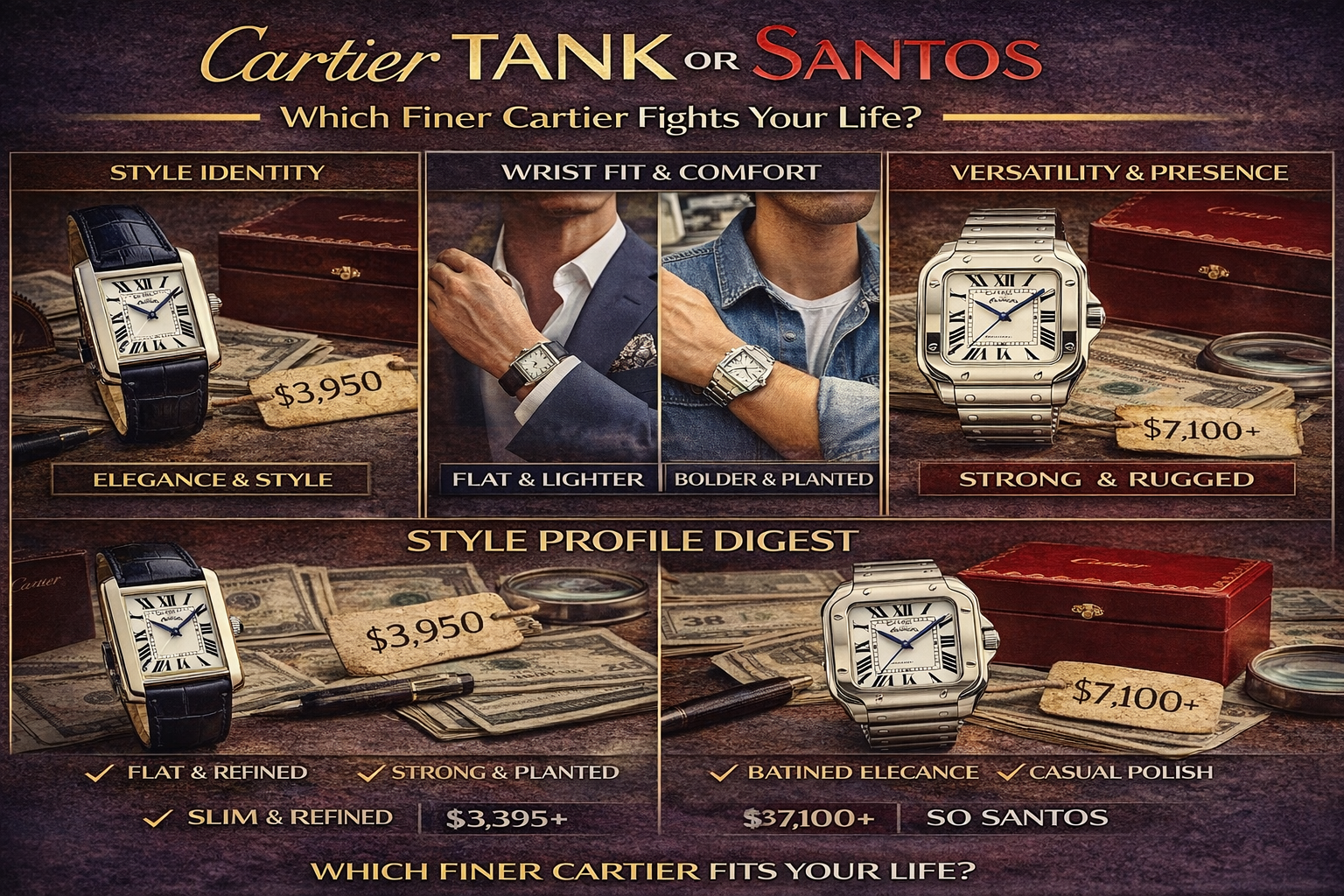
If Rolex vs Omega is about brand direction, Cartier Tank vs Santos is about personal taste.
That is why this comparison feels so difficult for first-time luxury buyers. Both watches come from the same house. Both are iconic. Both look unmistakably Cartier. Both can be worn for years without feeling dated. But they do not create the same impression on the wrist, and they definitely do not solve the same lifestyle problem.
The Tank is usually the watch buyers choose when they want elegance, restraint, and a design that feels more like style than hardware. The Santos is usually the watch buyers choose when they want Cartier design with more presence, more daily versatility, and a stronger “this can be my main watch” feeling.
So this is not really a question of which watch is better.
It is a question of whether your life, wrist, wardrobe, and budget point more naturally toward quiet refinement or structured everyday confidence.
If you are deciding between the Cartier Tank and the Cartier Santos as your first Cartier, the smartest move is to stop thinking in terms of hype and start thinking in terms of how the watch will actually live on your wrist.
Quick answer
The Cartier Tank usually makes more sense if you want a slimmer, dressier, more elegant watch that prioritizes style, refinement, and visual timelessness over rugged versatility. The Cartier Santos usually makes more sense if you want a more wearable daily luxury watch with stronger wrist presence, more bracelet appeal, and a better chance of becoming your main all-purpose piece. The Tank is often the purer style choice. The Santos is often the more practical ownership choice.
Why this comparison matters so much
A lot of buyers think choosing between Tank and Santos is mainly about shape.
It is not.
It is really about what kind of watch role you want in your life. The Tank often behaves more like a style object with real horological legitimacy. The Santos often behaves more like a full luxury watch package: recognizable design, stronger versatility, more wrist presence, and easier day-to-day adaptability.
That is why first-time buyers get stuck here. They love the elegance of the Tank, but worry it may be too delicate, too formal, or too specialized. Then they look at the Santos and see something more grounded and wearable, but wonder whether it loses a bit of the Tank’s pure aesthetic charm.
Both instincts are reasonable.
Before choosing either one, it helps to clarify whether you are fundamentally shopping for a dress-leaning watch or a true everyday luxury watch. That is exactly why Dress Watch vs Everyday Watch: What’s the Real Difference and Which Should You Buy First? is such a useful starting point. This Cartier decision becomes much easier when you know what role the watch is meant to play.
The Tank’s biggest strength: pure design elegance
The Tank is one of those rare watches that feels bigger in culture than it does on the wrist.
That is part of its charm.
It is not trying to impress with bulk, technical aggression, or sporty functionality. It wins by proportion, shape, and restraint. The rectangular case, Roman numerals, clean dial layout, and refined lines create a kind of elegance that many round watches simply cannot match.
That is why the Tank often appeals to buyers who care about clothing, silhouette, and personal style as much as they care about watches themselves. The Tank does not just tell time. It changes the tone of your outfit.
It also feels unusually timeless. A lot of watches chase versatility by becoming visually neutral. The Tank does something more difficult: it stays distinctive without feeling loud.
For buyers who want a luxury watch that feels graceful, cultured, and less predictable than the usual steel sports-watch route, the Tank is often incredibly persuasive.
The Santos’ biggest strength: luxury design with real daily versatility
The Santos is different.
It still looks unmistakably Cartier, but it carries more structure, more visual confidence, and more obvious everyday functionality. It feels more substantial, more bracelet-friendly, and more naturally suited to buyers who want one luxury watch to handle a lot of life without feeling too precious.
That is why the Santos often becomes the easier answer for first-time buyers.
It keeps the square Cartier identity, but adds more wrist presence and more “daily watch” energy. On bracelet especially, it feels far more casual and adaptable than many people expect. It can still dress up, but it does not depend on dressy situations to make sense.
That makes the Santos especially attractive to people who love Cartier design but do not want their first Cartier to feel limited to certain outfits or occasions.
In that sense, the Santos often fits naturally into the kind of role discussed in Bracelet Watch vs Leather Strap Watch: Which One Is Better as Your First Automatic?, because bracelet-versus-strap flexibility changes the ownership experience a lot here. The Tank often shines most as a strap-first elegance watch. The Santos often shines as a bracelet-first daily luxury watch that can still adapt.
Style first: which one actually matches your wardrobe?
This is where the decision becomes real.
If your wardrobe leans tailored, refined, minimal, fashion-aware, or quietly elegant, the Tank often feels almost unbeatable. It works beautifully with knitwear, shirting, blazers, loafers, softer tailoring, and cleaner monochrome outfits. It does not need to dominate the look. It improves the look by adding shape and intention.
If your wardrobe is more mixed, more casual, or more centered around smart everyday wear, the Santos often makes more sense. It handles polos, denim, jackets, travel outfits, office-casual looks, and weekend wear more easily without feeling like a watch you have to “dress for.”
This is an important distinction. A lot of buyers admire the Tank, but not all of them live Tank lives. In the same way, a lot of buyers assume the Santos is the more sensible choice, but some actually dress with enough refinement that the Tank becomes the more natural long-term fit.
A simple way to test yourself is to ask: when I imagine this watch on my wrist most often, am I picturing a bracelet-friendly daily luxury look or a more refined, style-conscious one?
That answer usually reveals more than spec sheets do.
Wrist fit: this matters more than people think
Square and rectangular watches do not wear like round watches, which means buyers often misjudge them from photos alone.
This matters a lot with both the Tank and the Santos.
The Tank often looks elegant because it wears flatter, slimmer, and visually quieter. But that same quality can make it feel too small or too delicate for buyers who are used to sport watches or who want more obvious wrist presence. The Santos, by contrast, often feels more solid and substantial immediately, especially on bracelet, but it can also feel more dominant on smaller wrists if the proportions are not right.
That is why you should not treat this as a purely aesthetic choice. It is a fit choice too.
If you are still unsure how watch proportions actually translate to your wrist, Automatic Watch Size Guide: 36mm vs 38mm vs 40mm vs 42mm — What Actually Fits Your Wrist? and Best Automatic Watches for Small Wrists: What to Look for Before You Buy are both useful mindset resets, even though this is a Cartier comparison. The principle is the same: a watch can be beautiful and still be wrong for your wrist.
Thickness matters here too. The Tank usually wins easily on slim elegance, while the Santos often feels more substantial and sporty. That is exactly the kind of trade-off explained in Automatic Watch Thickness Guide: Why 11mm Feels Elegant and 14mm Feels Sporty. If you want a watch that disappears under a cuff and feels graceful, the Tank has a major advantage. If you want a watch that feels planted and more visibly present, the Santos often wins.
Which one feels more “Cartier”?
This is a surprisingly useful question.
Some buyers look at the Tank and think: that is Cartier in its purest form. Elegant, architectural, refined, unmistakable. Others look at the Santos and think: that is the Cartier I can actually wear every day without compromise.
Both views are valid.
The Tank usually feels more like Cartier as a style statement. The Santos usually feels more like Cartier as a full daily luxury watch. The Tank is more about line, proportion, and refinement. The Santos is more about shape, hardware, and presence.
So the answer depends on what “more Cartier” means to you. If it means distilled elegance, the Tank wins. If it means recognizable luxury design you can actually live in every day, the Santos has a very strong case.
Which one is more versatile in real life?
This is where many first-time buyers end up leaning Santos.
The Santos is often easier to justify as a first and only luxury watch because it covers more situations with less effort. It works well in the office, on weekends, while traveling, on bracelet, and in more relaxed clothing environments. It has enough structure to feel luxurious, but enough ease to avoid feeling over-formal.
The Tank is versatile too, but in a different way. It is versatile inside a refined style language. It can absolutely work casually when worn with confidence, but its magic shows most clearly when the rest of the outfit has some polish and intention.
That means the Tank often suits buyers who already know they enjoy that kind of style. The Santos often suits buyers who want more freedom and less wardrobe dependency.
This is similar to the broader tension behind Tool Watch vs Dress Watch: Which One Fits Your Lifestyle Better?. The Tank is not a literal tool-vs-dress example, of course, but the same logic applies: some watches reward elegance, others reward daily adaptability. Buyers are happiest when they know which side of that balance they actually live on.
Budget: where the choice starts to shift
Budget changes this comparison more than many people expect.
If your budget is tighter and you want the strongest possible Cartier identity without necessarily paying for maximum mechanical complexity or sports-watch presence, the Tank can make a lot of sense. It often gives buyers that unmistakable Cartier design language in a more direct, style-first form.
If your budget is broader and you want a more all-around ownership experience, the Santos often feels easier to justify. You are paying not just for the design, but for a more versatile luxury-watch role: more presence, more bracelet utility, and a stronger chance that the watch can handle most of your actual life.
That is why budget is not just about price. It is about expectations.
A buyer stretching for a Santos because it feels like the “safer” one-watch answer may actually be happier with a Tank if what they love most is elegance and style. On the other hand, a buyer trying to save money with a Tank may later realize they really wanted the more substantial daily-wear confidence of the Santos all along.
A practical buyer example
Imagine two buyers with similar admiration for Cartier but very different lifestyles.
Alex works in a creative office, dresses cleanly, likes loafers, knit polos, unstructured jackets, and values elegance more than ruggedness. He already knows he prefers things that feel quietly refined rather than obviously sporty. He wants a watch that feels intentional and stylish, not just “luxurious.”
The Tank probably makes more sense for Alex.
Now imagine Daniel. He works in a business-casual environment, travels often, rotates between shirts, polos, denim, and casual tailoring, and wants one luxury watch that feels strong on wrist without becoming too aggressive. He likes Cartier, but he wants it in a form he can wear most days without having to think too hard.
The Santos probably makes more sense for Daniel.
Neither buyer is choosing the “better” Cartier. They are choosing the Cartier that fits their actual life with less friction.
The emotional side of the decision
This is one of those watch choices where emotion matters a lot.
A Tank often feels like taste. A Santos often feels like confidence.
That is a simplification, but it is useful.
People who fall for the Tank usually do so because it hits something deeper than specifications. They respond to its shape, its restraint, its cultural elegance, and the way it changes the mood of the person wearing it. People who fall for the Santos usually do so because it combines design identity with everyday practicality in a way that feels reassuring.
So if you are stuck, ask yourself this: am I trying to buy the Cartier that feels most beautiful to me, or the Cartier that feels easiest to own?
Sometimes those are the same watch. Often they are not.
Which one makes more sense as a first luxury watch?
If you want the cleanest first-luxury-watch answer, the Santos usually has the easier case. It is more adaptable, more bracelet-friendly, more obviously substantial, and usually less dependent on a refined wardrobe to feel at home.
If you want the more stylish, distinctive, and quietly sophisticated answer, the Tank often wins. It may not be the most universally practical first luxury watch, but for the right buyer it becomes the more emotionally correct one, and that matters.
A first luxury watch should not just be defensible on paper. It should feel like you.
A simple decision test
Choose the Tank if these thoughts sound more like you:
- I care more about elegance than sporty versatility.
- I want my watch to feel refined, iconic, and style-driven.
- I do not need my first Cartier to be my most rugged or casual watch.
- I want something timeless that feels almost like jewelry in the best sense.
Choose the Santos if these thoughts sound more like you:
- I want Cartier design, but in a watch I can wear almost anywhere.
- I prefer stronger wrist presence and bracelet versatility.
- I want my first Cartier to function as a serious daily luxury watch.
- I need the watch to work with a broader range of outfits and routines.
Final verdict
If your top priority is elegance, refined style, and timeless design purity, the Cartier Tank usually makes more sense.
If your top priority is everyday wearability, wrist presence, and all-around luxury-watch versatility, the Cartier Santos usually makes more sense.
The Tank is often the more beautiful answer. The Santos is often the more practical answer.
The smartest choice is not the one the internet calls more iconic. It is the one that fits your wrist, your wardrobe, and your real habits so naturally that you stop thinking about whether you chose correctly.
That is when a luxury watch starts to feel right.
FAQ
Is the Cartier Tank too formal for everyday wear?
Not necessarily. It can absolutely be worn casually, especially if your personal style already leans refined. But it usually feels most natural on buyers who are comfortable with a more elegant visual language.
Is the Cartier Santos a better first Cartier than the Tank?
For many buyers, yes, because it is easier to wear daily and often feels more versatile. But if what you truly love is the Tank’s elegance, the Tank may still be the better first Cartier for you.
Which Cartier fits smaller wrists better?
That depends on the exact model and proportions, but many buyers with smaller wrists find the Tank easier because of its slimmer, quieter wearing style. The Santos can still work very well, but sizing matters more.
Is the Tank more timeless than the Santos?
Many buyers would say yes in a pure design sense. The Tank has an unusually lasting elegance. But the Santos is also deeply iconic and often more practical in everyday use.
Which one should I choose if I want one luxury watch?
In most cases, the Santos is the safer one-watch answer. But buyers with a refined wardrobe and strong personal style may find the Tank more satisfying over the long term.