Beat Rate (Hz/VPH) Explained: Does It Matter for Accuracy, Smoothness, and Service?
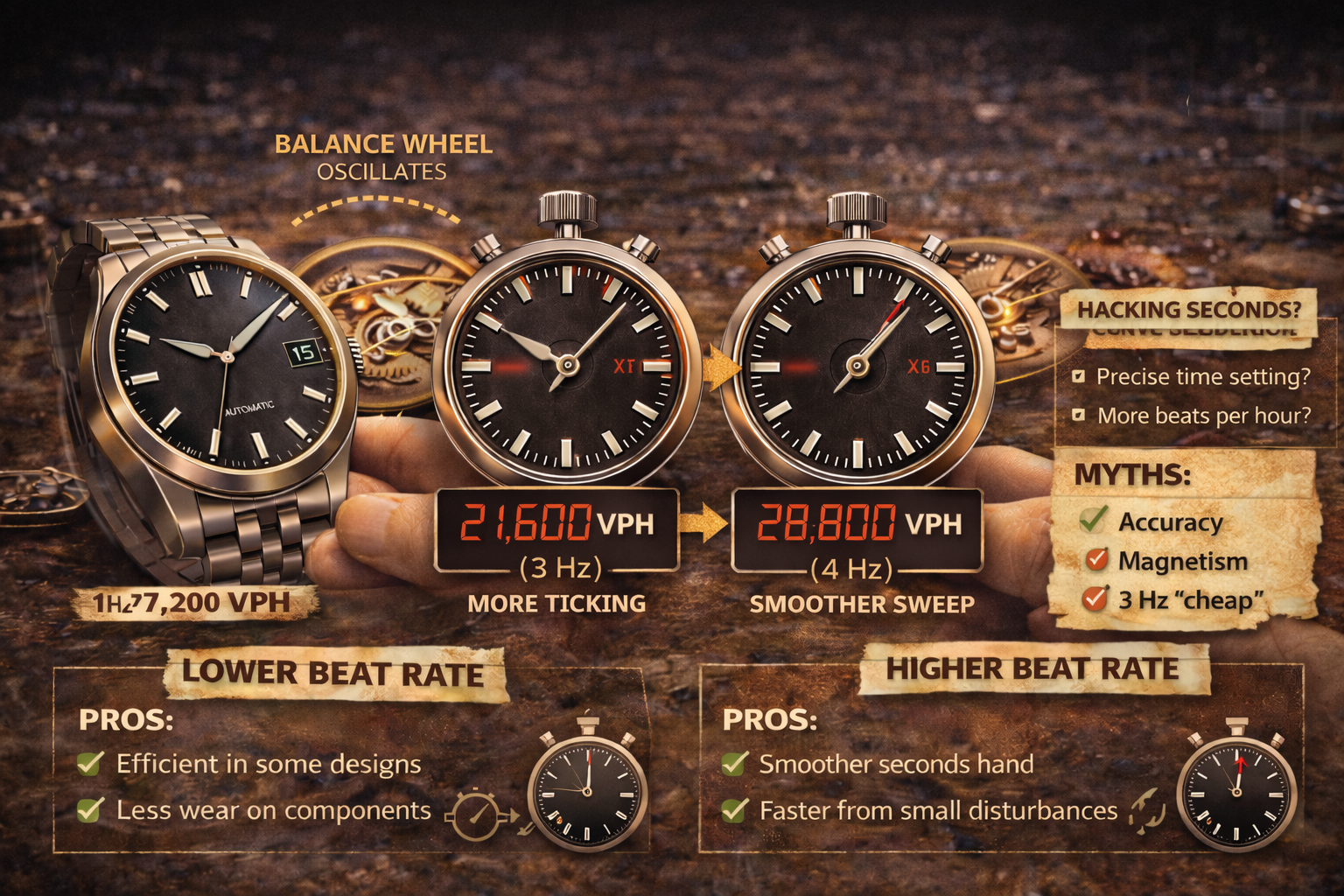 If you’ve seen specs like 3 Hz, 4 Hz, or 28,800 vph, you’re looking at a watch’s beat rate. It’s one of the most misunderstood specs in mechanical watches—because it sounds like “higher must be better,” but the real answer depends on what you care about.
If you’re new to automatic watches, start with:
What Is an Automatic Watch? Pros, Cons & Who Should Buy One
Quick Answer: What Beat Rate Means
-
Beat rate = how fast the balance wheel oscillates.
-
It’s expressed as Hz (oscillations per second) or VPH (vibrations per hour).
-
Higher beat rate often means a smoother seconds hand and potentially more stable timing in some situations—but it can also mean different wear/efficiency tradeoffs.
To understand the movement basics first:
How Does an Automatic Watch Work? Simple Beginner Guide
Hz vs VPH: The Simple Conversion
Most watch specs use VPH. Here are the common ones:
| Beat Rate | VPH | What You’ll Notice |
|---|---|---|
| 2.5 Hz | 18,000 vph | More “ticking” look, classic feel |
| 3 Hz | 21,600 vph | Common modern baseline |
| 4 Hz | 28,800 vph | Smooth seconds, very common |
| 5 Hz | 36,000 vph | Very smooth, more demanding |
Rule of thumb:
Higher Hz = more “ticks” per second, so the seconds hand appears smoother.
Does Beat Rate Affect Accuracy?
Beat rate alone doesn’t guarantee accuracy. A well-regulated 3 Hz watch can outperform a poorly regulated 4 Hz watch.
Accuracy depends on:
-
movement design and regulation
-
magnetism exposure
-
lubrication condition/service history
-
how consistently the watch is worn/wound
Start with your accuracy baseline here:
Are Automatic Watches Accurate?
What Beat Rate Changes in Real Life (Pros & Cons)
1) Seconds-hand smoothness
Higher beat = smoother sweep. If you care about “smoothness,” 4 Hz and above usually looks more fluid.
2) Stability vs disturbances
In some designs, higher beat can help timing recover more quickly from small disturbances. But it’s not magic—regulation and quality matter more.
3) Power reserve tradeoffs
Higher beat rates can consume energy faster, potentially affecting power reserve unless the movement compensates with better efficiency.
If your watch stops when not worn, that’s power reserve behavior, not beat rate alone:
Do Automatic Watches Stop If Not Worn? Power Reserve, Why It Happens & Easy Fixes
4) Wear and servicing
More beats per hour means more cycles. That can influence long-term wear patterns and servicing needs depending on materials and lubrication.
Servicing guidance:
How Often Should You Service an Automatic Watch?
Should You Choose 3 Hz or 4 Hz?
Choose 3 Hz if you value:
-
traditional feel
-
often good power efficiency (movement-dependent)
-
you don’t care about ultra-smooth seconds
Choose 4 Hz if you value:
-
smoother sweep
-
very common parts/service familiarity
-
strong “modern standard” balance
Bottom line: Most buyers won’t “feel” a dramatic difference day-to-day. Prioritize overall movement quality, fit, and use case.
Beat Rate and “Hacking Seconds”
Beat rate is often discussed alongside precise setting and timing. If you want to set your watch to the exact second, hacking seconds matters more than Hz.
Read: What Is Hacking Seconds?
Safe setting matters too:
How to Set an Automatic Watch Safely
Common Myths About Beat Rate
Myth 1: Higher beat always means more accurate
Not necessarily. Regulation and condition matter more.
Myth 2: Lower beat is “cheap”
Not true—many classic and high-quality movements use lower beats by design.
Myth 3: Beat rate fixes magnetism
No—magnetism is a separate issue. If your watch suddenly runs fast, check:
Watch Magnetism: Signs Your Watch Is Magnetized, How to Test It
FAQ: Beat Rate (Hz/VPH)
What does 28,800 vph mean?
It means the balance “vibrates” 28,800 times per hour (commonly called 4 Hz).
Does higher beat rate improve shock resistance?
Sometimes it can help recovery from small disturbances, but shock protection design is more important.
Does beat rate affect servicing frequency?
Not directly. Condition, lubrication, and usage habits matter more, but higher cycle counts can influence wear over very long periods.
Is 21,600 vph bad?
No. Many reliable watches run at 21,600 vph and perform well when regulated and maintained.