Chronometer vs Chronograph: What’s the Difference and Which One Matters More to Buyers?
Few watch terms confuse buyers more than chronometer and chronograph.
That makes sense. The words look similar. They sound related. And if you are new to watches, it is easy to assume both terms describe the same type of feature.
They do not.
Here is the simple answer:
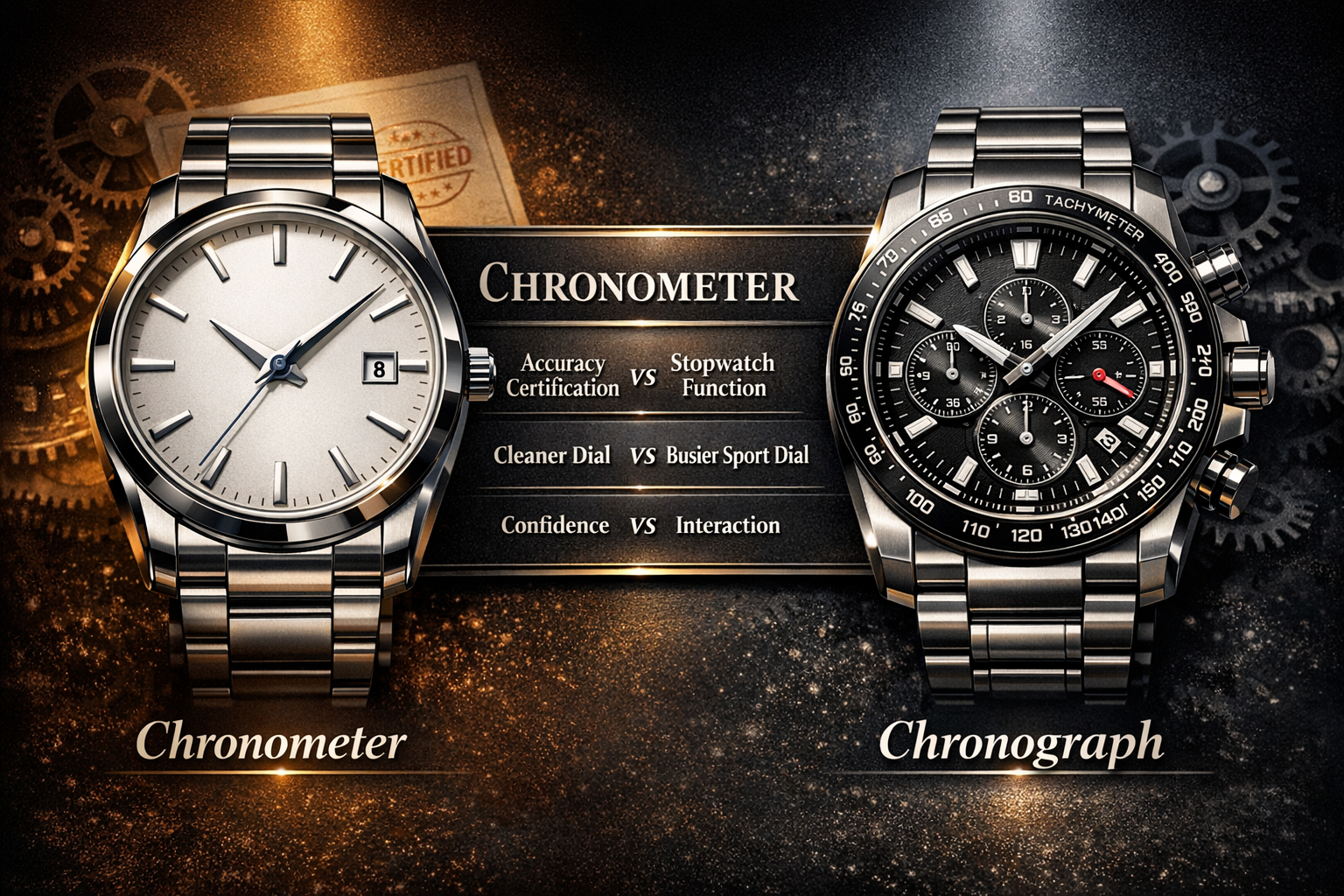
A chronometer is about accuracy certification. A chronograph is a stopwatch function built into a watch.
That is the cleanest way to remember it.
A chronometer tells you something about how a watch or movement has been tested for timekeeping performance.
A chronograph tells you the watch can measure elapsed time, usually using pushers and subdials.
So if you have ever looked at a watch listing and thought, “Wait, is this the accurate one or the one with the stopwatch?”—you are asking exactly the right question.
And in buying terms, the answer matters, because these two words affect ownership in very different ways.
The short answer: which one matters more to buyers?
For most buyers, chronograph matters more to how the watch looks and feels, while chronometer matters more to peace of mind and accuracy-focused buying.
That means:
- if you care about timing things, sporty styling, and visual complexity, chronograph matters more
- if you care about precision, certification, and long-term confidence in daily timekeeping, chronometer matters more
- if you are a first-time buyer, neither term automatically makes a watch “better”—the right one depends on how you plan to wear it
And this is the part many people miss:
A watch can be a chronometer without being a chronograph. A watch can be a chronograph without being a chronometer. Some watches are both. Many are neither.
Once that clicks, watch specs get much easier to read.
What is a chronometer?
A chronometer is a watch or movement that has been tested to meet a recognized accuracy standard.
In plain English, that means the watch is not just claiming to be accurate in marketing language. It has been measured against a formal testing benchmark.
To most buyers, “chronometer” usually means one thing:
this watch is emphasizing tested precision, not just style or complication count.
That said, a chronometer does not mean:
- the watch will never gain or lose time
- the watch is automatically better than every non-chronometer watch
- the watch has stopwatch functions
It simply means the watch is leaning into accuracy certification as part of its value story.
That can matter if you are the kind of owner who checks your watch against your phone, notices drift, or wants more confidence in daily timekeeping. If that is you, Are Automatic Watches Accurate? Real-World Tolerances, Why They Drift & How to Improve Accuracy is a good companion read.
What is a chronograph?
A chronograph is a watch with a stopwatch function.
Usually, that means:
- extra pushers on the side of the case
- one or more subdials on the dial
- the ability to start, stop, and reset elapsed timing
A chronograph changes what the watch does.
It is not mainly about certification or accuracy testing. It is about function.
That function can be genuinely useful, or simply enjoyable. Some people use chronographs to time parking, cooking, workouts, coffee brewing, commute intervals, or short events. Others simply like the more technical, motorsport-inspired look.
If you want the full practical breakdown of how that complication works, Chronograph Explained: What It Is, How It Works, and Common Mistakes to Avoid goes deeper.
The easiest way to remember the difference
If you want one memory trick, use this:
- Chronometer = certified accuracy
- Chronograph = stopwatch
That is it.
One is about timekeeping quality.
The other is about elapsed-time measurement.
Once you stop reading them as near-identical words, the difference becomes very straightforward.
Why buyers confuse them so often
There are three reasons this mix-up happens all the time.
1. The words look almost the same
They share the same first half, so newer buyers assume the difference is minor. In fact, the meanings are completely different.
2. Both sound technical and premium
A lot of watch language is full of heritage terms, and both of these sound more complicated than they need to be. One sounds like a precision term. The other sounds like a feature term. That overlap makes them easy to blur together.
3. Some watches are both
This is where people get really confused. A watch can have a chronograph complication and also be a chronometer. That means it is both a stopwatch watch and an accuracy-certified one.
But that does not mean the words are interchangeable. It just means the watch happens to check both boxes.
How to tell them apart in 10 seconds
If you are browsing product pages or scanning listings quickly, here is the easiest practical test.
It is probably a chronograph if:
- it has pushers at 2 and 4 o’clock
- it has subdials that track seconds, minutes, or elapsed time
- the listing talks about timing events or stopwatch function
It is probably a chronometer if:
- the listing specifically uses the word chronometer
- the dial text includes chronometer or officially certified chronometer
- the brand is emphasizing tested precision rather than stopwatch features
It may be both if:
- it has chronograph pushers and subdials
- and the listing also says the movement is chronometer-certified
This one habit alone will help many buyers avoid reading the wrong spec into the wrong watch.
Chronometer vs chronograph: what actually changes in ownership?
This is where the buying decision gets interesting.
Because in real life, these two terms affect your watch experience in different ways.
A chronometer changes confidence
A chronometer tends to matter in a quieter way. It is not always visible in use, but it may matter to buyers who care about how consistently a watch keeps time.
If you are the sort of owner who appreciates knowing your watch was tested to a known standard, a chronometer can be satisfying. It feels like a reassurance feature.
A chronograph changes interaction
A chronograph changes the watch more dramatically.
It changes:
- the case design
- the dial layout
- the visual complexity
- the thickness, in many cases
- the way you interact with the watch
A chronograph can feel more technical, more tool-like, and more active. Even people who rarely use the stopwatch often like the look and tactile feel.
So if the question is which one changes ownership more visibly, the answer is usually chronograph.
If the question is which one matters more to the buyer who cares about timekeeping performance, the answer is chronometer.
Real-world buyer case #1: the first-time everyday watch buyer
Let’s say someone is buying their first serious automatic watch. They want something clean, versatile, and easy to live with. They are not timing laps. They are not obsessed with motorsport styling. They mostly want a watch that looks good, feels balanced, and keeps time well.
For that buyer, chronometer matters more than chronograph—but only slightly.
Why? Because a chronograph may add visual clutter, more case thickness, and more complication than they actually need. A simpler watch is often the smarter first purchase.
That is why many first-time buyers do better starting with something closer to Best Automatic Watches for Beginners: Top Picks & Buying Tips rather than jumping straight into a busy chronograph dial.
Real-world buyer case #2: the sporty-style buyer
Now imagine someone loves technical-looking watches. They enjoy subdials, pushers, and the feeling that the watch does more than just tell the time. Maybe they occasionally time workouts, a parking meter, or small daily tasks.
For that buyer, chronograph matters much more.
This is true even if they do not use the stopwatch every single day. The chronograph complication affects the character of the watch in a visible, tactile way.
And once they go deeper into this category, they may naturally care about topics like Tachymeter Explained: How It Works, How to Use It, and What the Scale Really Means, Flyback Chronograph Explained: What It Is, How It Works, and How to Use It Safely, or the difference between Column Wheel vs Cam Chronograph: Differences, Feel, Reliability & What to Choose.
Real-world buyer case #3: the accuracy-focused owner
There is also the buyer who notices when a watch drifts. They may not be extreme about it, but they care. They want a mechanical watch that feels thoughtfully regulated and performance-minded.
For that buyer, chronometer matters more, because it speaks directly to the kind of reassurance they value.
That does not mean every chronometer will outperform every non-chronometer watch in all real-life situations. But as a buying signal, it tells the buyer what the brand wants them to pay attention to: tested timekeeping performance.
Which one is more useful in daily life?
This depends entirely on the wearer.
Chronograph is more useful if:
- you actually time things
- you enjoy interacting with the watch
- you like a sportier, more technical design
- you want the complication to feel visible and active
Chronometer is more useful if:
- you care about accuracy and consistency
- you check your watches against reference time
- you prefer a cleaner watch but still want performance reassurance
- you are spec-conscious in a quieter, less flashy way
Neither matters much if:
- you mainly buy based on fit, style, and comfort
- you rarely think about stopwatch timing
- you do not care whether the watch is certified
- you just want a reliable daily watch you enjoy wearing
And to be honest, that last group includes a lot of normal buyers.
How to actually use a chronograph
Since this article is decision-oriented, let’s keep this practical.
If your watch is a chronograph, the usual operation looks like this:
- Press the top pusher to start timing
- Press the top pusher again to stop
- Press the bottom pusher to reset
That is the basic use case.
But buyers often assume a chronograph is only for racing or aviation. In normal life, it can be used for:
- timing coffee or tea
- timing parking
- short workout intervals
- tracking a commute segment
- timing cooking or meetings
In other words, it is more practical than many people think—but only if you actually enjoy using it.
How to decide if chronometer is worth paying for
This part is less obvious, so here is a simple test.
Ask yourself these questions:
Do I care if my watch gains or loses noticeable time over the week?
If yes, chronometer may matter more to you.
Do I prefer a clean dial and simple daily ownership?
If yes, a chronometer-style value proposition may suit you better than a chronograph complication.
Am I buying the watch for confidence, or for interaction?
If the answer is confidence, that points more toward chronometer.
If the answer is interaction, that points more toward chronograph.
This is a useful filter because it shifts the question away from “which word sounds better” and toward “what kind of owner am I?”
The hidden tradeoff: simplicity vs complication
A big reason this comparison matters is that many buyers are not really choosing between two terms. They are choosing between two personalities.
A chronometer-leaning watch often feels:
- cleaner
- more restrained
- more daily-friendly
- more classic in layout
A chronograph-leaning watch often feels:
- busier
- more technical
- more sporty
- more interactive
Neither is automatically better.
But if you know you prefer cleaner, more wearable designs, you may be happier with a simpler watch that emphasizes timekeeping confidence over complication count.
If you know you enjoy function, detail, and button-driven interaction, a chronograph may be much more satisfying.
Can a watch be both a chronometer and a chronograph?
Yes, absolutely.
A watch can have:
- a stopwatch complication
- and an accuracy-certified movement
That means it is both a chronograph and a chronometer.
This sounds impressive, and sometimes it is. But from a buyer’s perspective, it is still worth separating the two ideas mentally:
- the chronograph part tells you what the watch can do
- the chronometer part tells you how the movement has been positioned and tested for performance
That distinction helps you avoid overpaying for terms you do not actually care about.
Common buyer mistakes
1. Assuming chronometer means stopwatch
It does not. This is the most common mistake and the whole reason many people search this topic in the first place.
2. Assuming chronograph means more accurate
It does not. A chronograph is a complication, not an accuracy certification.
3. Paying for a chronograph without wanting the design
A lot of people like the idea of more functions, then realize they prefer the cleaner look of a simple dial after a few months.
4. Paying extra for chronometer when accuracy is not a personal priority
If you never think about drift and never compare your watch to reference time, chronometer may be a nice bonus rather than a decisive factor.
What should most buyers choose?
Here is the most honest buying advice.
Choose a chronometer-leaning watch if:
- you care more about precision than extra functions
- you want a cleaner, less cluttered dial
- you value tested performance and daily reassurance
- you are buying a versatile watch for regular wear
Choose a chronograph if:
- you want stopwatch functionality
- you prefer a sportier, more technical watch
- you enjoy subdials, pushers, and active interaction
- the visual complexity is part of the appeal
Choose both if:
- you genuinely want the complication
- and you also care about certified performance
Choose neither as a priority if:
- fit, comfort, and style come first
- you are buying your first watch and do not want to overcomplicate the decision
- you simply want a solid automatic watch that suits daily life
That last path is often smarter than buyers expect. Before chasing terms, it is worth grounding the choice in basics like use case, size, and practicality. Articles like Automatic Watch vs Quartz: Differences, Pros & Which to Choose and How to Maintain an Automatic Watch: Daily Wear, Storage & Servicing help frame that bigger ownership picture.
A 30-second buying checklist
If you are staring at two watches and one says chronometer while the other says chronograph, use this:
Buy the chronometer-oriented watch if:
- you want cleaner design
- you care about precision
- you want less visual clutter
- you are buying one main everyday watch
Buy the chronograph if:
- you love the look
- you will use the timing function
- you want a sportier personality
- you enjoy more mechanical interaction
In many cases, the answer is not “which is technically superior?”
It is “which one will I actually enjoy wearing for the next three years?”
That is the better buying question.
FAQ
Is a chronometer the same as a chronograph?
No. A chronometer is about tested accuracy. A chronograph is a stopwatch function.
Which is better, chronometer or chronograph?
Neither is automatically better. Chronometer matters more for accuracy-focused buyers. Chronograph matters more for buyers who want stopwatch functionality and a sportier design.
Can a watch be both a chronometer and a chronograph?
Yes. Some watches combine a chronograph complication with chronometer-level accuracy certification.
Does a chronograph keep better time?
Not necessarily. A chronograph is a feature for measuring elapsed time. It does not automatically mean the watch is more accurate.
Is a chronometer worth it?
It can be, especially if you care about precision, consistency, and the reassurance of tested performance. But it is not essential for every buyer.
Is a chronograph worth it if I do not use the stopwatch much?
It depends. Many owners buy chronographs because they love the look and feel, not because they constantly use the timing function. That is a valid reason—as long as you genuinely like the busier dial and added thickness that often come with it.
Final verdict
If you want the simplest possible takeaway:
- Chronometer = accuracy certification
- Chronograph = stopwatch function
That is the difference.
And if you are asking which matters more to buyers, the honest answer is this:
Chronograph matters more to style, interaction, and visible personality. Chronometer matters more to confidence, precision-minded ownership, and spec-driven reassurance.
For many first-time buyers, the safer move is to decide based on lifestyle first:
- want a clean everyday watch? lean toward the chronometer side
- want a sporty, hands-on watch? lean toward the chronograph side
- want both? make sure you truly value both
- want simplicity? do not let either term overcomplicate the purchase
Because in the end, the best watch is rarely the one with the most impressive-sounding word.
It is the one that fits how you actually wear it.