Flyback Chronograph Explained: What It Is, How It Works, and How to Use It Safely
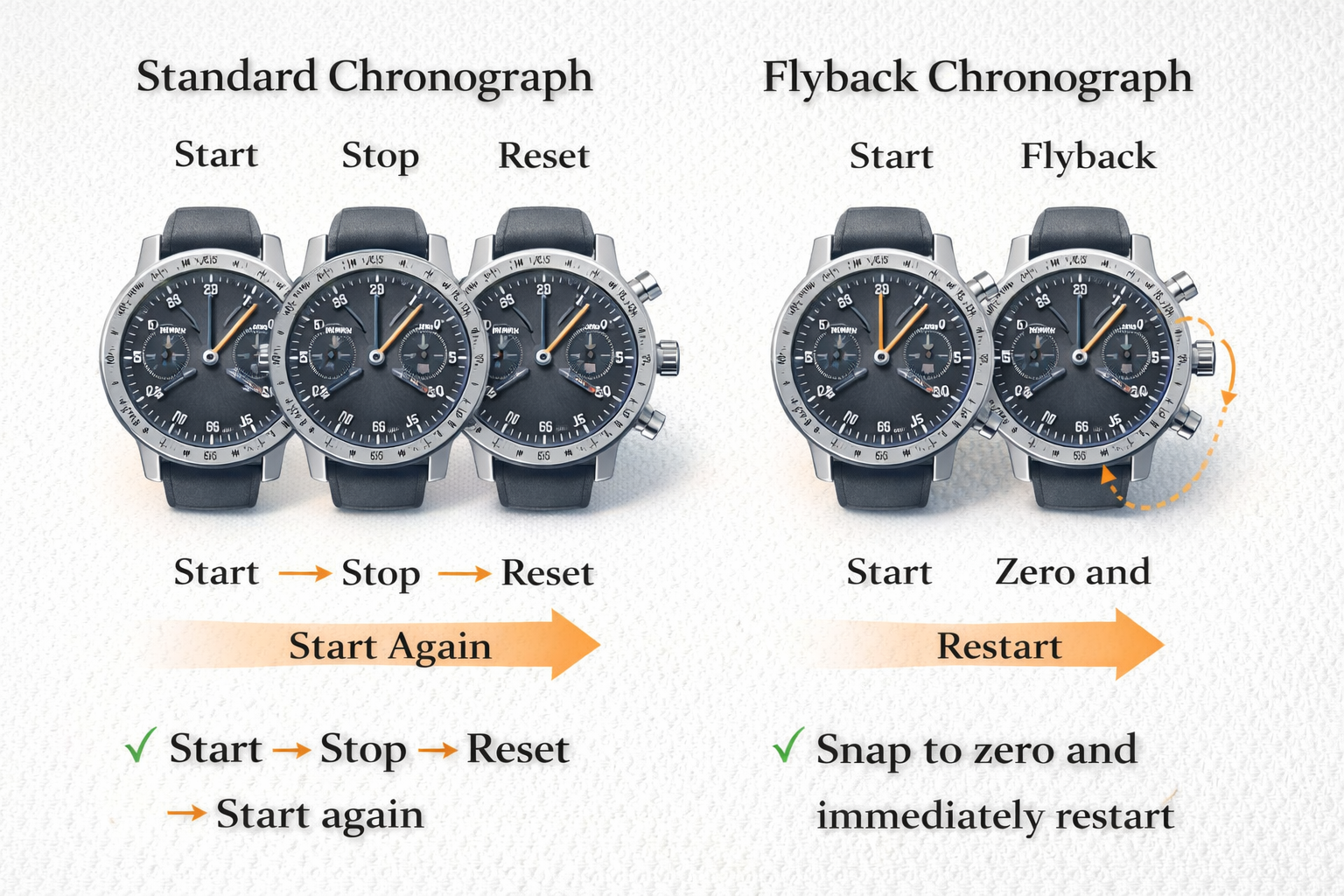 A flyback chronograph is a chronograph that lets you reset and restart timing with a single press—without stopping first. It’s designed for timing consecutive intervals quickly (historically useful in aviation and navigation).
If you need the basic chronograph foundation first, read:
Chronograph Explained: What It Is, How It Works, and Common Mistakes to Avoid
Quick Answer
-
Standard chronograph: Start → Stop → Reset → Start again
-
Flyback chronograph: While running, press flyback reset and it snaps to zero and immediately starts timing again
-
This is fast, but it’s also a more complex mechanism, so you should use it correctly.
What Flyback Is Used For (Real Examples)
Flyback is useful when you need to time:
-
repeated laps or segments without losing time between resets
-
navigation legs (start a new interval instantly)
-
quick consecutive events (kitchen timing, training intervals)
How Flyback Works (Simple Explanation)
A flyback chronograph uses:
-
a chronograph mechanism (start/stop/reset)
-
plus additional components so the reset can happen while the chronograph is engaged
Instead of requiring “stop first,” the system coordinates:
-
disengage or control the coupling momentarily
-
hammer resets hands to zero
-
immediately re-engage timing
Movement basics if you want more background:
How Does an Automatic Watch Work? Simple Beginner Guide
Flyback vs Standard Chronograph (Key Differences)
| Feature | Standard Chronograph | Flyback Chronograph |
|---|---|---|
| Reset while running | ❌ No (stop first) | ✅ Yes |
| Speed for consecutive intervals | Slower | Faster |
| Mechanical complexity | Lower | Higher |
| Best use case | Occasional timing | Frequent consecutive timing |
How to Use a Flyback Chronograph Safely
1) Use the correct pusher
Flyback is typically activated by the reset pusher—on a flyback design it behaves differently.
2) Don’t “machine-gun” the button
Even though flyback is designed for running resets, avoid rapid repeated presses for no reason.
3) If anything feels rough, stop
If pushers feel gritty or resistance changes, don’t force them.
Care habits matter more than people think:
How to Maintain an Automatic Watch: Daily Wear, Storage & Servicing
And service expectations:
How Often Should You Service an Automatic Watch?
Does Flyback Affect Accuracy or Power Reserve?
Running any chronograph can add load in some designs and may slightly affect:
-
amplitude
-
power reserve
-
stability
Accuracy baseline:
Are Automatic Watches Accurate?
If your watch suddenly starts running fast, magnetism is a common cause:
Watch Magnetism: Signs Your Watch Is Magnetized, How to Test It
Flyback and the Tachymeter (Perfect Pair)
Flyback chronographs pair naturally with tachymeter use because you can time back-to-back segments quickly.
Read: Tachymeter Explained: How It Works, How to Use It, and What the Scale Really Means
Want to understand why some chronographs handle “running + reset behavior” more smoothly? Read Vertical vs Horizontal Clutch:
Vertical vs Horizontal Clutch Chronograph: Differences, Pros, Cons & Which You Should Choose
Curious why some chronographs have smoother pusher feel and more precise switching? Read Column Wheel vs Cam Chronograph:
Column Wheel vs Cam Chronograph: Differences, Feel, Reliability & What to Choose
FAQ: Flyback Chronographs
Is flyback the same as reset?
No. A standard reset happens after stopping. Flyback resets while running and immediately restarts timing.
Can I use flyback repeatedly?
Yes, but don’t abuse it with rapid pointless presses. Use it when you actually need consecutive timing.
Does flyback make a chronograph “better”?
Not necessarily. It’s a specialized feature. If you never time consecutive intervals, you may not need it.
Will flyback damage my watch?
Not if it’s a true flyback chronograph and used normally. If you’re unsure whether your watch is flyback, don’t reset while running.