Tachymeter Explained: How It Works, How to Use It, and What the Scale Really Means
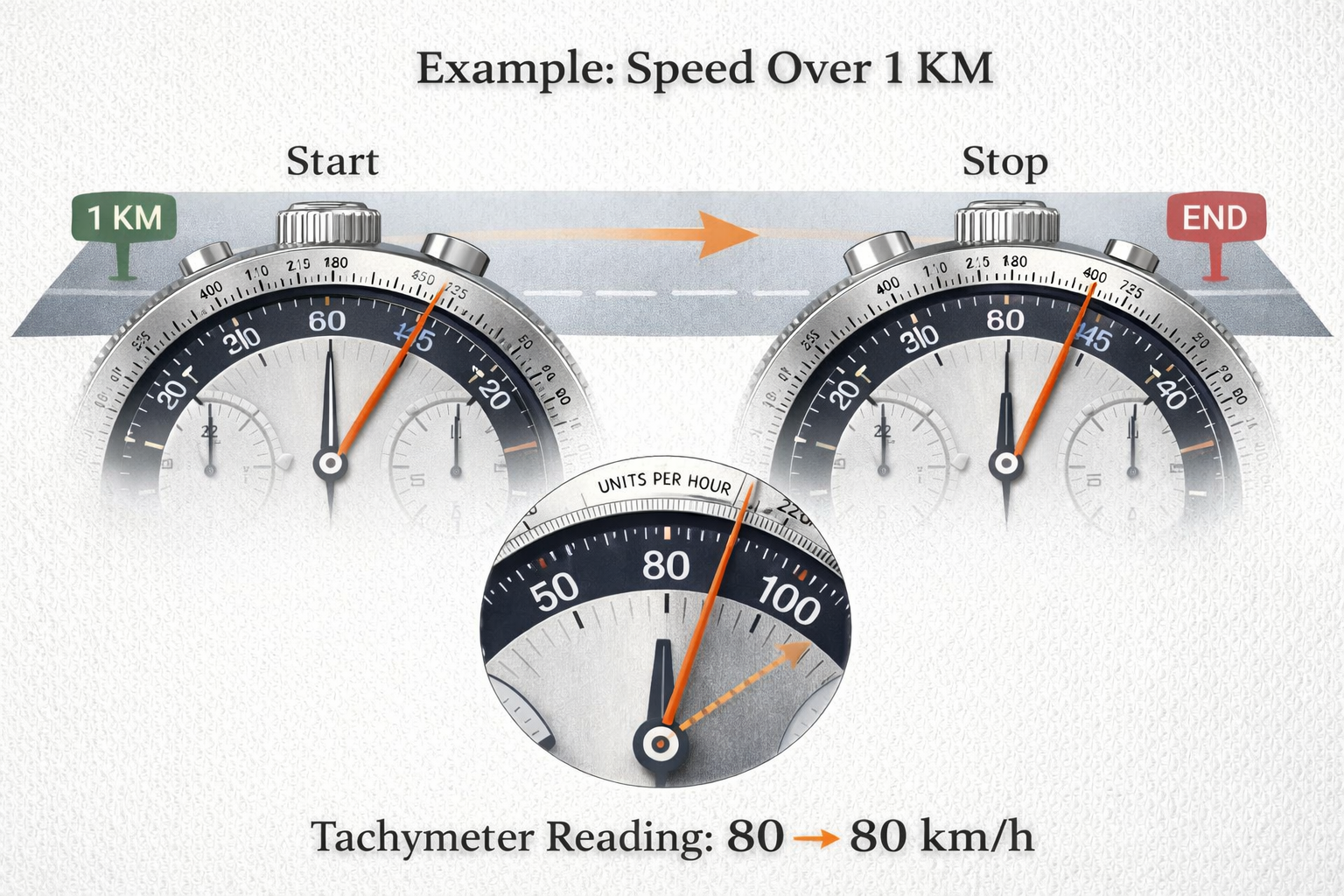 A tachymeter is a scale—usually printed on the bezel or around the dial—designed to work with a chronograph. It lets you calculate a rate per hour (most commonly speed) based on how long an event takes.
If you haven’t read the chronograph basics first, start here:
Chronograph Explained: What It Is, How It Works, and Common Mistakes to Avoid
Quick Answer
-
A tachymeter converts time (seconds) into a rate per hour.
-
You start the chronograph at the beginning of an event and stop it at the end.
-
Where the seconds hand points on the tachymeter scale gives you the rate.
What a Tachymeter Measures (It’s Not Only Speed)
Most people use it for speed (e.g., km/h or mph), but a tachymeter can measure any “per hour” rate if the event distance/quantity is known:
-
speed over 1 km or 1 mile
-
production rate (items per hour)
-
repetitive tasks (cycles per hour)
How to Use a Tachymeter (Step-by-Step)
Example 1: Speed over 1 km (or 1 mile)
-
Use a known distance: 1 km (or 1 mile)
-
Start chronograph at the start marker
-
Stop chronograph at the end marker
-
Read the number on the tachymeter scale where the seconds hand stops
If it stops at 90, your speed is 90 km/h (if you used 1 km) or 90 mph (if you used 1 mile).
The unit depends on the distance you choose.
Why the Scale Says “Units per Hour”
A tachymeter assumes:
-
you measured the time for one unit (1 km / 1 mile / 1 item)
-
then it converts that time into “how many units would happen in one hour.”
Quick Reference Table (Common Times)
| Time for 1 unit | Tachymeter reading (approx.) | Meaning |
|---|---|---|
| 60 seconds | 60 | 60 units/hour |
| 45 seconds | 80 | 80 units/hour |
| 40 seconds | 90 | 90 units/hour |
| 36 seconds | 100 | 100 units/hour |
| 30 seconds | 120 | 120 units/hour |
Common Mistakes
1) Using the wrong distance unit
If you measure 0.5 km but read the tachymeter as if it were 1 km, your result will be wrong.
(You can still do it—you just need to adjust math.)
2) Forgetting it measures “per hour”
If you time something that takes 2 minutes, a typical tachymeter scale may not apply cleanly (many are designed for 7–60 seconds range).
3) Resetting the chronograph while it’s still running
Always stop first, then reset.
Chronograph best practices:
Chronograph Explained: What It Is, How It Works, and Common Mistakes to Avoid
Can You Use a Tachymeter for Slower Events?
Yes, but you may need:
-
multiple units (e.g., time 2 km instead of 1 km, then adjust)
-
or a different scale design
Does Running the Chronograph Affect Accuracy?
Sometimes. Running the chronograph can add load in some movements and may slightly affect timekeeping.
Accuracy baseline:
Are Automatic Watches Accurate?
If your watch suddenly runs fast or becomes erratic, magnetism is common:
Watch Magnetism: Signs Your Watch Is Magnetized, How to Test It
Maintenance Note (Chronographs Need Care)
Chronographs have more moving parts. If the pushers feel rough or performance changes, follow your service guidance:
How Often Should You Service an Automatic Watch?
And daily care here:
How to Maintain an Automatic Watch: Daily Wear, Storage & Servicing
Advanced Reading
Want to understand why some chronographs start smoother than others when you hit the pusher? Read our deep dive on Vertical vs Horizontal Clutch:
Vertical vs Horizontal Clutch Chronograph: Differences, Pros, Cons & Which You Should Choose
Curious why some chronographs have a more refined pusher feel? Learn the difference between Column Wheel vs Cam switching systems:
Column Wheel vs Cam Chronograph: Differences, Feel, Reliability & What to Choose
FAQ: Tachymeter
What does a tachymeter do?
It converts elapsed time into a “per hour” rate—most commonly speed.
Does it work in mph or km/h?
It works in either, depending on whether you time 1 mile or 1 km.
Can I use it for timing anything?
Yes—any repetitive measurable unit works (items/hour), as long as your timing fits the scale range.
Is a tachymeter useful today?
It’s more of a functional heritage feature, but it’s still usable and fun.