Tudor Black Bay 54 vs Black Bay 58: Which One Should You Buy First?
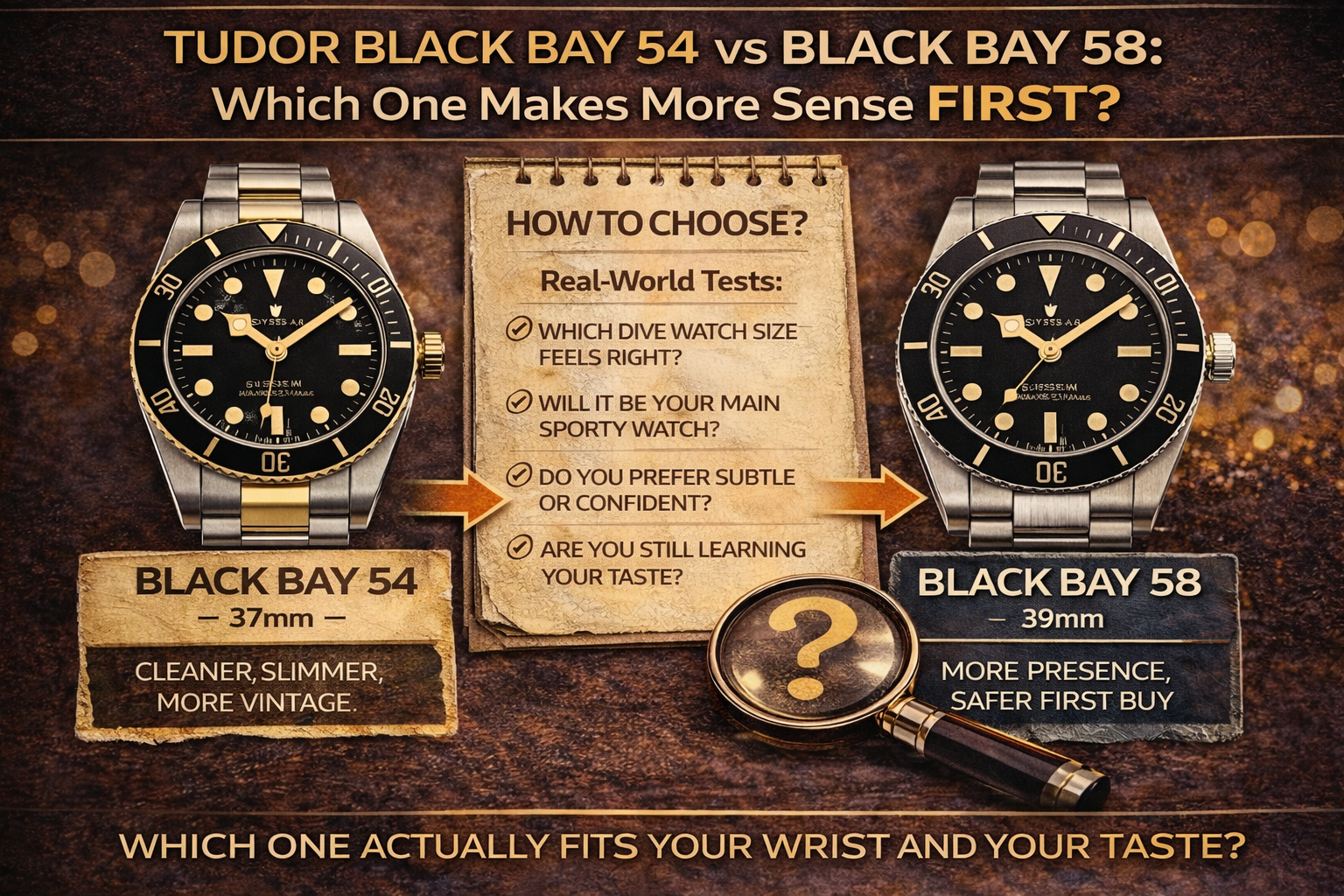
This looks like a simple size comparison.
It isn’t.
On paper, the Tudor Black Bay 54 and Black Bay 58 seem close enough that many buyers assume the decision will be easy. Both are steel dive watches with strong vintage cues, both are water-resistant to 200 metres, both use in-house time-only movements, and both sit in that sweet spot where a watch can feel serious without becoming bulky. Tudor currently lists the Black Bay 54 in a 37 mm case with the COSC-certified MT5400 and about 70 hours of power reserve, while the current steel Black Bay 58 is 39 mm, uses the MT5400-U with COSC and METAS certification, and has about 65 hours of power reserve.
But in real life, these two watches do not wear like close siblings.
They wear like two different answers to the same question.
The short version is this:
- Buy the Black Bay 54 if you want the cleaner, trimmer, more vintage-correct, more discreet watch.
- Buy the Black Bay 58 if you want the more universally familiar dive-watch stance, more wrist presence, and a slightly more modern-feeling fit.
That is the headline. The rest of this article is about which one makes more sense first.
Because that changes the answer.
Why this comparison matters so much
The Black Bay 54 is Tudor’s most direct modern homage to its original 1954 Submariner-era dive watch, with a 37 mm case and a stripped-back bezel insert with no minute graduations. Tudor says exactly that on its official Black Bay 54 family page.
The Black Bay 58, meanwhile, has become one of Tudor’s defining modern hits. The current steel version stays at 39 mm, keeps the vintage-inspired formula, and adds a more technically updated spec sheet through the MT5400-U movement and Master Chronometer-level METAS certification.
So this is not just “smaller vs bigger.”
It is really:
- purer vs more versatile-looking
- more vintage-correct vs more broadly modern
- quieter vs safer
- niche charm vs mainstream confidence
That is why buyers get stuck.
A lot of people love the 54 in theory and buy the 58.
A lot of people assume the 58 is the obvious answer and then get pulled back toward the 54.
What is actually different on paper?
Let’s remove the noise first.
Black Bay 54
Tudor lists the Black Bay 54 with a 37 mm steel case, 11.2 mm thickness, 20 mm lug width, 200 m water resistance, MT5400 (COSC) movement, and approximately 70 hours of power reserve. The black version uses an aluminium bezel insert without minute graduations, while Tudor also now lists a blue textured-dial version with a polished steel bezel insert.
Black Bay 58
Tudor lists the current steel Black Bay 58 with a 39 mm steel case, 11.7 mm thickness, 20 mm lug width, 200 m water resistance, and MT5400-U movement that is both COSC and METAS certified, with 65 hours of power reserve. The steel model shown currently uses an anodised aluminium bezel insert and a domed black dial with applied markers.
Those numbers sound close.
On the wrist, they are not.
The Black Bay 54: why people end up loving it
The Black Bay 54 is the kind of watch that makes more sense the longer you wear it.
At first, some buyers worry it may be too small. Then they put it on and realise it is not really a “small diver.” It is a compact, extremely well-proportioned diver.
That distinction matters.
The 37 mm case, 11.2 mm thickness, and no-minute-marking bezel make the watch feel unusually clean and compact for a modern diver. Tudor’s own family page leans into this by calling it the most true-to-form example of its first dive watch.
In real life, the 54 tends to do four things very well:
1. It wears flatter and easier
Not dramatically flatter on paper, but meaningfully easier in use. That 11.2 mm thickness and smaller overall footprint make it disappear in a very pleasant way.
2. It feels more refined
The 54 is less “tool watch first impression” and more “beautifully edited daily diver.”
3. It suits smaller wrists naturally
This is obvious, but still important. If you already know you prefer compact watches, the 54 usually makes immediate sense.
4. It looks more distinctive within the Tudor lineup
The 58 is more universally liked. The 54 is more specific. That specificity is exactly why some buyers fall hard for it.
This connects naturally with Best Automatic Watches for Small Wrists: What to Look for Before You Buy and Automatic Watch Size Guide: 36mm vs 38mm vs 40mm vs 42mm — What Actually Fits Your Wrist?.
The Black Bay 58: why it is still the safer first buy for many people
The Black Bay 58 is easier to understand instantly.
It looks like what many people imagine when they picture a modern-vintage dive watch: 39 mm, strong bezel presence, more open dial, and a very familiar sporty stance. Tudor’s official specs keep it compact by modern standards, but it still feels more like a conventional dive watch than the 54.
That matters because your first Tudor usually needs to do more than charm you.
It needs to reassure you.
The 58 is strong at that.
1. It looks more like a “normal dive watch”
For a lot of buyers, that makes the 58 easier to commit to.
2. It has more immediate wrist presence
At 39 mm and 11.7 mm thick, it still wears compactly, but it has more visual weight than the 54.
3. It gives you the stronger spec-sheet story
The current steel 58 uses Tudor’s MT5400-U, which the brand says is both COSC and METAS certified. That is a real technical selling point for buyers who care about movement validation, not just style.
4. It is easier to recommend without many caveats
The 54 requires taste. The 58 mostly requires preference.
That difference is huge for a first purchase.
Which one wears better?
If the question is purely “which one wears better,” the answer depends on what “better” means to you.
The Black Bay 54 wears better if:
- you prefer compact watches
- you dislike bulky divers
- you want vintage proportions
- you want a dive watch that behaves almost like a GADA watch
The Black Bay 58 wears better if:
- you want more familiar dive-watch presence
- you have a medium-to-larger wrist
- you want the safer all-round size
- you want a first Tudor that feels immediately substantial
This is similar to what happens in Rolex Explorer 36 vs 40: Which Size Actually Wears Better?. The wrong watch is rarely “bad.” It is just slightly wrong in proportion, and that becomes more noticeable the longer you own it.
The real buying question: which one should you buy first?
This is where the answer changes.
If you already know your taste, the choice is easier.
If you are still learning your taste, the first-watch decision matters more.
Buy the Black Bay 54 first if…
You already know you love compact proportions, vintage restraint, and watches that feel edited rather than assertive. The 54 is also a smart first buy if you have tried 39–40 mm divers before and always felt they were a little too much.
Buy the Black Bay 58 first if…
You want the lower-risk answer. The 58 is easier to understand, easier to recommend, and less likely to trigger second thoughts if you are still figuring out your Tudor lane.
That is why, for many buyers, the 58 makes more sense as a first Tudor, even if the 54 ends up being their favorite later.
Real-world scenarios
Scenario 1: You want one dive watch that can do almost everything
The Black Bay 58 is usually the safer answer.
It has enough vintage charm to feel interesting, but enough conventional dive-watch presence to work as your main sporty watch without much overthinking.
Scenario 2: You want a diver that does not wear like a typical diver
The Black Bay 54 is the better answer.
That is almost its whole appeal. It gives you dive-watch credibility without the usual bulk or stance.
Scenario 3: You mostly wear slim, understated watches already
The Black Bay 54 will often integrate better into your collection.
Scenario 4: This is your first serious Swiss dive watch
The Black Bay 58 is still the default recommendation for a reason.
It is easier to love immediately.
What buyers get wrong
They think the 54 is just the smaller version of the 58.
It is not.
Yes, both are compact vintage-leaning Black Bays. But the 54 is a more radical proposition than that. The bezel treatment, the proportions, and the overall feel make it a distinctly different watch, not a shrink-ray version of the 58. Tudor’s own positioning around the 54 as the most true-to-form take on the 1954 original makes that clear.
The other common mistake is assuming the 58 is automatically outdated because the 54 is newer.
That is also wrong.
The current steel 58 has been technically refreshed with the MT5400-U and METAS certification, which means Tudor is not treating it like a stale middle child.
A practical try-on checklist
If you can try both on, do this:
Step 1: Look from arm’s length
Do not inspect them like products. Look at them like a watch you would actually wear.
Step 2: Wear each for a few minutes, not a few seconds
The 54 often gets better after a minute. The 58 often wins the first impression.
Step 3: Try them with a sleeve
A compact diver can change dramatically once clothing enters the picture.
Step 4: Ask which one disappears in the right way
The best first watch is often the one that feels easiest to live with, not the one that shouts hardest in boutique lighting.
Final verdict
If you want the most broadly recommendable first Tudor, buy the Black Bay 58.
It is the safer first purchase because it looks more familiar, wears more conventionally for a dive watch, and now brings a very strong technical package through its 39 mm case, MT5400-U, COSC + METAS certification, 65-hour power reserve, and 200 m water resistance.
But if you already know you prefer smaller, cleaner, more vintage-correct watches, the Black Bay 54 may actually be the better watch for you. Its 37 mm case, 11.2 mm thickness, MT5400, 70-hour power reserve, and stripped-back bezel make it one of the most convincing compact modern dive watches Tudor makes.
So the honest answer is this:
- Buy the Black Bay 58 first if you want the safer, broader recommendation.
- Buy the Black Bay 54 first if you already know your taste leans compact, restrained, and vintage.
The wrong answer is not buying the smaller one or the bigger one.
The wrong answer is assuming they are basically the same.
FAQ
Is the Black Bay 54 smaller than the Black Bay 58?
Yes. Tudor lists the Black Bay 54 at 37 mm and the current steel Black Bay 58 at 39 mm.
Is the Black Bay 54 thinner than the Black Bay 58?
Yes. The Black Bay 54 is listed at 11.2 mm thick, while the current steel Black Bay 58 is 11.7 mm thick.
Do both the Black Bay 54 and Black Bay 58 have 200m water resistance?
Yes. Tudor lists both models as water-resistant to 200 m (660 ft).
Which has the better movement, the Black Bay 54 or Black Bay 58?
The answer depends on what you value. The Black Bay 54 uses the MT5400 (COSC) with about 70 hours of power reserve, while the current steel Black Bay 58 uses the MT5400-U, which Tudor says is both COSC and METAS certified, with 65 hours of power reserve.
Which one is better for smaller wrists?
Usually the Black Bay 54, because of its 37 mm case and slimmer overall feel.
Which one should you buy first?
For most buyers, the Black Bay 58 is the safer first buy. For buyers who already know they prefer compact vintage proportions, the Black Bay 54 may be the better first choice. This is an inference based on Tudor’s official specs and the different proportions of the two watches.
Suggested Featured Excerpt
The Tudor Black Bay 54 is the better first buy if you already know you love compact, vintage-correct proportions. The Black Bay 58 is the safer first choice for most buyers because it offers a more familiar dive-watch fit, more wrist presence, and a stronger modern technical package.