Leather vs Bracelet vs Rubber Strap: How Strap Choice Changes Fit, Style, and Value
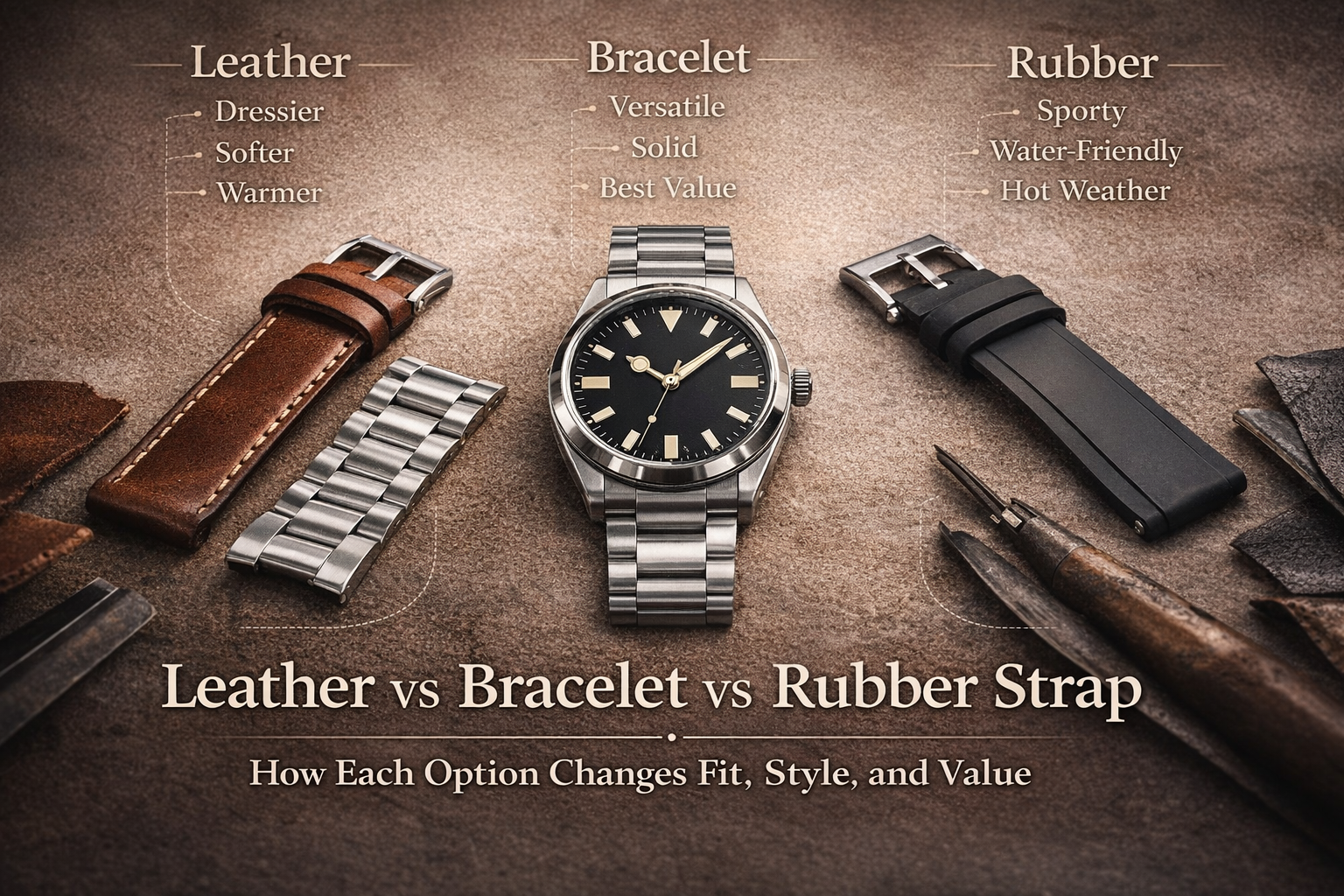
Leather vs Bracelet vs Rubber Strap: How Strap Choice Changes Fit, Style, and Value
A lot of people think they are buying a watch.
Very often, they are also buying a wearing experience—and the strap or bracelet is a huge part of that.
In fact, the same watch head can feel more elegant on leather, more substantial on a bracelet, and more casual or sporty on rubber. That means strap choice does not just change how the watch looks. It changes how the watch fits, how often you wear it, and whether it feels like a smart purchase six months later.
So here is the practical answer first:
Choose leather if you want the most refined look. Choose a bracelet if you want the most versatile and value-friendly setup. Choose rubber if you want the best comfort for active or hot-weather wear.
That is the short version.
But the better answer depends on how you dress, how much water exposure your watch will see, whether you wear one watch every day, and how much convenience matters to you.
If you are still early in the buying process, it helps to start with What Is an Automatic Watch? Pros, Cons & Who Should Buy One and Best Automatic Watches for Beginners: Top Picks & Buying Tips. But if your real question is how strap choice changes daily ownership, this guide is the practical one.
The short answer: which one is best?
If you want the fastest buying summary:
- Leather is best for style, elegance, and dressier wear
- Bracelet is best for all-round versatility, durability, and long-term value
- Rubber is best for comfort, active use, heat, and water-heavy lifestyles
That sounds simple, but daily wear is rarely that clean.
A watch on leather can look amazing and still feel wrong in summer.
A bracelet can be versatile and durable, but feel a little too heavy for some people.
Rubber can be incredibly comfortable, but not always the most refined choice for office or formal wear.
So the better question is not “Which strap is best?”
It is: Which strap makes the most sense for how I actually live?
Why strap choice matters more than many buyers think
Because the strap or bracelet affects five things immediately:
- how the watch sits on your wrist
- how the weight is distributed
- how formal or casual the watch feels
- how comfortable it is over a full day
- whether the watch still feels right across seasons and situations
That is why two people can buy the same watch and have completely different ownership experiences. One buys it on bracelet and wears it all year. The other buys it on leather, loves it in photos, then barely wears it in warm weather.
The watch head may be the same. The life with it is not.
Leather vs bracelet vs rubber: the real-life comparison
| Category | Leather Strap | Bracelet | Rubber Strap |
|---|---|---|---|
| Overall style | Refined, dressy, classic | Versatile, substantial, classic-sporty | Casual, sporty, modern |
| Comfort | Soft, light, flexible | Solid, secure, can feel heavier | Very comfortable, especially in heat |
| Water friendliness | Low | High | Very high |
| Formality | Strongest | Medium to strong | Lowest |
| Summer performance | Can get warm and wear faster | Good | Excellent |
| Long-term value | Stylish, but replaceable | Often best value | Good for use, less for dress appeal |
| Best for | Dress watches, office wear, smart casual | One-watch ownership, everyday versatility | Sports, travel, pool, hot weather |
| Ownership feel | Elegant | Practical and complete | Easy and active |
That chart gets you most of the way there.
If you want the safest one-watch answer, bracelet usually wins.
If you want the most refined look, leather wins.
If you want the easiest active comfort, rubber wins.
Leather strap: why it looks so good so quickly
Leather has one major advantage that never really goes out of style:
it makes a watch look more intentional and more elegant, almost immediately.
A simple automatic watch on leather often feels:
- cleaner
- warmer
- more refined
- more vintage-friendly
- more dress-appropriate
That is why leather works so naturally with pieces that lean formal or classic. Even a modestly priced watch can look more elevated on a well-chosen leather strap.
This is exactly the kind of styling logic behind many watches that fit naturally into Best Automatic Dress Watches Under $1000: Elegant Picks for Formal Style.
The downside of leather in daily life
Leather looks great, but it has clear tradeoffs.
It is usually less ideal for:
- frequent water exposure
- hot, humid weather
- heavy sweating
- beach or pool trips
- truly carefree all-day abuse
A leather strap can also age faster depending on climate, sweat, and how often you wear it. That is not a flaw. It is just part of the ownership reality.
Leather is often best when:
- appearance matters a lot
- your routine is mostly dry and controlled
- you like a more classic wearing experience
- you are comfortable replacing the strap over time
So leather is beautiful—but not always the easiest.
Bracelet: why it is still the safest all-round choice
If someone asks for the most practical default answer, bracelet is usually it.
Why? Because a metal bracelet gives you:
- better all-season usability
- stronger durability
- better resistance to sweat and water
- a more “complete” feeling package
- stronger resale and ownership value perception
That last point matters more than many buyers realize. A watch sold on bracelet often feels like the fuller purchase, because you can always add leather or rubber later. Going the other direction is sometimes more expensive or harder to match well.
That is one reason bracelets remain such a strong option for first-time buyers and one-watch owners.
Why bracelet changes the watch so much
A bracelet does more than attach the watch to your wrist.
It changes how the watch feels in three major ways:
1. It increases visual weight
The watch looks more substantial and more integrated.
2. It increases physical weight
This can be a good thing or a bad thing depending on your taste. Some people love the heft and solidity. Others realize they prefer a lighter setup.
3. It increases versatility
A bracelet can usually move between casual, office, travel, and everyday use better than most straps.
That is why bracelet is often the best answer for someone buying one main automatic watch, especially if they are also comparing across categories in Best Automatic Watches by Budget: $300 vs $500 vs $1000 — How to Choose the Right One.
The downside of bracelet
Bracelets are not perfect.
They can feel:
- heavier
- hotter than expected in some conditions
- less soft than leather
- less flexible in feel
- annoying if the fit is not adjusted properly
A badly sized bracelet can make an otherwise excellent watch feel clumsy. That is why bracelet ownership depends heavily on good sizing.
Still, when the fit is right, bracelet is hard to beat for day-to-day usefulness.
Rubber strap: the most underestimated daily option
A lot of buyers think rubber is only for divers or sporty watches.
That is outdated.
A good rubber strap can be one of the most comfortable, practical options in modern watch ownership—especially if you live somewhere warm, travel often, or simply prefer easy wear.
Rubber usually gives you:
- excellent comfort
- strong sweat resistance
- easy cleaning
- strong water performance
- a relaxed, modern feel
In real life, rubber often works best for buyers who want their watch to feel effortless, especially in active or casual settings.
That makes it a very natural match for watches that already lean sporty, including many in Best Automatic Dive Watches Under $1000: Durable, Reliable & Built for Adventure.
The downside of rubber
Rubber is practical, but it does not always help a watch look more expensive or more refined.
That is the tradeoff.
Rubber can feel:
- too casual for dressier settings
- too sporty for office-heavy wardrobes
- less visually rich than leather
- less “complete” than a bracelet for some buyers
In other words, rubber often wins on use and loses on elegance.
That does not make it inferior. It just means its strengths are situational and lifestyle-driven.
Real-world buyer case #1: the one-watch beginner
Let’s say someone is buying their first automatic watch. They want one piece for work, weekends, travel, and general daily life. They do not want to overthink ownership.
For this buyer, bracelet is usually the safest choice.
Why?
Because bracelet handles:
- weather
- sweat
- more casual wear
- office use
- long-term flexibility
And later, the buyer can always add a leather or rubber strap to change the personality of the watch.
That flexibility is extremely valuable for beginners, which is why bracelet often makes the most sense for people choosing their first real automatic from Best Automatic Watches for Beginners: Top Picks & Buying Tips.
Real-world buyer case #2: the office-first buyer
This buyer wears shirts, knitwear, jackets, and smarter casual clothes most days. They want their watch to look refined, not bulky. Water use is limited. Style matters more than sport use.
For this buyer, leather often feels better.
Why?
Because leather softens the watch, adds warmth, and leans into elegance. It also tends to pair more naturally with formal or smart-casual clothing than rubber does, and sometimes more gracefully than bracelet does too.
This is especially true when the watch itself is already slim or dress-leaning.
Real-world buyer case #3: the vacation / summer buyer
This buyer lives in a warm climate, travels often, or wants a watch that can handle poolside days, walking, sweat, heat, and easy care.
For this buyer, rubber often wins.
This is where rubber stops being “just a sporty option” and becomes the smartest ownership choice. It is comfortable, low-maintenance, and much easier to live with in active conditions.
If you already know water exposure is part of the equation, Water Resistance Explained for Everyday Watches: 30m vs 50m vs 100m vs 200m — What You Can Actually Do is worth reading alongside this topic, because strap choice and water use usually need to be thought about together.
Which one feels best on the wrist?
This depends on what “best” means to you.
Leather usually feels best if you want:
- softness
- flexibility
- a lighter setup
- less wrist noise
- more organic comfort
Bracelet usually feels best if you want:
- solidity
- security
- weight balance across the wrist
- a more substantial feel
- the classic watch experience
Rubber usually feels best if you want:
- low fuss
- easy comfort
- sport-ready wear
- sweat resistance
- hot-weather friendliness
So the best-feeling strap is really the one that matches your daily conditions, not the one that wins a generic comparison.
Which one is best for hot weather?
Usually, rubber first, bracelet second, leather third.
That is the cleanest real-world ranking.
Rubber handles heat and sweat extremely well. Bracelet also works well because it is easy to clean and not harmed by moisture in the same way leather is. Leather is usually the most challenging in hot conditions because it can absorb sweat and wear faster.
If you live in a hot climate, this question matters a lot more than many buyers realize.
Which one is best for formal wear?
Usually, leather first, bracelet second, rubber third.
Leather gives the cleanest, most refined, most classic formal look. Bracelet can still work very well, especially on the right watch, but it feels more versatile than truly dress-first. Rubber is usually the least formal option.
That is why buyers aiming for elegance usually end up favoring leather at least some of the time.
Which one adds the most value?
This depends on what you mean by value.
Bracelet often wins on purchase value
A watch on bracelet often feels like the best deal because:
- it is usually more expensive to add later
- it increases versatility
- it makes the watch feel more complete
- it can support both casual and smart use
Leather often wins on style value
Leather can make a watch look dramatically better for certain wardrobes and formal situations.
Rubber often wins on use value
Rubber can make a watch much more wearable in heat, travel, water, and active life.
So if by value you mean best total package, bracelet often wins.
If by value you mean best visual upgrade, leather can win.
If by value you mean best daily practicality in rough conditions, rubber can win.
How strap choice changes the same watch
This is maybe the most important point in the whole article.
A single watch can become three very different watches depending on what it is attached to.
On leather
It feels:
- slimmer
- more refined
- more classic
- more mature
On bracelet
It feels:
- more substantial
- more versatile
- more complete
- more everyday-capable
On rubber
It feels:
- more relaxed
- more sporty
- more modern
- more practical in active use
That means strap choice is not a small accessory decision. It is part of the watch’s identity.
Practical operation: how to choose the right strap for your lifestyle
If you are stuck, use this simple test.
Step 1: think about your actual wardrobe
Do you mostly wear:
- shirts and jackets?
- T-shirts and casual clothes?
- mixed office and weekend wear?
- active or travel-heavy outfits?
This will usually narrow the answer quickly.
Step 2: think about climate
Do you live in:
- hot, humid weather?
- mild year-round weather?
- cooler, dry conditions?
Rubber and bracelet become more attractive as heat and humidity rise.
Step 3: think about water
Will the watch regularly see:
- rain?
- sweat?
- pool or beach use?
- travel and outdoor activity?
If yes, leather becomes less ideal.
Step 4: think about your patience
Do you want:
- one setup that just works?
- a refined option you may swap seasonally?
- a sporty option for specific days?
Bracelet usually works best if you want the least thinking.
Step 5: think about what you want the watch to feel like
This is the emotional test:
- elegant?
- substantial?
- effortless?
That answer matters as much as any spec sheet.
The easiest one-watch buying strategy
If you are buying one watch and do not want to make a mistake, this is the safest route:
Buy on bracelet first. Add leather or rubber later if needed.
That is usually the smartest long-term strategy because:
- bracelet is harder or more expensive to add later
- you get the most versatile starting point
- you can change style with straps afterward
- it protects the purchase from becoming too limited
This is especially smart for buyers still learning their own taste.
Common buyer mistakes
1. Choosing leather because it looks best in photos
It may still be right, but many buyers underestimate how much climate and sweat affect real ownership.
2. Choosing rubber for comfort without thinking about wardrobe
Rubber can feel amazing, but it may not suit a more formal or office-heavy lifestyle.
3. Ignoring bracelet fit
A badly adjusted bracelet can make an excellent watch feel disappointing.
4. Treating strap choice like a small accessory detail
It is not. It changes comfort, style, seasonality, and value.
5. Buying for one situation instead of real life
A watch worn 250 days a year should be chosen around everyday life, not just vacation fantasy or dress-up moments.
Which one should most buyers choose?
Here is the most honest recommendation.
Choose leather if:
- style and elegance matter most
- you wear smarter clothes regularly
- your routine is mostly dry and controlled
- you want the watch to feel more refined than sporty
Choose bracelet if:
- you want the safest all-round option
- this is your main or first watch
- you value flexibility and long-term purchase value
- you want one setup that works in most situations
Choose rubber if:
- comfort and practicality matter most
- you live in a warm climate
- you travel or swim often
- your wardrobe is casual or sporty
- you want easy, low-maintenance wear
If you are unsure
Start with bracelet.
That is the safest answer for most buyers.
FAQ
Is leather or bracelet better for a watch?
It depends on use. Leather is usually better for elegance and dressier wear. Bracelet is usually better for versatility, durability, and one-watch ownership.
Is rubber strap good for an automatic watch?
Yes. A good rubber strap can be one of the most comfortable and practical options, especially for hot weather, travel, and sporty daily wear.
Which strap is best for summer?
Rubber is usually best, bracelet is next, and leather is usually the least summer-friendly.
Which strap makes a watch look more expensive?
Leather often makes a watch look more refined, while bracelet often makes it feel more complete and substantial. The better answer depends on the watch style.
Should I buy a watch on bracelet or leather first?
For most buyers, bracelet first is the smarter move because it offers more flexibility and is often harder or more expensive to add later.
Is bracelet more comfortable than leather?
Some people think so, especially once it is sized correctly. Others prefer the softness and lightness of leather. Comfort depends heavily on climate, fit, and personal taste.
Final verdict
If you want the simplest real-world answer:
- Leather is best for elegance
- Bracelet is best for versatility
- Rubber is best for comfort in active or hot-weather wear
So the right choice is not just about what looks good in product photos.
It is about what kind of ownership you want.
Do you want your watch to feel:
- refined and classic? Choose leather
- complete and adaptable? Choose bracelet
- easy and athletic? Choose rubber
And if you are buying one watch and want the safest long-term answer,
bracelet is usually the best place to start.