Field Watch vs Pilot Watch: Differences, Pros, Cons & Which One Works Better Daily
Field Watch vs Pilot Watch: Differences, Pros, Cons & Which One Works Better Daily
Field watches and pilot watches have a lot in common.
They both come from tool-watch thinking. They both usually prioritize legibility. They both appeal to buyers who want something practical rather than flashy. And in product listings, they can sometimes look similar enough that newer buyers are not sure which one they are actually looking at.
But once you wear them, the difference becomes clearer.
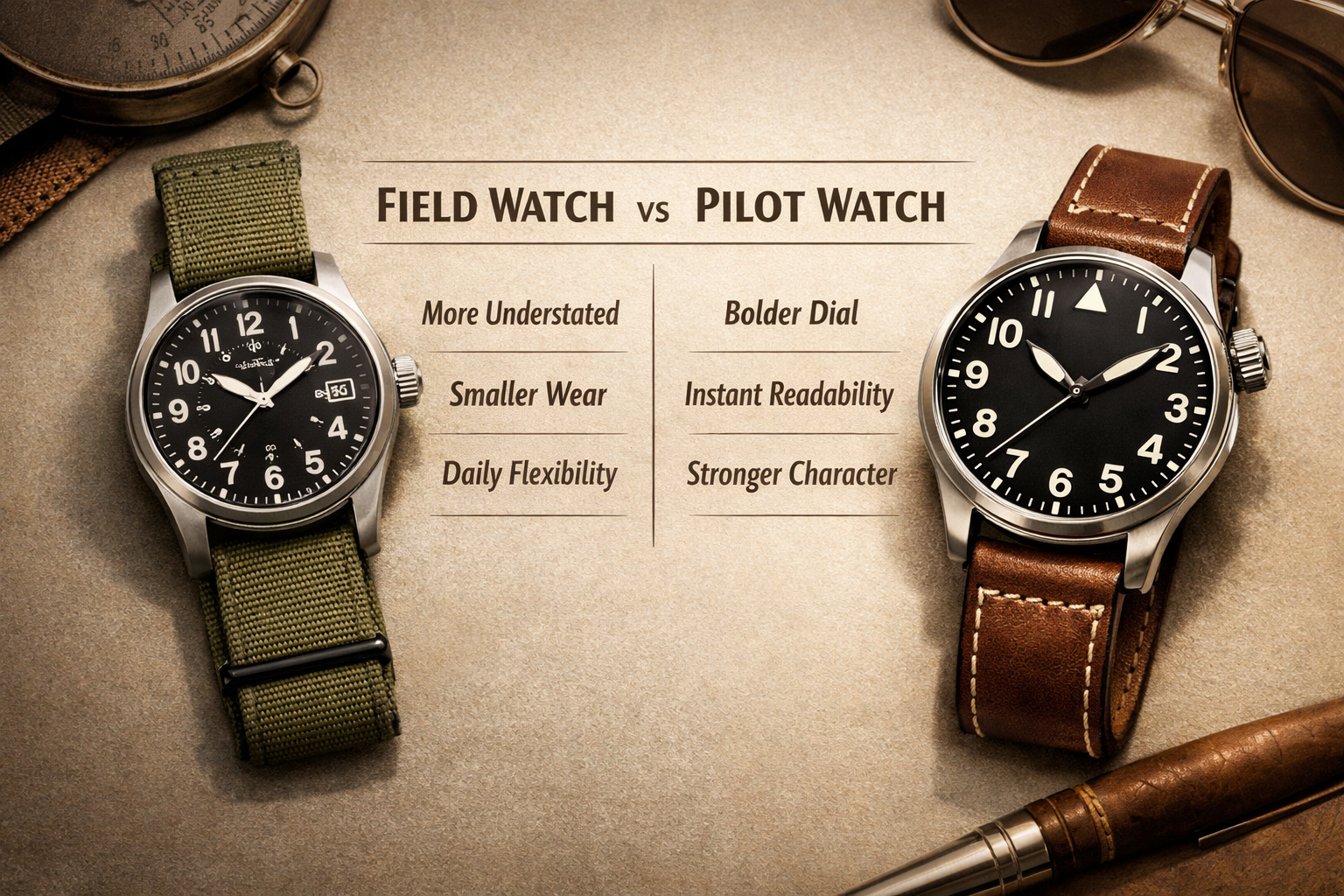
A field watch usually feels more compact, more understated, and more grounded in everyday practicality. A pilot watch usually feels bolder, more dial-driven, and more visually specific.
So here is the practical answer first:
Choose a field watch if you want the safer, more understated everyday option. Choose a pilot watch if you want stronger dial character, easier at-a-glance readability, and a more distinctive tool-watch personality.
That is the short version.
The better answer depends on your wrist size, your wardrobe, and whether you want your watch to blend in or make a little more of a statement.
If you are still early in the learning process, it helps to start with What Is an Automatic Watch? Pros, Cons & Who Should Buy One and Best Automatic Watches for Beginners: Top Picks & Buying Tips. But if your actual question is whether a field watch or pilot watch is better for daily life, this guide is the practical version.
The short answer: what is the difference?
The cleanest way to think about it is this:
- Field watch = compact, rugged simplicity
- Pilot watch = bold, high-legibility instrument style
A field watch is usually designed to feel:
- practical
- restrained
- easy to wear
- compact and straightforward
A pilot watch is usually designed to feel:
- highly readable
- more dial-focused
- more aviation-inspired
- slightly bolder in identity
Both can be excellent everyday watches. But they succeed in different ways.
What is a field watch?
A field watch is usually a simple, rugged watch built around practicality, clarity, and easy wear.
Most field watches emphasize:
- clean dials
- readable numerals or markers
- compact proportions
- straightforward styling
- casual versatility
A good field watch often feels like a watch you can put on without thinking too much. It is usually one of the easiest categories to live with because it does not try too hard in any direction.
That is a big reason why so many buyers end up liking field watches more and more over time.
If you want to explore the category directly, Best Automatic Field Watches Under $1000: Rugged, Minimal & Built to Last is the natural next step.
What is a pilot watch?
A pilot watch is usually built around fast legibility, simple visual hierarchy, and a stronger instrument-like identity.
Most pilot watches emphasize:
- larger numerals
- strong hand contrast
- quick time reading
- cleaner time-first design
- more visual presence than a typical field watch
A pilot watch often feels more specific and more immediately recognizable than a field watch. It has a stronger visual identity.
That is part of the appeal. It is also part of the tradeoff.
Why buyers confuse them so often
Because both categories are function-first. They share a lot of traits:
- practical design
- strong readability
- tool-watch heritage
- casual wearability
- easy daily styling
But the overlap hides the main difference.
A field watch is usually trying to be quietly useful.
A pilot watch is usually trying to be instantly readable and visually purposeful.
That is why a field watch often disappears into daily life more easily, while a pilot watch is more likely to feel like a chosen style.
Field watch vs pilot watch: the real-life comparison
| Category | Field Watch | Pilot Watch |
|---|---|---|
| Overall vibe | Rugged, understated, compact | Bold, readable, instrument-like |
| Dial style | Simpler, often more restrained | More pronounced numerals and dial identity |
| Typical wear | Casual, versatile, easy | Casual to smart-casual, more specific |
| Wrist presence | Usually lower | Usually higher |
| Best strength | Everyday practicality | Instant readability and character |
| Best for | One-watch minimalists, small to medium wrists | Buyers who want function plus strong style |
| Dress potential | Better than expected | Usually less dress-friendly |
| Daily ease | Extremely strong | Strong, but more style-dependent |
That table gets to the heart of it.
If you want the safer all-rounder, field usually wins.
If you want more visual personality, pilot usually wins.
Readability: who wins?
Both categories are readable, but they do it differently.
Field watch readability
Field watches are usually readable because they are clean and balanced. The dial does not fight you. It stays simple.
Pilot watch readability
Pilot watches are usually readable because they are more emphatic. Larger numerals, stronger contrast, and more obvious visual hierarchy make them very easy to read at a glance.
So if the question is which one is easier to read instantly, pilot often wins.
If the question is which one feels calmer and easier to live with every day, field often wins.
That difference matters more than it sounds like it should.
Style: which one is easier to wear with real clothes?
For most people, field watches are easier to wear with more outfits.
A field watch usually works well with:
- T-shirts
- denim
- overshirts
- knitwear
- casual jackets
- relaxed office wear
A pilot watch also works well with many of those, but its stronger numerals and bigger visual character can make it feel less neutral.
That means a field watch is more likely to blend into different wardrobes without asking for attention. A pilot watch is more likely to become part of the outfit’s personality.
Neither is wrong. It just depends on what you want.
Size and wrist presence: field watches are often more forgiving
This is one of the biggest real-world differences.
Field watches are often easier on smaller wrists because they tend to be:
- more compact
- less visually open
- lower in presence
- easier to wear daily
Pilot watches often wear larger than expected because:
- the dial is usually more open
- the numerals are bolder
- the design tradition favors visibility
- the overall look is more assertive
So even when the case sizes sound similar, a pilot watch often feels bigger.
That is why buyers with smaller wrists often find field watches easier to wear confidently. If fit is already a concern, it also helps to think through size issues the same way we do in Best Automatic Watches for Small Wrists: What to Look for Before You Buy.
Which one is better for everyday wear?
For most buyers, field watch is the easier everyday choice.
Why?
Because an everyday watch needs to do a few things well:
- fit easily into normal outfits
- stay comfortable
- avoid visual fatigue
- work in many different situations
- feel useful without demanding attention
Field watches usually do those things very well.
Pilot watches can also be great everyday watches, but they work best when the buyer specifically likes:
- larger numerals
- stronger dial presence
- a more obvious tool-watch identity
So the honest answer is:
- Field watch is better for everyday wear for more people
- Pilot watch is better for everyday wear for the right person
Real-world buyer case #1: the one-watch buyer
This buyer wants one automatic watch for commuting, weekends, errands, travel, and casual office use. They want to put it on and not think too hard.
For this person, field watch usually wins.
It is easier to style, easier to fit, and less likely to feel too specific after six months. It usually gives the buyer what they actually need:
clarity, comfort, and normal-life flexibility.
This is exactly why field watches so often show up in strong beginner recommendations and no-regret buying advice.
Real-world buyer case #2: the buyer who wants more visual character
This buyer likes functional watches, but does not want something too plain. They want the watch to feel distinctive from across the room. They like strong numerals and a more instrument-style look.
For this buyer, pilot watch often wins.
This is where the pilot category becomes very compelling. It keeps the function-first DNA, but adds more visual identity.
If a field watch sometimes feels “a little too quiet,” a pilot watch may be the better answer.
Real-world buyer case #3: the smaller-wrist buyer
This person likes both categories, but worries about proportions and daily comfort.
For them, field watch is often the safer starting point.
That is not because pilot watches are impossible on smaller wrists. It is because field watches are usually more forgiving. They tend to be easier to wear without the dial or case overwhelming the wrist.
A pilot watch can still work beautifully on a small wrist if the size and lug-to-lug are controlled. But as a category, field is easier.
Which one works better in an office?
Again, field watch usually wins.
A field watch tends to feel:
- quieter
- more balanced
- more flexible with business-casual clothing
- less visually specific
A pilot watch can still work in an office, especially casual or creative settings. But its bold dial often gives it a stronger weekend or casual-tool personality.
If your office wardrobe leans cleaner and more restrained, a field watch usually integrates more naturally.
Which one is better for travel?
This depends on the kind of travel.
Field watch is better if you want:
- versatility
- comfort
- easy pairing with different clothes
- low visual fuss
Pilot watch is better if you want:
- very fast readability
- stronger time-first clarity
- a watch with more visual identity on the road
For most people, field still wins the travel question because it is so adaptable. But pilot is a very good choice for travelers who genuinely value bold readability.
Which one feels more rugged?
This is interesting, because the answer depends on what you mean.
Field watch ruggedness feels like:
- practical
- understated
- durable
- grounded
Pilot watch ruggedness feels like:
- functional
- instrument-like
- visually purposeful
- more explicit
So field feels more naturally rugged. Pilot feels more intentionally functional.
That difference is subtle, but real.
Water resistance and daily toughness
Neither category is automatically better here. This depends on the specific watch, not just the style label.
That said, field watches often feel more naturally aligned with everyday rough use, while pilot watches are more often chosen for dial clarity and style character.
So if water exposure, travel use, or daily unpredictability matter a lot, it helps to think beyond category and look at the actual practical specs. That is exactly why Water Resistance Explained for Everyday Watches: 30m vs 50m vs 100m vs 200m — What You Can Actually Do matters in this decision too.
Strap choice: which category wears better on leather, bracelet, or fabric?
This is another place where the categories start to separate.
Field watch on strap options
Field watches are extremely adaptable. They usually work well on:
- leather
- bracelet
- fabric or NATO-style straps
- some rubber setups
That versatility is part of their charm.
Pilot watch on strap options
Pilot watches often feel most natural on:
- leather
- rivet-style or aviation-inspired straps
- some bracelets, depending on the design
Pilot watches can still work on multiple setups, but they usually look best when the strap supports their stronger character rather than trying to neutralize it.
If strap choice is part of your buying process, Leather vs Bracelet vs Rubber Strap: How Strap Choice Changes Fit, Style, and Value is worth reading alongside this comparison.
Which one ages better in a collection?
For most buyers, field watch ages better.
That is because field watches are more likely to remain useful in a collection even after your taste evolves. They are easier to wear when:
- you want something casual
- you want something quiet
- you want something easy
- you do not want your watch to become the center of attention
Pilot watches can age very well too, especially if you really love the style. But they rely more on continued enthusiasm for that specific visual language.
Field watches rely less on novelty. That usually helps them age better.
What buyers often get wrong
1. Assuming pilot is just a bigger field watch
It is not. The design logic and visual identity are different.
2. Assuming field is boring
A good field watch is not boring. It is just more restrained.
3. Choosing pilot only because the dial looks cool online
It may still be the right choice, but the buyer should make sure they want that stronger visual identity every day.
4. Choosing field because it sounds safer, even when they clearly want more character
That leads to a different kind of regret. Safe is not always satisfying.
Which one should most buyers choose?
Here is the most honest buying advice.
Choose a field watch if:
- you want the safest everyday option
- you prefer subtle, rugged simplicity
- you have a smaller wrist
- you want broad wardrobe flexibility
- you value long-term wearability over dial drama
Choose a pilot watch if:
- readability matters a lot
- you want stronger visual character
- you like larger numerals and a more instrument-like dial
- you want a tool watch that feels more distinctive
- you are comfortable with a more style-specific look
If you are unsure
Choose field watch.
It is usually the lower-risk daily option.
A quick 30-second buying checklist
If you are stuck between the two, ask:
Do I want the watch to quietly fit into daily life?
Choose field.
Do I want the watch to feel more visually specific and easier to read at a glance?
Choose pilot.
That one question solves most of the decision.
FAQ
What is the difference between a field watch and a pilot watch?
A field watch is usually more compact, understated, and ruggedly simple. A pilot watch is usually more dial-driven, more readable at a glance, and more visually specific.
Which is better for everyday wear, field watch or pilot watch?
For most people, field watch is the easier everyday choice because it is more versatile and understated. Pilot watch can still be excellent daily wear for buyers who prefer its stronger visual style.
Are pilot watches bigger than field watches?
Often, yes in feel if not always in actual diameter. Pilot watches usually have more visual presence and can wear larger because of their dial design.
Are field watches more versatile?
Usually, yes. Field watches tend to work with more outfits and more daily situations without standing out too much.
Which is better for a small wrist?
Field watch is usually the safer option because it tends to be more compact and less visually dominant.
Can a pilot watch be a one-watch collection?
Yes, especially if you genuinely like the style. But for most buyers, a field watch is the easier one-watch solution.
Final verdict
If you want the simplest possible answer:
- Field watch is the safer everyday choice
- Pilot watch is the more distinctive everyday choice
- Field watch usually wins on versatility
- Pilot watch usually wins on dial character and instant readability
So the real choice is not just about heritage or design labels.
It is about what kind of daily watch you want.
Do you want:
- a quieter, easier, more adaptable tool watch? Choose field
- a bolder, more readable, more instrument-like watch? Choose pilot
For most buyers, field watch is the smarter default.
For the right buyer, pilot watch is the more satisfying one.
And that is exactly why both categories still matter.