- Home
- Top-Tier Replica Rolex Datejust vs Pre-Owned Genuine: Which One Makes More Sense?
Top-Tier Replica Rolex Datejust vs Pre-Owned Genuine: Which One Makes More Sense?
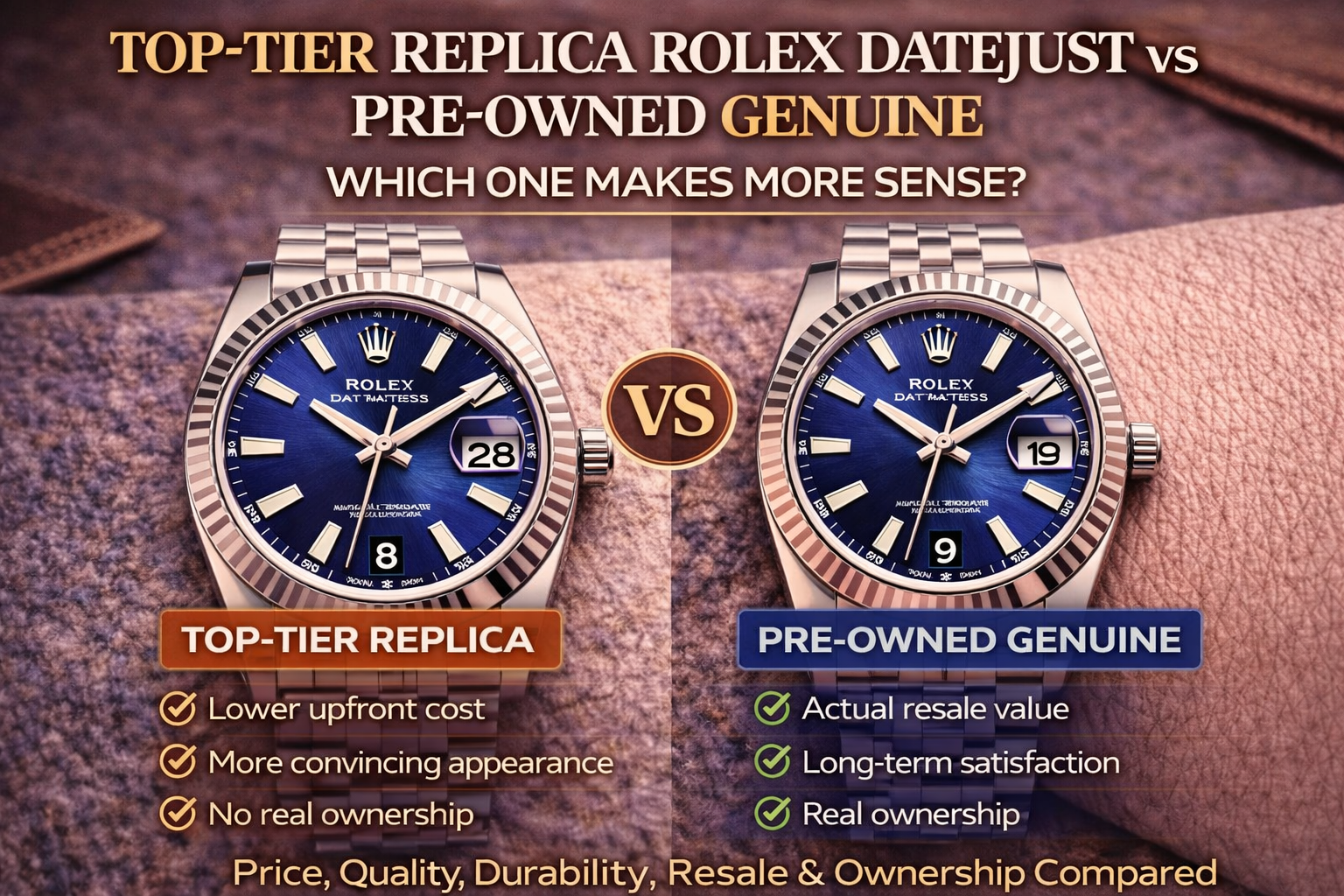
This is the comparison many buyers make privately, even if they do not say it out loud.
Not real Rolex vs no watch.
Not new Rolex vs used Rolex.
But this:
top-tier replica Rolex Datejust vs pre-owned genuine Rolex Datejust.
And on the surface, it can feel like a fair question.
One option gives you the look for far less money.
The other gives you the real thing, but at a much higher cost, often with scratches, stretch, age, and the uncertainty that comes with the used market.
So which one actually makes more sense?
The short answer is this: if you care about real ownership, real value, real serviceability, and long-term satisfaction, the pre-owned genuine Datejust makes far more sense. If you only care about appearance in the short term, the replica can seem cheaper—but it usually becomes the more expensive mistake emotionally, and often financially, over time.
That is the simple version.
But the real answer becomes obvious only when you stop comparing photos and start comparing ownership.
The short answer
Choose a pre-owned genuine Rolex Datejust if you want:
- real watchmaking and real build quality
- legitimate resale value
- serviceable long-term ownership
- confidence in what you are wearing
- a watch you can keep, sell, or trade later
Choose a top-tier replica Datejust only if you want:
- the look from a distance
- lower upfront spend
- no expectation of legitimate resale
- no expectation of true long-term ownership value
If you are thinking seriously, not impulsively, the pre-owned genuine watch is usually the better decision.
If you are thinking mainly about cost today and not what happens after, the replica can feel tempting.
That temptation is exactly where a lot of buyers lose money.
Why this comparison feels closer than it actually is
This question exists because good replicas have improved.
That is the reality.
From a few feet away, and especially in seller photos, a high-end replica can look convincing enough to trigger the dangerous thought:
“Why pay so much more for the real one?”
That is the wrong comparison.
Because what you are actually buying with a genuine pre-owned Rolex is not just the image of the watch.
You are buying:
- the underlying quality
- the movement integrity
- the metal finishing
- the service path
- the authenticity of ownership
- the ability to recover value later
A replica can imitate the outline.
It cannot replicate the ownership equation.
That is the part buyers often understand only after spending money.
The top-tier replica argument: why it sounds persuasive at first
Let’s be fair.
The replica argument is not stupid.
It usually goes like this:
“I want the Datejust look.”
“I do not want to spend genuine Rolex money.”
“I can get something visually close.”
“I am not buying it as an investment anyway.”
On day one, that logic can feel solid.
Especially if the buyer mainly sees watches through photos, mirror checks, and quick social comparison. In that context, the replica looks like a hack.
Less money. Similar appearance. Problem solved.
Except it usually is not solved.
Because the deeper issue is not how the watch looks when you first open the package.
It is how the watch feels once it becomes yours.
That is where the replica logic starts to weaken.
If you have not read it yet, Replica Rolex Datejust vs Real: What You Actually Get (And What You Risk) should sit right next to this article, because it explains why visual similarity is only the beginning of the story, not the conclusion.
The pre-owned genuine argument: why it usually wins over time
A pre-owned genuine Datejust asks more money from you upfront.
That is true.
It may come with light scratches. It may need careful inspection. It may not feel as “perfect” out of the box as a polished replica in staged photos.
But it gives you something the replica never can:
a real ownership foundation.
That means the watch can be authenticated, serviced, insured, sold, traded, and enjoyed without the constant low-grade doubt that sits under replica ownership.
That doubt matters.
People underestimate how much value there is in wearing a watch you do not have to explain to yourself.
A real buyer example: the shortcut that wasn’t one
A buyer I know was deciding between a high-end replica Datejust and an older genuine pre-owned Datejust.
His reasoning was simple.
The replica looked newer, cleaner, and cheaper.
The genuine watch was older, more expensive, and showed honest signs of use.
So he bought the replica first.
At first, he was satisfied.
Then real ownership started.
A few months in, the bracelet felt cheaper than he had hoped. The date magnification bothered him. The dial that had looked “close enough” in photos started feeling less convincing in daylight. Most importantly, the watch never gave him the feeling of having actually solved the problem.
He had not bought the Datejust.
He had bought a temporary substitute.
A year later, he bought a pre-owned genuine Datejust anyway.
His conclusion was blunt: “I thought I was saving money. I was just paying to delay the real decision.”
That is a very common pattern.
Build quality: where the gap becomes obvious after the honeymoon period
This is where the comparison stops being theoretical.
A top-tier replica can look very convincing in still images.
But day-to-day ownership reveals more than photos ever do.
On a genuine pre-owned Rolex Datejust, even an older one, you usually still feel:
- sharper case execution
- more coherent finishing
- better bracelet solidity
- cleaner dial furniture
- more convincing overall precision
On a replica, the watch often feels strongest at first glance and weakest over repeated handling. The more you wear it, the more you start to notice what was “close enough” rather than correct.
That is why the gap widens with time instead of shrinking.
If you want to understand what details start revealing themselves first, How to Tell If a Rolex Datejust Is Fake Before You Buy is the practical companion to this article.
Movement: the invisible difference that defines ownership
Most buyers obsess over the dial first.
The movement matters more.
A pre-owned genuine Rolex movement may not be new, but it is still part of a real service ecosystem. It can be evaluated, maintained, regulated, and understood.
A replica movement exists in a very different category.
Even when it runs acceptably, it does not carry the same long-term ownership logic. Repair decisions become less sensible. Service value becomes questionable. Confidence becomes conditional.
This matters most once the initial novelty is gone.
A real watch invites maintenance.
A replica often invites replacement.
That is a completely different ownership philosophy.
If your buyer mindset cares about how a watch actually behaves, not just how it photographs, related reading like Why Is My Watch Running Fast or Slow? 9 Common Causes (And Fixes) and Timegrapher Readings Explained: Amplitude, Beat Error & What’s Normal also fits naturally into the genuine-watch buying path in a way it usually does not with replicas.
The pre-owned fear: what buyers worry about, and what actually matters
Now let’s address the reason some buyers hesitate on genuine pre-owned.
They worry about:
- fakes
- overpolishing
- stretched bracelets
- swapped parts
- no box and papers
- paying real money for an imperfect watch
All of those concerns are fair.
But they are also solvable.
That is the key difference.
The risks in the pre-owned genuine market are real—but they can be reduced through discipline, verification, and patience.
The risks in the replica market are built into the purchase.
That is a huge distinction.
If you go genuine pre-owned, you should not buy blindly. You should work through How to Spot a Fake Rolex Before You Buy: 13 Red Flags That Actually Matter, How to Tell If a Watch Is Overpolished Before You Buy, Fake vs Aftermarket vs Franken Watch: The Difference That Can Cost You Thousands, and How to Check a Used Watch in Person: 15 Things to Inspect Before You Buy.
That sounds like work.
It is.
But it is productive work.
The hidden cost of the replica route
The replica’s biggest selling point is lower upfront price.
Its biggest weakness is that buyers often treat upfront price as total cost.
It is not.
The real cost of a replica often includes:
- no legitimate resale
- no real trade-up path
- no meaningful service logic
- lower long-term satisfaction
- a higher chance you buy the real one later anyway
That changes the math.
The comparison is not always:
replica vs genuine
It is often:
replica now plus genuine later vs genuine now
Once you see that clearly, the shortcut stops looking like one.
Resale: the place where the difference becomes brutally simple
This section is short because it is not complicated.
A genuine pre-owned Rolex Datejust has a real resale market.
A replica does not.
That alone answers the question for many serious buyers.
Even if you think you will keep the watch forever, life changes. Tastes change. Priorities change. Money matters. The ability to recover value is not a niche bonus. It is part of what you are paying for.
A genuine pre-owned Datejust can still be sold, traded, or upgraded later.
A replica is a dead end.
That is a huge ownership difference disguised as a resale point.
Which one feels better psychologically?
This matters more than most buyers admit.
A genuine pre-owned Datejust, even with signs of age, often feels better because it is settled. It is real. It has identity. It does not require mental editing.
A replica may look cleaner and newer at first, but it often creates a strange low-level dissatisfaction. The buyer knows it is standing in for something else. That may not matter on day three. It often matters a lot more on month nine.
Luxury-watch ownership is emotional.
That is exactly why the psychological gap matters.
A watch you do not fully believe in rarely becomes satisfying for very long.
Who should choose the pre-owned genuine Datejust?
Almost any buyer who cares about more than just appearance.
Especially if you want:
- a real long-term watch
- a proper entry into Rolex ownership
- something you can service and trust
- a watch with market legitimacy
- the option to upgrade or exit later
If that is you, the genuine pre-owned route makes far more sense.
Who is the replica actually for?
A replica is mainly for the buyer who is honest that they are not pursuing ownership in the real sense.
That may mean:
- visual curiosity only
- extremely short-term use
- no intention to hold value
- no expectation of real watch satisfaction
That is a narrower category than many buyers think.
Most people considering a Rolex Datejust want more than just a look.
They want the real experience, even if they are trying to talk themselves out of it.
A better decision framework before you spend money
If you are torn between the two, ask these questions in order:
1. Am I buying a watch, or am I buying an image?
A pre-owned genuine watch serves both. A replica mainly serves one.
2. Will I care about resale later, even a little?
If yes, the replica already loses.
3. Will I still be satisfied once I know the details are not right?
This is where many replica decisions start to collapse.
4. Am I actually okay with buying twice?
Because many buyers go replica first, genuine later.
5. Would I rather own an older real Datejust or a newer fake one?
That is the cleanest version of the decision.
For most serious buyers, the answer becomes obvious there.
The smarter alternative if budget is tight
If budget is truly the issue, the answer is usually not “buy the replica.”
The smarter answer is usually one of these:
- buy an older genuine Datejust
- buy a simpler configuration
- wait longer and buy once
- consider a real alternative brand
That is why comparison articles like Rolex Datejust vs Omega Aqua Terra: Which Everyday Luxury Watch Makes More Sense? are more useful long term than trying to justify replica ownership. One path gives you a different real watch. The other gives you a substitute.
Those are not the same thing.
Final verdict
If you are asking which one makes more sense between a top-tier replica Rolex Datejust and a pre-owned genuine Datejust, the serious answer is the genuine watch.
Not because the replica never looks convincing.
Because convincing is not ownership.
A pre-owned genuine Datejust gives you a real watch, a real market, real serviceability, and real satisfaction potential.
A replica gives you a lower entry point into something that usually remains emotionally unfinished.
The replica may look newer.
The genuine watch is still the real purchase.
And for most buyers who care enough to research this comparison properly, that difference matters more than they want to admit.
FAQ
Is a top-tier replica better than an older genuine Rolex Datejust?
Usually no. It may look cleaner at first, but the older genuine watch still wins on ownership, serviceability, legitimacy, and resale.
What if the genuine pre-owned Datejust has scratches?
That is normal. Honest wear on a real watch is usually a better trade than artificial perfection on a fake one.
Is the replica ever worth it financially?
Only if you define value as short-term appearance only. Long term, it usually does not hold up well as a financial or emotional decision.
Is buying a pre-owned Datejust risky?
Yes, but it is manageable risk if you buy carefully and verify properly. Replica risk is built into the purchase from the start.
What is the best alternative if I cannot afford a genuine Rolex Datejust yet?
A pre-owned genuine watch, a simpler Datejust configuration, or a real alternative brand is usually smarter than going replica.