How to Spot a Fake Omega Seamaster Diver 300M Online
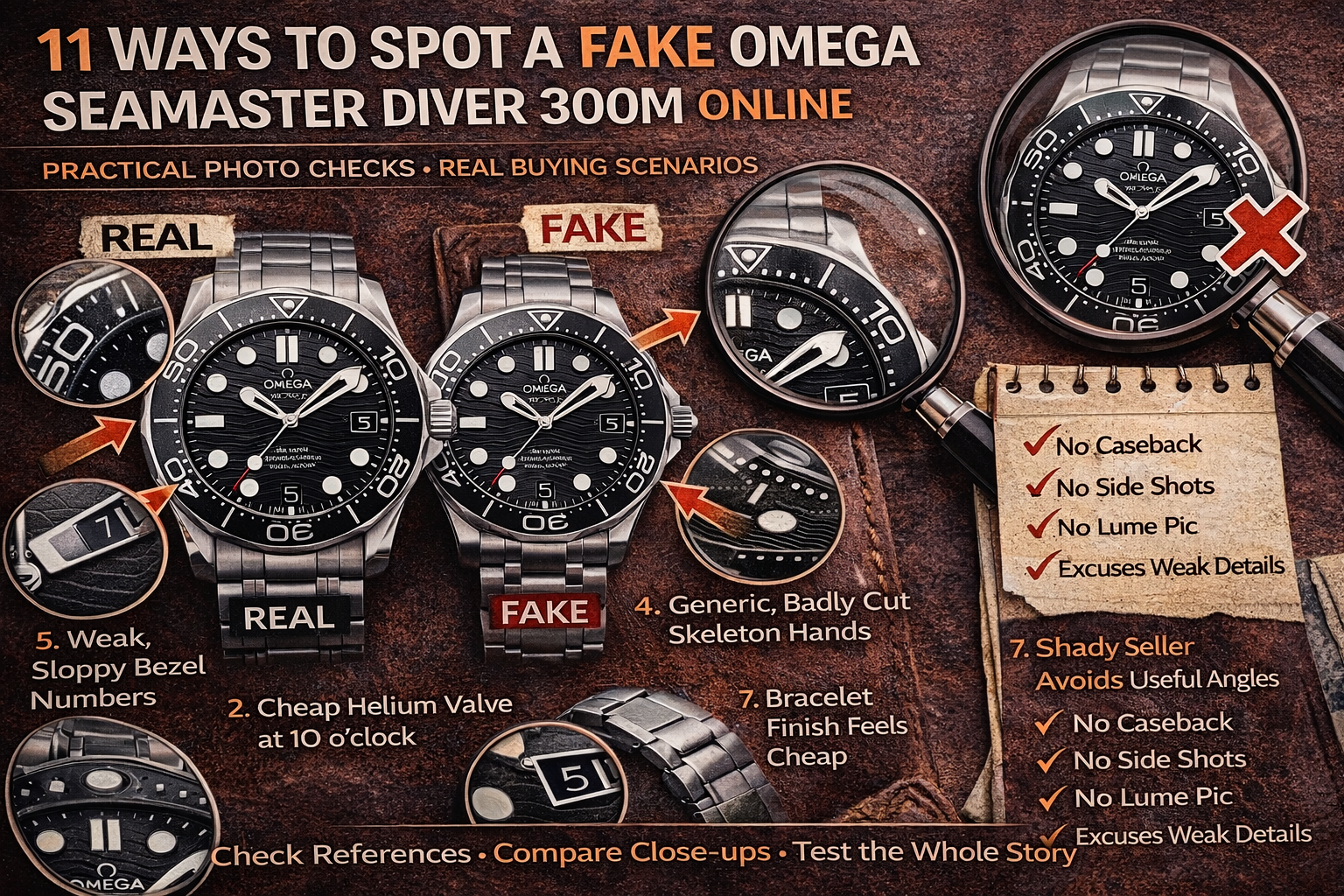
A fake Omega Seamaster Diver 300M usually looks convincing from far away and starts falling apart the moment you ask for better photos.
That is what makes this model tricky.
It is not hard because the Seamaster Diver 300M is obscure. It is hard because it is famous. Since 1993, the Diver 300M has been one of OMEGA’s best-known sports watches, and OMEGA’s recent updates have kept its core identity intact: 42 mm sizing, the helium escape valve at 10 o’clock, skeletonized hands, and signature dive-watch styling. More recent releases have also expanded the range with updated steel, titanium-and-bronze, bronze-gold, and orange-accented versions.
That popularity creates a perfect fake-watch environment.
A buyer already knows the watch. A seller only needs to get the outline mostly right. A listing with one flattering dial shot and one dramatic wrist photo can do the rest.
And unlike some simpler watches, the Seamaster gives counterfeiters a lot to imitate: bezel details, wave textures, skeleton hands, lume, crown guards, the helium valve, bracelet architecture, and case finishing. The good news is that all those details also give you more places to catch a bad watch.
This guide is built for how people actually shop: laptop open, five tabs running, too many screenshots saved, seller messages going back and forth, and that dangerous feeling that maybe this “great deal” is finally the one.
If you are still deciding whether the Seamaster Diver 300M is even the right dive watch for you, that is a different conversation. But if you are already staring at listings, here is how to judge them before money leaves your account.
Why the Omega Seamaster Diver 300M gets faked so often
Because it sits in a very attractive middle ground.
The Seamaster Diver 300M is not some niche collector’s reference. It is a mainstream luxury dive watch with broad name recognition, strong design identity, and years of visibility far beyond watch nerd circles. OMEGA itself still treats the Diver 300M as one of the collection’s most celebrated and iconic families, and the brand continues to refresh it with new materials and colorways rather than letting it fade into the catalog.
That matters because fake sellers love watches with three characteristics:
- easy visual recognition
- broad aspirational demand
- enough complexity to confuse first-time buyers
The Seamaster has all three.
It is also a classic “I want one good luxury sports watch” purchase, which means buyers often approach it emotionally. The watch promises versatility, diving heritage, Bond-era cool, and daily wearability all at once. That emotional momentum is exactly what bad listings feed on.
First rule: identify which Seamaster Diver 300M the seller is claiming to sell
Do not begin by zooming into the logo.
Begin by figuring out what the watch is supposed to be.
That sounds obvious, but it is where a lot of buyers fail. Older ceramic-dial Diver 300Ms, newer aluminium-dial releases, mesh-bracelet variants, rubber-strap variants, titanium-and-bronze executions, bronze-gold models, and orange-accented versions can all look meaningfully different. In Omega’s 2024–2025 Diver 300M releases alone, the brand described stainless-steel 42 mm models with aluminium bezels and dials, a titanium-and-bronze-gold version, bronze-gold burgundy versions, and black-and-orange steel editions, all still carrying hallmark Diver 300M traits.
So before anything else, ask:
- What exact reference or version is this?
- Is it steel, titanium, bronze gold, or a mixed-material model?
- Is it on mesh, rubber, or bracelet?
- Is it all original?
- Has anything been replaced, refinished, or polished?
Once the seller answers, then you compare the photos to that story.
That sequence matters. If you skip it, you can easily reject a real watch because it differs from the last Seamaster photo you saved, or approve a fake because the seller chose a configuration you do not know well enough to challenge.
Do not let “box and papers” do the thinking for you
This mistake keeps repeating because people want relief.
A listing says “full set,” “warranty cards,” “box included,” and suddenly the buyer feels safer than the watch itself deserves.
Do not do that.
Accessories can support a watch. They do not authenticate it by magic. A suspicious Seamaster with a good box is still suspicious. A copied card is still copied. A fake watch with polished presentation is still a fake watch.
That is exactly why Box, Papers, Warranty, and Service History: What Really Matters When Buying Pre-Owned? matters so much in real buying situations. The watch comes first. The seller comes second. Everything else comes after that.
11 photo checks that help expose a fake Omega Seamaster Diver 300M
1. The bezel looks cheap, vague, or strangely shaped
A real Seamaster Diver 300M bezel usually looks controlled.
The edge shape should feel deliberate. The insert should look clean. The numerals and markers should not look sloppy, cartoonish, or weakly cut. On current official releases, OMEGA is still emphasizing details like oxalic anodised aluminium bezel rings on newer models, while the broader Diver 300M identity also retains the scalloped bezel profile people associate with the collection.
On suspicious listings, the bezel is often one of the first things to go wrong. It may look too shiny, too thick, too rough at the edge, or simply too crude relative to the price category the seller is asking you to believe.
Ask for a straight-on bezel shot and one angled daylight photo. A lot of fake bezels survive dark moody photos and collapse under plain lighting.
2. The helium escape valve at 10 o’clock looks badly integrated
The Diver 300M’s helium escape valve is one of its visual signatures. OMEGA still highlights that 10 o’clock valve as a defining design feature of the collection across recent official releases.
That makes it an excellent fake check.
On a bad watch, the valve may look oversized, awkwardly shaped, too shiny, poorly seated, or just visually disconnected from the rest of the case. Sometimes the proportions look off. Sometimes the finishing is what gives it away. Sometimes it simply looks like an extra object attached to the watch instead of part of the design.
Ask for one clean case-side photo that shows the valve and crown guards together. That one photo often tells you more than three glamour shots of the dial.
3. The dial texture or wave pattern looks wrong
This is one of the most useful checks, but only if you stay flexible.
Some current and recent Diver 300M models use laser-engraved waves on black aluminium dials, while older or different variants may present the pattern differently. The point is not that every Seamaster must show the exact same wave treatment. The point is that the dial should look intentional, crisp, and appropriate to the version being sold.
Fakes often miss this in one of two ways:
- the texture looks too loud and cheap
- or it looks soft and lifeless, like a generic printed approximation
If the dial is the emotional center of the listing, it should hold up under a close-up. If it gets weaker every time you zoom in, pay attention.
4. The skeleton hands look generic instead of precise
OMEGA explicitly still identifies the skeletonized hands as one of the Diver 300M’s distinguishing details.
That matters because fake makers often get the broad silhouette roughly correct while missing the finishing.
On a suspicious watch, the hands may look:
- too thick
- too flat
- too shiny in the wrong way
- badly cut at the edges
- mismatched in quality with the rest of the dial
This is not a detail to dismiss. On a watch like the Seamaster, the hands carry a lot of the model’s identity. If they feel cheap, the whole watch starts to feel cheap.
5. The date window or date font feels off
Not every fake fails here, but many do.
The date may sit poorly in the window. The font may look wrong. The alignment may appear slightly high, low, or sideways. The surrounding dial printing may look fine while the date somehow feels disconnected from everything around it.
That kind of “almost right” detail is exactly how fake listings survive. A lot of people will forgive a weak date because the bezel or bracelet looked convincing at first glance.
Do not give that free pass.
6. The bracelet or mesh looks easier than Omega usually looks
This is a big one because recent official Diver 300M releases have leaned hard into bracelet identity. In late 2024 and 2025, OMEGA specifically described new mesh-bracelet executions as part of the refreshed Diver 300M rollout, alongside rubber-strap versions.
On fake listings, the bracelet often looks:
- too light visually
- too sharp at the edges
- too flat in the links
- too loose or too rattly in photos
- badly finished where brushed and polished surfaces should transition cleanly
If it is a mesh version, the weave should not look crude or bargain-grade. If it is a bracelet version, the link architecture should not feel generic.
Ask for bracelet close-ups, clasp photos, and at least one wrist shot. A seller who avoids those images may know exactly why.
7. The caseback story does not match the listing story
Current official Diver 300M releases described by OMEGA use sapphire display casebacks that show the Co-Axial Master Chronometer Calibre 8806. Some older versions may differ. That is why you should not start with a rigid rule. You should start with the version being claimed, then ask whether the caseback and movement presentation match that claim.
If a seller claims a current-style 42 mm refreshed Diver 300M but never shows the caseback, that matters.
If the caseback is shown and looks soft, generic, or inconsistent with the rest of the watch, that matters too.
Again, you are not looking for one magical reveal. You are looking for consistency.
8. The lume story sounds better than the photos
Dive-watch buyers love lume, and fake sellers know it.
On newer official orange Diver 300M models, OMEGA specifically notes white Super-LumiNova in the hands and indexes with blue glow, along with lume-filled bezel markings on those editions. Other recent releases also reference vintage or white Super-LumiNova depending on the model.
That means lume can be useful, but only if the seller can actually show it honestly.
If a seller talks up “strong lume” but provides no lume shot, ask for one.
If the lume shot looks wildly uneven or bizarrely green-blue in random places, ask more questions.
If the watch claims one configuration but the lume layout does not fit the dial and bezel story, stop.
9. The seller’s photos are stylish, not useful
This is one of the strongest fake checks because it is not about Omega. It is about behavior.
A suspicious listing often has:
- one hero shot
- one low-angle wrist photo
- one blurry clasp image
- no straight-on dial photo
- no close case-side shot
- no caseback
- no bracelet detail
- no lume image
- no movement view when the version should have one
That pattern matters.
A real seller may be bad at photography. A dishonest seller is often selective in a much more strategic way. They give you enough to want the watch, not enough to trust it.
10. The watch feels over-explained in words and under-explained in photos
This happens constantly with fake or compromised listings.
The seller writes a lot. “Rare.” “Collector owned.” “Amazing condition.” “Looks unbelievable in person.” “Bond style.” “Authentic to the best of my knowledge.”
But the actual evidence stays thin.
That imbalance is a clue.
A real, honest watch usually gets stronger when you ask for more boring details.
A fake or shaky listing usually gets more theatrical.
11. The price is making the decision for you
The Seamaster Diver 300M is exactly the kind of watch where buyers get manipulated by the phrase “under market.”
That does not mean every cheap listing is fake. It means every cheap listing deserves harder scrutiny, not softer scrutiny.
If the price is dramatically lower than comparable examples, your standards should rise immediately.
A lot of fake-watch mistakes are not caused by ignorance. They are caused by desire plus discount.
My simple 12-minute screening process before messaging any Seamaster seller
This is the practical part.
If I were browsing Diver 300M listings tonight, this is exactly how I would screen them before getting emotionally involved.
Step 1: Look at the watch before reading the description
Ignore the seller’s story for thirty seconds.
Does the watch feel coherent? Does the bezel, dial, valve, bracelet, and case shape all seem to belong together? Or do you already feel slight friction?
Step 2: Identify the claimed version
Is it an older ceramic-wave model? A refreshed aluminium-dial 42 mm version? A mesh-bracelet model? A titanium-and-bronze execution? An orange-accented release? OMEGA’s recent releases make it clear that the Diver 300M family now includes several distinct material and dial combinations, so this step is not optional.
Step 3: Ask for seven specific images
Ask for:
- a straight-on dial photo
- a bezel close-up
- a crown-and-helium-valve side shot
- a bracelet or mesh close-up
- a clasp photo
- a caseback photo
- a lume shot
If the seller has the watch, these are normal requests.
Step 4: Ask the boring originality questions
Ask:
- Is the bezel original?
- Is the dial original?
- Is the bracelet or mesh original?
- Has it been polished?
- Has the crystal been replaced?
- Has it been serviced?
- Are any parts aftermarket?
Dishonest sellers hate boring questions because boring questions create traceable claims.
Step 5: Compare answers to photos, not just to your hopes
This is where buyers either protect themselves or talk themselves into trouble.
Do not ask, “Can I make this work?”
Ask, “Do the evidence and the story actually agree?”
If not, walk.
Three real-world buying scenarios
Case 1: The “great deal” that gets worse every time you zoom in
A buyer finds a steel Diver 300M for meaningfully below the usual range. The first image looks strong. The seller mentions box and papers, one owner, and “amazing condition.”
Then the details start arriving.
The bezel numerals look weak. The helium valve photo never comes. The bracelet shot is soft. The date looks slightly wrong. The caseback is either missing or blurry. Suddenly the listing stops looking like a steal and starts looking like a test of how badly the buyer wants to believe.
That is a pass.
Case 2: The real watch with bad original photos
This is the important counter-example.
A real Diver 300M can start out looking mediocre online because plenty of private sellers are terrible photographers. Maybe the first photos are yellow, low-contrast, and unhelpful. Maybe the bracelet looks worse than it is. Maybe the dial texture barely shows.
But once asked, the seller provides daylight close-ups, a clean case-side shot, a proper caseback photo, and direct answers about service and originality.
That listing usually improves under scrutiny.
That is what you want.
Case 3: The genuine watch that is still not a smart buy
Some online Seamasters are genuine but still wrong for the money.
Maybe the watch is over-polished. Maybe the bracelet is tired. Maybe the bezel insert has been replaced badly. Maybe the seller is asking top-market money for a watch that is merely okay.
This is why “real or fake” is not the only question that matters.
A bad buy can still be genuine.
That is also why How to Buy a Used Luxury Watch Online: 12 Checks Before You Pay should sit right next to this article in your buying process.
What not to do when checking a Seamaster online
Do not authenticate from one hero shot.
Do not trust “full set” more than the watch itself.
Do not assume every Diver 300M should look identical across generations.
Do not use price as proof.
Do not confuse “not obviously fake” with “safe to buy.”
Do not buy because you are tired of searching.
That last one matters more than people admit.
Most watch-buying mistakes happen when the buyer is mentally worn down. After enough tabs, screenshots, and negotiations, a suspicious listing starts to feel acceptable simply because it is available.
That is not a good reason to own anything.
If you love the Seamaster but hate the counterfeit risk
There is nothing weak about admitting that the buying process itself may not be worth the stress.
The Seamaster Diver 300M is attractive precisely because it does so many things well: daily wear, real dive-watch design, strong brand recognition, sport-luxury versatility, and a level of technical credibility that includes Master Chronometer certification in current releases. OMEGA’s current refreshed Diver 300M models all continue to emphasize that certification and the Calibre 8806.
But if every listing starts to feel like a small investigation, be honest with yourself.
You may be better off paying more through a cleaner source rather than spending less on uncertainty.
And if you ever find yourself drifting toward replica listings because “they look close enough,” stop and read Homage vs Replica vs Counterfeit Watch: What’s the Difference and What Should You Actually Buy?. That is exactly the fork in the road where buyers either make a smart watch decision or a regrettable one.
Final verdict: how to spot a fake Omega Seamaster Diver 300M online
The smartest way to spot a fake Omega Seamaster Diver 300M online is not to chase one dramatic giveaway.
It is to test whether the bezel, helium valve, dial texture, skeleton hands, date, bracelet, caseback, lume, seller photos, and pricing all tell the same story.
A real, honest listing usually becomes clearer as you ask for more.
A fake or compromised listing usually becomes foggier. The details stop matching. The photos stay selective. The seller talks more, proves less, and hopes the discount does the final bit of persuasion.
That is usually your answer.
You do not need to be an Omega archivist to avoid most bad Diver 300M listings. You just need to slow down, ask for the right angles, and refuse to let excitement do the buying for you.
FAQ
How can you tell if an Omega Seamaster Diver 300M is fake from photos?
Start with overall case and bezel quality, then inspect the helium escape valve, dial texture or wave pattern, skeleton hands, date window, bracelet or mesh finishing, and caseback. Also judge the seller’s photo choices and willingness to provide specific close-ups.
What is the biggest fake Omega Seamaster giveaway?
Usually not one thing. The most common pattern is a combination of weak bezel execution, a badly integrated helium valve, poor dial texture, generic-looking hands, and bracelet finishing that feels cheaper than the watch category.
Do all Omega Seamaster Diver 300M models have the same dial and bezel details?
No. Recent official releases show meaningful variation in materials, dial execution, bezels, and strap or bracelet options, even while retaining core Diver 300M identity markers such as the 42 mm format and helium valve.
Does box and papers prove a Seamaster is real?
No. They help, but they do not prove the watch itself is correct. Always judge the watch first.
Is it safe to buy an Omega Seamaster Diver 300M online?
It can be, but only if you verify the claimed version, request specific photos, check originality carefully, and stay willing to walk away.
What movement do current refreshed Seamaster Diver 300M models use?
OMEGA’s recent 2024–2025 refreshed Diver 300M releases use the Co-Axial Master Chronometer Calibre 8806, visible through the sapphire crystal caseback.
Suggested Featured Excerpt
A fake Omega Seamaster Diver 300M often reveals itself through a weak bezel, a badly integrated helium valve, poor dial texture, generic skeleton hands, cheap bracelet finishing, and seller photos that avoid useful angles. The safest way to evaluate one online is to check for overall consistency, not just one dramatic fake tell.