The Dior Bar Jacket: Anatomy of a Revolution
Few garments in history have managed to encapsulate an era's spirit while remaining eternally relevant. The Dior Bar Jacket, unveiled on February 12, 1947, at 30 Avenue Montaigne, is one such creation. More than a piece of clothing, it was a powerful manifesto—a deliberate and exquisite revolt against the austerity, restrictions, and boxy silhouettes imposed by World War II. Christian Dior, then an unknown designer, presented a vision of radical femininity that left the audience breathless. American Harper's Bazaar editor-in-chief Carmel Snow famously christened the collection the "New Look," a term that would forever mark a seismic shift in fashion history.
This was not merely a new style; it was a new feeling. Dior's genius lay in understanding the profound, collective desire for beauty, luxury, and joy after years of hardship. The Bar Jacket, the cornerstone of this look, became the symbol of a reborn, elegant, and self-assured womanhood. This article traces the jacket's legendary origins, dissects the architectural secrets of its construction, and explores how its foundational principles have been faithfully guarded and transmitted through the decades of haute couture craftsmanship.
I. The Birth of a Revolution: February 1947
The post-war landscape was one of fabric rationing and utilitarian fashion. Christian Dior defied this reality with an almost rebellious extravagance. His "Corolle" line (named for the circle of petals in a flower) used up to 20 yards of fabric in a single skirt, a shocking and delightful excess. The Bar Suit—comprising the iconic jacket and a full, black crepe skirt—epitomized this new opulence.
The jacket's design was a masterclass in contrast and construction. Its key features formed a head-to-toe rebuke of wartime fashion:
-
Soft, Rounded Shoulders: Replacing the severe, padded, square shoulders of the 1940s with a gentle, feminine slope.
-
A Cinched Wasp Waist: Achieved through expert internal structuring to create an hourglass silhouette.
-
Emphasized Hips: The jacket's basques (peplums) were gently padded, a technique inspired by Cristóbal Balenciaga's 1939 "Infanta" dresses, to accentuate the hips and create a dramatic contrast with the tiny waist.
-
A Structured yet Fluid Bust: The jacket was tailored to follow the natural curves of the torso without constriction.
The initial Bar Jacket was crafted from ivory Shantung silk, a fabric with a distinctive slubbed texture that added richness, paired with a modest black skirt to let the jacket's architecture shine. The effect was nothing short of sculptural. As Dior himself stated, he aimed to create "the epitome of the vertical line, highlighting the feminine figure" with bodices that perfectly followed the body's contours. He succeeded in designing a silhouette that was both powerfully present and gracefully fluid.
II. The Architectural Secrets: Inside the Atelier
The Bar Jacket's enduring magic lies in its hidden engineering. Creating such a defined shape that appears effortless on the body is the pinnacle of haute couture. The process is a marathon of precision, requiring over 150 hours of meticulous handiwork by the house's most skilled artisans: pattern makers, cutters, seamstresses, and fitters.
The pattern itself is a complex blueprint. The jacket's signature curves are not achieved by force but through intelligent cutting and assembly. Multiple shaped panels—for the front, side, back, and basques—are carefully joined to follow and enhance the body's topography. A key figure in solving the initial structural challenge was a young Pierre Cardin, then a model maker for Dior. He ingeniously used folded surgical cotton to build the subtle volume in the hips, ensuring the basques held their shape without collapsing—a technique still rooted in the atelier's practice today.
The choice of material is equally critical. While the original used Shantung, the traditional Bar Jacket relies on structured, malleable fabrics like wool melton or high-quality cotton coutil. These materials have enough body to hold the sculpted shape but sufficient flexibility to move with the wearer. Every internal seam is meticulously finished, and hidden components like horsehair canvas interfacing provide invisible support, ensuring the jacket molds to the body like a second skin.
III. The Evolution of a Code: A Legacy in Safe Hands
A testament to the Bar Jacket's perfect design is that, while endlessly reinterpreted, its core proportions and spirit have remained sacrosanct for over 75 years. Each successive creative director of the House of Dior has approached it as both a duty and a creative opportunity
Yves Saint Laurent, Dior's immediate successor, respectfully chose not to rework the Bar Jacket, perhaps sensing its untouchable perfection in its original form.
-
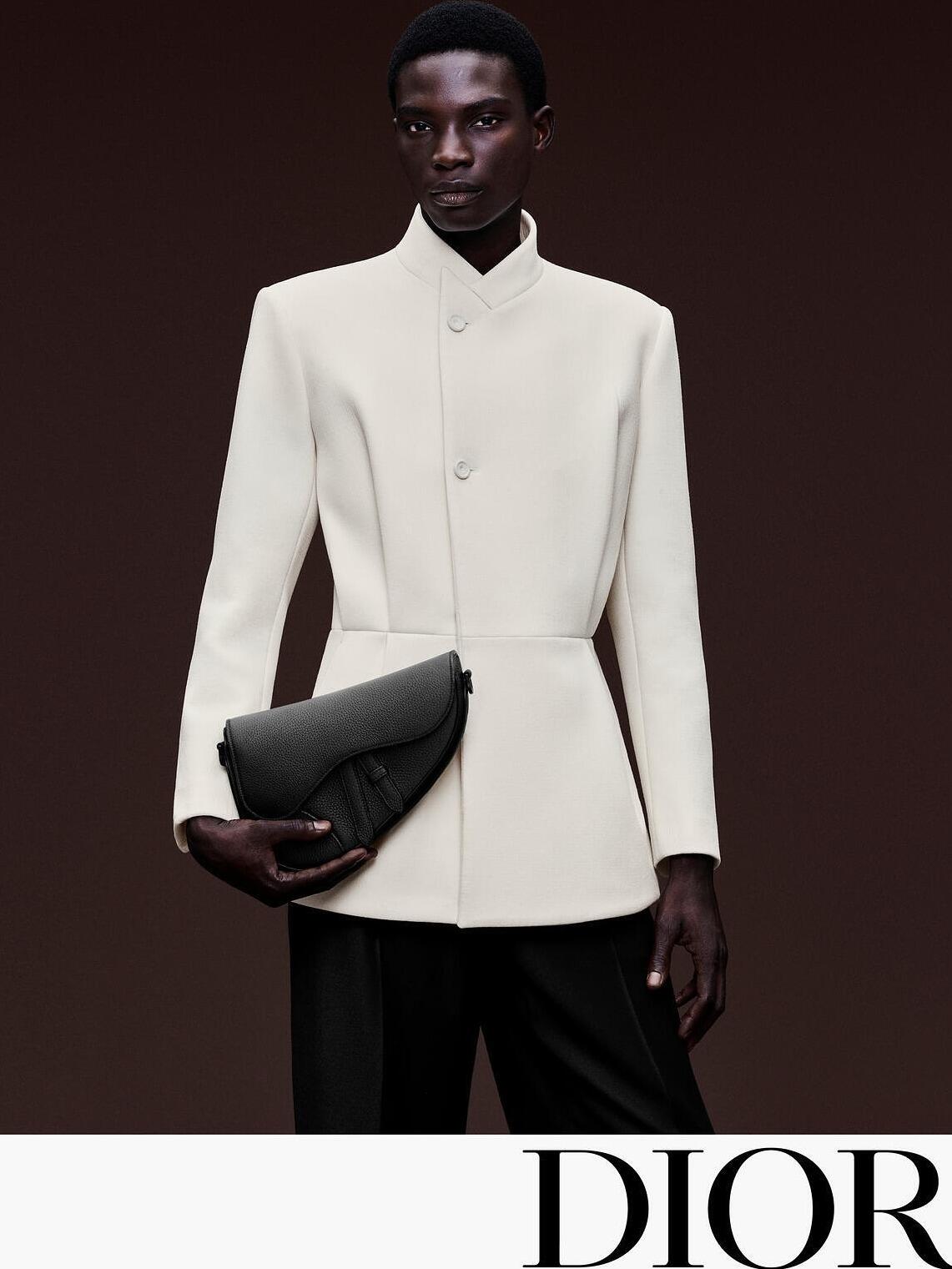
John Galliano brought theatrical romance and exaggeration in the late 1990s, while Raf Simons offered a modernist, minimalist take, famously pairing the jacket with precise trousers instead of a skirt.
-
Maria Grazia Chiuri, Dior's first female creative director, has placed the Bar Jacket at the heart of her feminist narrative for the house. She has explored it in stark black and white, deconstructed it in collaborations with contemporary artists like Mickalene Thomas, and, most innovatively, reimagined it in sumptuous knitwear for the Autumn/Winter 2020 collection. This latter feat required developing at least four different prototype knits to achieve the same sculptural effect as woven fabrics, marrying iconic form with unprecedented comfort.
Through all these iterations, the guiding principle remains: "to slim the body without breaking the waist". The Bar Jacket is not a rigid cage but an architectural framework designed to celebrate the feminine form. It established a "grammar of elegance" for Dior—a set of foundational rules on silhouette, structure, and craft that every collection since has spoken through。 From the "Miss Dior" lines of the 1950s to today's runways, the echo of that original, revolutionary jacket is always present, proving that true style is not about trends, but about timeless ideas executed with peerless artistry.
The Bar Jacket’s journey is far from a historical relic. In the next article, we will explore its dynamic modern life: how contemporary designers are playfully subverting its form, and most importantly, how you can integrate this symbol of haute couture into your everyday wardrobe, making its legendary elegance a personal reality.